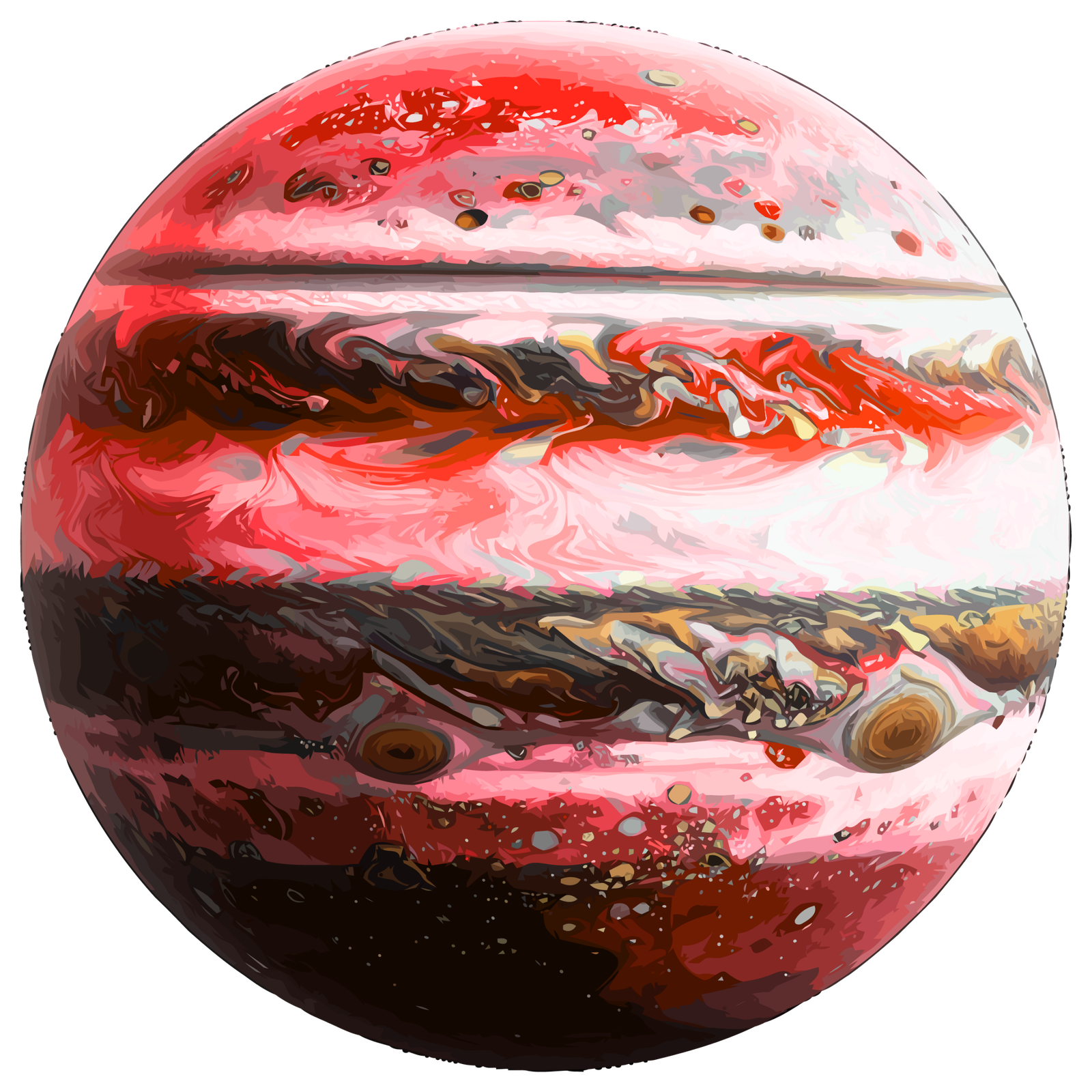

The solar system is the Sun and everything held in its gravitational grip: eight planets, five dwarf planets, hundreds of moons, and countless asteroids and comets, all orbiting our star. It formed about 4.6 billion years ago from a collapsing cloud of gas and dust, and it’s the cosmic neighborhood we call home. The word “solar” comes from the Latin for Sun, because the Sun truly is the center of it all.
It’s easy to picture the solar system as just the Sun and its planets, but it’s far richer and stranger than that, stretching out into icy frontiers most people have never heard of. Let’s take the full tour, from the blazing Sun at the center all the way to the distant, frozen edge.
The Sun Holds It All Together
Everything in the solar system revolves around one object: the Sun. And it dominates completely. The Sun contains more than 99% of all the mass in the entire solar system, which means everything else, all the planets, moons, and asteroids combined, makes up less than 1% of the total.
That overwhelming mass gives the Sun overwhelming gravity, and it’s that gravity that keeps every planet, comet, and speck of dust locked in orbit around it. Without the Sun’s pull, the whole system would simply drift apart into the dark. Our profile of what sort of star the Sun is takes a closer look at the star running the show.
What’s Actually in the Solar System
There’s a lot more here than just planets. Here’s the full inventory of what orbits our Sun.
| Object | Count |
|---|---|
| Star | 1 (the Sun) |
| Planets | 8 |
| Officially named dwarf planets | 5 |
| Moons | Hundreds |
| Asteroids | About 1.4 million known |
| Comets | Around 4,000 known |
How the Solar System Is Arranged
The layout of the solar system isn’t random. It falls into clear zones, moving outward from the Sun.
First come the four inner planets: Mercury, Venus, Earth, and Mars. These are the terrestrial planets, small worlds with solid, rocky surfaces. You can meet them all in our beginner’s guide to the planets. Just beyond Mars lies the asteroid belt, a ring of rocky rubble left over from the solar system’s birth.
Farther out are the four giant planets: Jupiter and Saturn, the enormous gas giants, followed by Uranus and Neptune, the ice giants. These worlds are vastly larger than the rocky planets, and all four sport ring systems, though none rival Saturn’s. Beyond Neptune, the solar system keeps going into the Kuiper Belt, a broad ring of icy bodies that’s home to Pluto and most of the dwarf planets. And far, far beyond even that lies the Oort Cloud, a giant spherical shell of icy objects that marks the true outer boundary of the Sun’s realm.
How the Solar System Formed
All of this came from a single event about 4.6 billion years ago. A vast cloud of gas and dust, possibly nudged by the shockwave from a nearby exploding star, began to collapse under its own gravity. As it fell inward it flattened into a spinning disk, and at the center, most of the material piled up and grew hot enough to ignite nuclear fusion. That was the birth of the Sun, which swept up over 99% of everything available.
The leftover material in the surrounding disk started clumping together too. Bits collided and merged into bigger and bigger objects, some eventually growing massive enough for gravity to pull them into spheres, becoming the planets and moons. This also explains the layout: close to the young, hot Sun, only rock and metal could survive, so we got small rocky planets. Farther out, where it was cold, ice and gas could gather in huge amounts, building the giant planets.
Where the Solar System Sits in the Galaxy
Our solar system isn’t floating alone. It’s one tiny part of the vast Milky Way galaxy, tucked into a minor spiral arm called the Orion Arm, roughly 26,000 light-years from the galaxy’s center. And it’s on the move, orbiting the galactic center at around 828,000 kilometers per hour. Even at that speed, it takes about 230 million years to complete a single lap. Our piece on how many solar systems are in the Milky Way shows just how much company we have out there.
Where Does the Solar System End?
This is trickier than it sounds, because the solar system doesn’t have a hard edge. The planets are just the beginning. Past them lies the Kuiper Belt, and far beyond that, the Oort Cloud extends as far as 1.6 light-years from the Sun, nearly halfway to the next star. That immense icy shell marks the outer limit of the Sun’s gravitational influence.
NASA’s twin Voyager spacecraft, launched back in 1977, have already crossed into interstellar space, yet even they won’t clear the distant Oort Cloud for many thousands of years. That’s how staggeringly big our home system really is. And for all its planets, moons, and frozen worlds, it holds one thing that makes it truly special: Earth, the only place in the entire solar system where we’ve ever found life. NASA’s solar system facts page is a wonderful place to keep exploring our cosmic backyard.
If you enjoyed this article, don’t forget to drop us a comment, it really helps support the site, and be sure to check out our other articles because we think you’re going to love them too.