
Beyond Neptune, beyond Pluto, beyond even the icy Kuiper Belt, scientists believe there’s a vast, spherical shell of icy debris surrounding our entire solar system like a thick bubble. It’s called the Oort Cloud, and here’s the strange part, nobody has ever actually seen it.
A Theory Built Entirely on Comets
The Oort Cloud is a proposed shell of icy, comet-like bodies believed to surround the Sun, planets, and Kuiper Belt at an almost unimaginable distance. Dutch astronomer Jan Oort first proposed its existence in 1950, after noticing that certain comets, ones with orbital periods stretching hundreds or even thousands of years, seemed to be arriving from every direction in the sky rather than the flat disk most other solar system objects orbit within. That pattern only made sense if their source was a roughly spherical cloud surrounding the entire solar system, rather than a flat disk like the Kuiper Belt.
Because it’s so far away, NASA has no direct images of the Oort Cloud itself, everything scientists know comes from studying the long-period comets that occasionally break free and swing into the inner solar system.
A Genuinely Staggering Distance
Estimates place the Oort Cloud somewhere between 2,000 and 100,000 astronomical units from the Sun, meaning its outer edge could sit nearly halfway to Proxima Centauri, the closest star to our own Sun. For comparison, Pluto orbits at an average of just 39 astronomical units, meaning even the inner edge of the Oort Cloud dwarfs the distance to Pluto by orders of magnitude.
Voyager 1, the fastest and farthest human-made object ever launched, still hasn’t come close to reaching it, NASA estimates it will take another 300 to 500 years just to reach the Oort Cloud’s inner edge, and roughly 30,000 years to pass all the way through it. If you’re curious just how far Voyager 1 has actually traveled so far, our piece on Voyager 1’s approaching light-day milestone covers exactly how much ground humanity’s most distant spacecraft has covered.
Trillions of Icy Leftovers
Scientists estimate the Oort Cloud could contain trillions of icy objects, remnants left over from the solar system’s formation roughly 4.6 billion years ago. Many of these objects likely formed much closer to the Sun before getting gravitationally flung outward by encounters with the giant planets, particularly Jupiter and Saturn, early in the solar system’s history. Some research even suggests a portion of Oort Cloud material may not have originated in our solar system at all, potentially captured from neighboring stars as they formed nearby and gradually drifted apart.
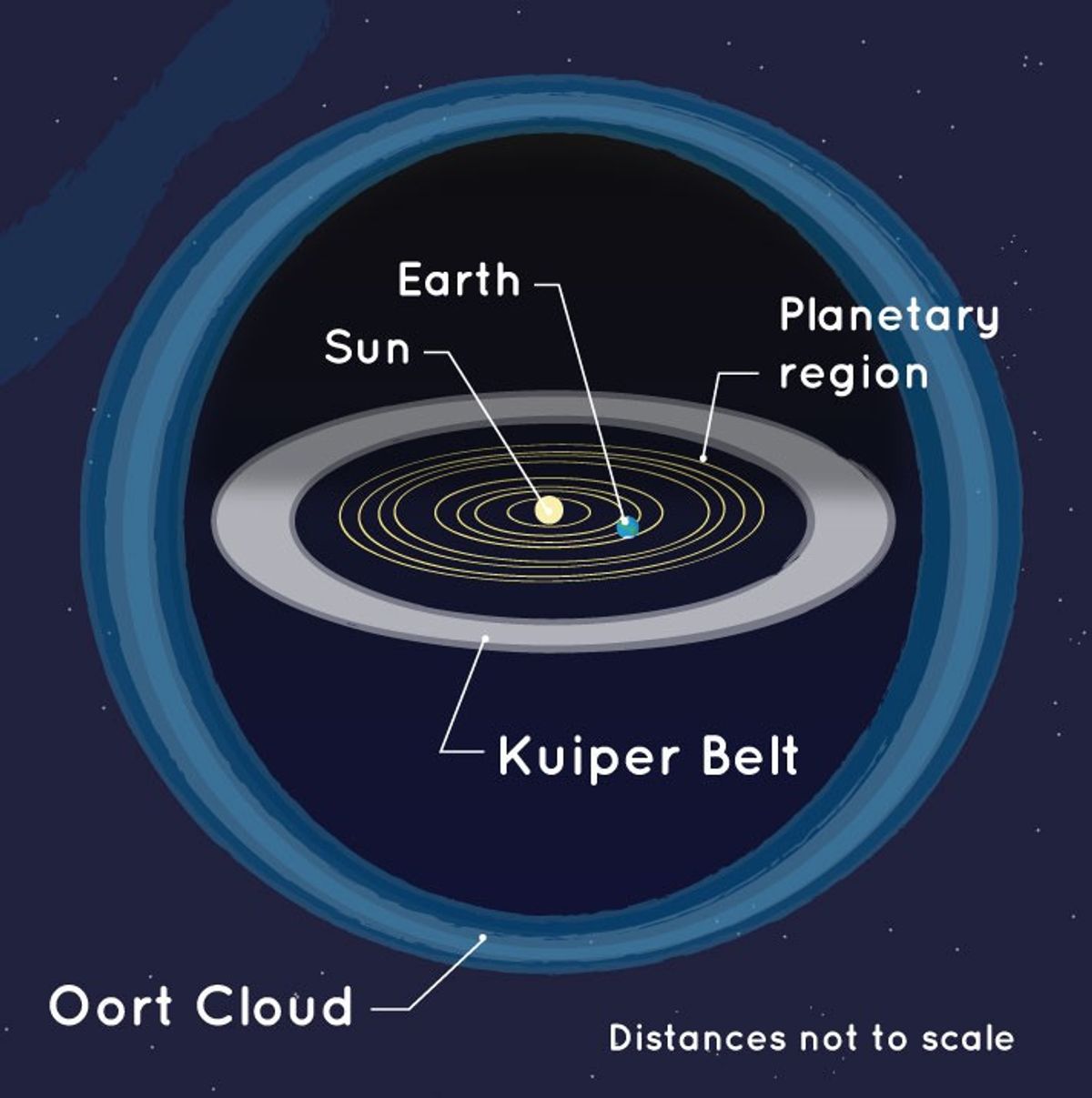 An artist’s concept showing our solar system’s planets and the Kuiper Belt tucked inside the far larger, spherical Oort Cloud. (Image: NASA)
Why It’s So Hard to Study
Exploring the Oort Cloud directly presents genuine challenges, mainly because of sheer distance and time. By the time any spacecraft launched today could actually reach it, centuries will have passed on Earth, and current probes like Voyager 1 and 2 will have long since lost power before ever getting there. For now, everything astronomers know comes from indirect evidence, mainly the trajectories and compositions of long-period comets that occasionally wander into view from that distant, invisible edge.
For more detailed data on the Oort Cloud, check out NASA’s official overview and the additional research summary from Space.com.
If you enjoyed this article, don’t forget to drop us a comment, it really helps support the site, and be sure to check out our other articles because we think you’re going to love them too.