
A constellation is a group of stars that forms a recognizable pattern in the night sky, one we’ve given a name, usually after a mythological figure, animal, or object. There are 88 of them officially recognized, and together they map out the entire sky. When you connect the dots of Orion the Hunter or trace the curve of Scorpius, you’re reading a chart humans have been using for thousands of years.
But here’s the twist that catches most people off guard: the stars in a constellation aren’t actually grouped together at all. They just look that way from where we happen to be sitting. Let’s unpack what a constellation really is, and why the sky is carved up the way it is.
Quick Facts
| Question | Answer |
|---|---|
| Official constellations | 88 |
| Recognized by | The International Astronomical Union (IAU) |
| Ancient ones from Ptolemy | 48 |
| Zodiac constellations | 12 (along the Sun’s path) |
| Largest | Hydra, the water snake |
| Smallest | Crux, the Southern Cross |
The Simple Definition
At its heart, a constellation is a pattern. Long ago, people looked up, picked out groupings of bright stars, and imagined shapes in them, a hunter, a lion, a swan, a scorpion. Those named patterns became the constellations.
In modern astronomy, though, the definition got a little more precise. The International Astronomical Union treats each of the 88 constellations not just as a star pattern but as a defined region of the sky with exact borders, like countries on a map. Every single point in the sky falls inside one, and only one, constellation. So a constellation isn’t only the connect-the-dots picture. It’s the whole patch of sky that picture lives in.
The Stars Aren’t Actually Together
This is the part that quietly blows people’s minds.
The stars that make up a constellation usually have nothing to do with one another. They can lie at wildly different distances from Earth, one relatively nearby, another hundreds of light-years farther out. They only appear to sit side by side because they happen to fall along roughly the same line of sight from our little corner of the galaxy. Step a few light-years to the side and the whole pattern would fall apart.
They’re not even holding still. Every star is drifting through space on its own path, a slow motion we can’t see over a human lifetime. But over tens of thousands of years, those drifts add up. The Big Dipper’s stars, for example, are gradually sliding out of formation, and in 100,000 years the familiar shape will look noticeably bent. The constellations we grew up with are really just a snapshot of this particular moment in cosmic time.
Where the 88 Came From
Our modern sky map is a patchwork of history. Around the second century AD, the Greek astronomer Ptolemy catalogued 48 constellations in a famous work called the Almagest, covering the sky visible from the Mediterranean. Those ancient figures, Orion, Ursa Major, Scorpius, and the rest, still anchor our sky today.
The gaps got filled in later. When European explorers sailed south and saw stars the Greeks never could, astronomers from the 16th to 18th centuries invented new constellations for the southern sky and squeezed extra ones into the empty spaces. Finally, in 1922, the IAU settled the official list at 88, and a few years later the astronomer Eugène Delporte drew the precise boundaries between them. The map has stayed fixed ever since.
Constellation vs Asterism: A Handy Distinction
Here’s a piece of jargon worth knowing, because it clears up a very common mix-up. The Big Dipper is not actually a constellation. It’s an asterism, a recognizable star pattern that isn’t one of the official 88. The Big Dipper is really just the bright core of the larger constellation Ursa Major, the Great Bear. The nearby Little Dipper works the same way, tucked inside Ursa Minor and home to the North Star.
Other famous asterisms include the Summer Triangle, which is stitched together from stars in three separate constellations, and the Teapot in Sagittarius. And then there’s the zodiac, the band of 12 constellations that lie along the ecliptic, the path the Sun appears to trace through the sky over a year. Worth stressing, since the zodiac invites the confusion: constellations are the domain of astronomy, the science of what’s really out there, not astrology, which has no scientific basis.
Why Constellations Still Matter
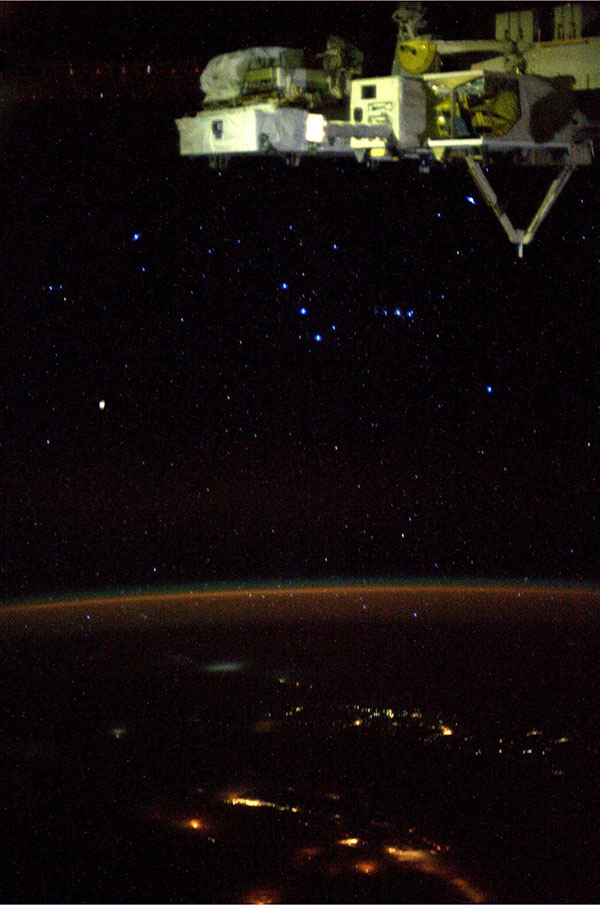 The constellation Orion, seen from the International Space Station. Its famous three-star belt makes it one of the easiest patterns to find in the whole sky. (Image: NASA/Karen Nyberg)
For all their ancient roots, constellations remain genuinely useful. Because each one marks a fixed patch of sky, astronomers use them as an address system. Stars, nebulae, and even meteor showers are named after the constellation they sit in, which is why October’s Orionid meteors appear to stream out of Orion. For centuries, sailors used the constellations for celestial navigation, and NASA astronauts have trained in the very same technique as a backup.
Which constellations you can actually see depends on where you are on Earth and the time of year, since our view shifts as the planet orbits the Sun. If you’d like to start spotting them yourself, our guide to what you can see in the night sky without a telescope is a friendly starting point, and the Andromeda constellation is a rewarding early target that even hides a whole neighboring galaxy. For the full official rundown, NASA’s guide to constellations is a lovely companion.
So the next time you pick out a familiar shape overhead, remember what you’re really seeing: a chance alignment of unrelated suns, framed by human imagination, and turned into a map that has guided us for thousands of years.
If you enjoyed this article, don’t forget to drop us a comment, it really helps support the site, and be sure to check out our other articles because we think you’re going to love them too.