
Somewhere out past the edge of our solar system, moving farther away with every passing second, theres a spacecraft roughly the size of a small car thats been flying for almost fifty years straight. Its called Voyager 1, its the single farthest human-made object in existence, and come November 2026, its about to cross a distance so vast that even astronomers describe it as genuinely hard to picture, a full light-day from Earth.
What Exactly Is Voyager 1?
Voyager 1 launched from Earth on September 5, 1977, technically a few weeks after its twin, Voyager 2, even though it ended up overtaking its sibling and racing ahead thanks to a faster trajectory. The original mission was designed to fly past Jupiter and Saturn, and Voyager 1 delivered in a big way, discovering a thin ring around Jupiter, two brand new moons, and five additional moons plus a whole new ring system at Saturn.
Once those planetary flybys wrapped up, NASA didn’t bring the mission to a close, they just kept letting Voyager 1 fly outward, and it’s been doing exactly that for nearly five decades now. In August 2012, Voyager 1 crossed a boundary called the heliopause, the outer edge of the Sun’s influence where solar wind gives way to the true interstellar medium, becoming the first human-made object to ever leave the bubble of our solar system’s protective influence and enter interstellar space.
Just How Far Is “Really Far”?
As of 2026, Voyager 1 sits somewhere around 15.8 to 16 billion miles from Earth, a distance thats already almost impossible to picture in any practical terms. To put that in perspective, sunlight takes about 8 minutes to reach Earth, and roughly 5.5 hours to reach Pluto. Voyager 1 is so far out that a radio signal, traveling at the speed of light, currently takes about 23 hours just to reach the spacecraft, and just as long again to get a response back.
That gap is only getting bigger. On or around November 15, 2026, Voyager 1 is set to cross an entirely new kind of milestone, becoming the first human-made object ever to reach a full light-day from Earth, meaning it will take light itself a complete 24 hours to travel the distance between the spacecraft and our planet. Its a genuinely staggering demonstration of both how much ground Voyager 1 has covered and just how enormous even our own tiny corner of the galaxy really is.
If you want to get a better sense of how these massive light based distances stack up, our light travel time calculator lets you compare Voyager 1’s journey against distances across the rest of the solar system.
Not the Fastest, But the Farthest
A common misconception is that Voyager 1 is the fastest thing humanity has ever built, but that title actually belongs to NASA’s Parker Solar Probe, which reaches far higher speeds thanks to repeatedly diving close to the Sun’s gravity well. Voyager 1 travels at a respectable but comparatively modest 38,000 miles per hour, having picked up most of that speed through gravitational slingshots past Jupiter and Saturn back in 1979 and 1980, essentially borrowing a bit of momentum from each planet’s own orbit around the Sun.
What actually makes Voyager 1 special is that its the fastest object specifically heading outward, away from the solar system entirely, and it’s simply had the longest head start of anything else moving in that direction. Nothing else humanity has ever launched has been traveling outward for as long, or covered as much distance, as this one aging spacecraft.
The Pale Blue Dot
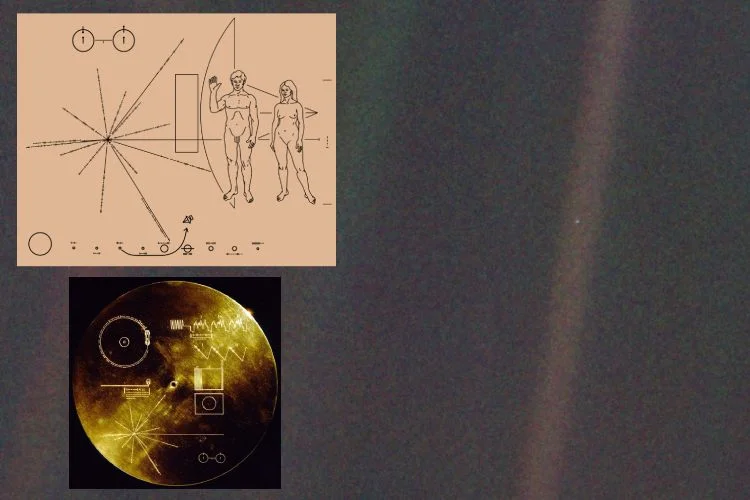
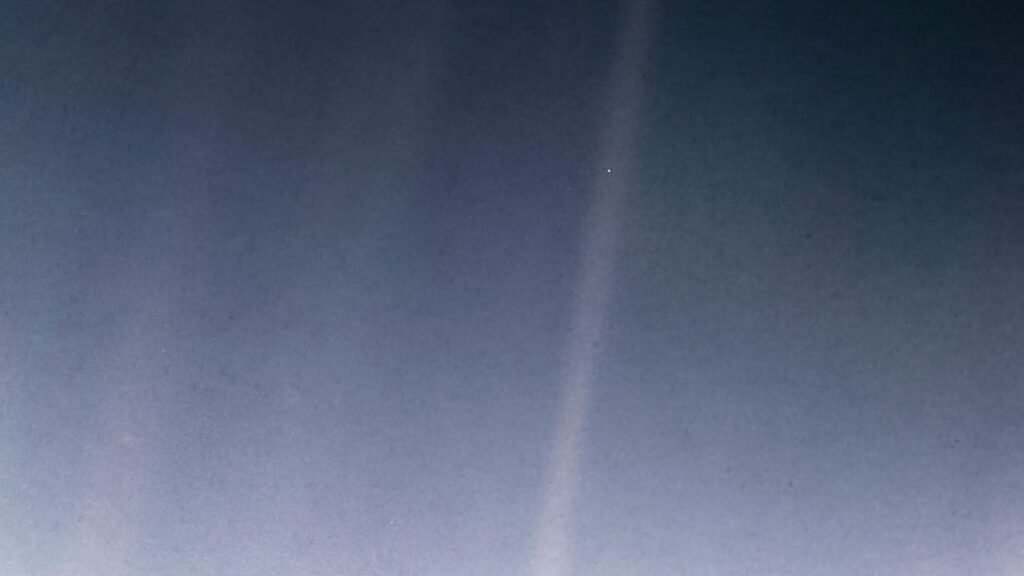
Before Voyager 1 permanently turned its cameras off to conserve power, it captured one final, deeply memorable image. At the suggestion of astronomer and science communicator Carl Sagan, the spacecraft turned around in February 1990 and snapped a photo of Earth from about 3.7 billion miles away. In that image, Earth appears as nothing more than a tiny, pale blue speck suspended in a sunbeam, barely more than a single pixel against the vast darkness of space.
Sagan later wrote extensively about that image, reflecting on just how small and fragile our entire planet, and everything and everyone on it, looks from that kind of distance. Its remained one of the most quietly powerful photographs ever taken, a perspective on our own home that simply wasn’t possible before Voyager 1 made the journey far enough out to capture it.
The Golden Record
Voyager 1 also carries something else worth knowing about, a genuine time capsule attached to its hull known as the Golden Record. It’s a gold plated phonograph record containing sounds and images meant to represent life and culture on Earth, greetings recorded in 55 different languages, music ranging from Bach to Chuck Berry, natural sounds like wind, thunder, and whale calls, along with encoded diagrams meant to explain basic science and our location in the galaxy, just in case the spacecraft is ever found by another form of intelligent life somewhere out in the depths of space. It’s a wildly optimistic gesture, sent out on a journey that will likely far outlast humanity itself.
Is Voyager 1 Still Working?
Remarkably, yes, though its aging noticeably. Voyager 1 runs on a radioisotope thermoelectric generator, a power source that’s been slowly and steadily losing output ever since launch. To keep the spacecraft running as long as possible, NASA engineers have had to gradually shut down its instruments one by one over the years, including switching off its Low-energy Charged Particles experiment back in April 2026. Only a small handful of instruments remain active today, still returning useful data on cosmic rays, magnetic fields, and plasma from interstellar space, information no other spacecraft has ever been positioned to collect.
NASA estimates Voyager 1’s remaining power will keep at least some instruments functioning for a bit longer, though the exact timeline continues to narrow as the decades add up. Eventually, and its now a matter of when rather than if, Voyager 1 will fall silent entirely, continuing to drift outward through the galaxy indefinitely, carrying its golden record along for a journey with no real end point.
If following humanity’s push beyond our own solar system interests you, our piece on O’Neill colonies explores a very different, but equally ambitious, vision for how far human presence in space might eventually reach.
A Milestone Worth Marking
When Voyager 1 crosses that one light-day distance in November 2026, it won’t change anything about how the spacecraft actually operates, its just a number, a symbolic marker of just how far a single human made object has managed to travel since being launched off our own planet nearly fifty years ago. But its exactly the kind of number worth pausing on. Somewhere out there, well past the edge of everything the Sun’s influence can reach, a small, aging spacecraft carrying a golden record and a photograph of a pale blue dot keeps drifting outward, a quiet, ongoing reminder of just how far human curiosity has actually managed to travel.
For more detailed tracking data and mission history, check out the official mission page from NASA Science and the milestone coverage from Popular Science.
If you enjoyed this article, don’t forget to drop us a comment, it really helps support the site, and be sure to check out our other articles because we think you’re going to love them too.