
Every so often a space idea comes along that sounds like pure science fiction until you realize actual physicists have crunched the numbers and said yeah, this could work. O’Neill colonies are exactly that kind of idea. They were dreamed up decades ago by a Princeton physicist, and today, thanks to guys like Jeff Bezos talking about them on stage, they’re getting a second life as one of the most serious proposals for how humanity might actually live in space long term.
So what exactly are O’Neill colonies, and why do so many scientists and engineers still think about them almost fifty years after they were first proposed? Lets break it down.
Who Came Up With This Idea?
The concept traces back to Gerard K. O’Neill, a physicist who taught at Princeton University in the 1970s. O’Neill wasn’t satisfied with the idea that humans were stuck choosing between Earth and other planets like Mars. He figured, why not build our own worlds from scratch, out in open space, instead of trying to force human life onto a hostile planetary surface. He laid out his full vision in a 1976 book called The High Frontier: Human Colonies in Space, and the design he came up with, now called the O’Neill cylinder, became the gold standard for what a truly livable space colony could look like.
O’Neill actually gave the assignment to his undergraduate physics students first, asking them to figure out whether large structures in space could realistically support human life. Their answer was yes, and that’s what pushed him to develop the concept further.
How Would an O’Neill Colony Actually Work?
Picture two massive cylinders, each about 20 miles long and somewhere between 4 and 5 miles wide, floating side by side in space and connected at their ends by a rod and bearing system. Each cylinder spins, and that spin is the whole trick. Just like water gets pushed to the outer edge of a bucket when you swing it around, people and buildings inside the cylinder would be pushed toward the inner wall, creating something that feels almost exactly like Earth’s gravity, even though there’s technically no gravity pulling you down at all.
The cylinders spin in opposite directions from each other too, which cancels out a wobbling effect called gyroscopic precession, keeping the whole structure aimed steadily at the Sun without wasting fuel constantly correcting its orientation.
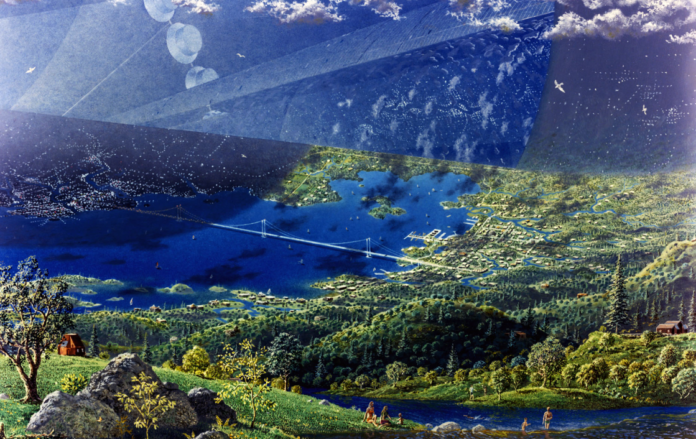
Inside, the design gets even more interesting. Each cylinder would be divided into six long strips running its full length, alternating between actual land area and giant windows. Mirrors on the outside would reflect sunlight in through those windows, and by adjusting the angle of the mirrors, colonists could simulate a full day and night cycle, or even seasons if they wanted them. All together, a single pair of cylinders could offer around 500 square miles of livable land, enough space for millions of people to live, farm, and build entire communities.
If you want a sense of just how different gravity would feel depending on where you are, it’s worth playing around with a weight on planets calculator to compare how your own weight would change across different worlds, and then imagine engineers dialing in that same kind of control inside a spinning colony.
Why Not Just Colonize a Planet Instead?
This is the part that surprises a lot of people. O’Neill actually argued that building colonies in open space made more sense than colonizing planets like Mars. Planets come with their own problems, weak gravity, no breathable air, radiation, and dust storms that can last for weeks. A cylinder colony, on the other hand, could be engineered from day one to have exactly the gravity, atmosphere, and climate humans are built for.
There’s also the materials question. O’Neill’s plan called for building these colonies using material mined from the Moon and later from asteroids, launched into orbit using a device called a mass driver, basically a giant electromagnetic catapult, rather than hauling everything up from Earth’s surface where gravity makes launches expensive. Getting a sense of how much energy it takes to escape a gravity well in the first place helps explain why this mattered so much to O’Neill’s team, and you can get a feel for that with our escape velocity calculator.
Is Anyone Taking This Seriously Today?
Absolutely. In 2019, Blue Origin founder Jeff Bezos stood on stage and told the world he thinks O’Neill colonies, not planets, are humanity’s real future in space. Bezos studied at Princeton not long after O’Neill taught there, and he’s said the idea stuck with him ever since. He’s floated the idea of colonies eventually housing a trillion people, with industry and heavy manufacturing moved off Earth entirely so our home planet can stay zoned, in his words, for residential and light industrial use.
Beyond Blue Origin, NASA actually ran its own serious study on the concept back in 1977, working with O’Neill and a team of researchers at NASA Ames to flesh out engineering details. Some of the most iconic paintings of what these colonies might look like inside, complete with rivers, small towns, and clouds, came out of that NASA-funded study, created by artist Don Davis.
O’Neill colonies have also left a mark on pop culture. They’ve shown up in science fiction novels and are often cited as inspiration for giant space habitats seen across books, movies, and games, proof that this idea captured people’s imaginations way beyond the science community.
The Bottom Line
O’Neill colonies remain one of the boldest and most detailed proposals ever put forward for how humans could live permanently in space. They solve the gravity problem, the radiation problem, and the resource problem all at once, at least on paper, and they do it using physics that’s been understood for over a century. Whether we ever actually build one is still an open question, but with companies like Blue Origin openly chasing the idea, O’Neill colonies feel less like science fiction every year and more like a blueprint someone might actually dust off.
For more on the engineering side of the concept, the National Space Society has a detailed breakdown available at nss.org, and you can also read O’Neill’s original thinking summarized on Wikipedia.
If you enjoyed this article, don’t forget to drop us a comment, it really helps support the site, and be sure to check out our other articles because we think you’re going to love them too.