Planet Gravity: Why Every World Pulls With a Different Strength
(Paste this on the same page as the gravity calculator — intro and Key Takeaways above the tool, the rest below it.)
(⚠ INTERNAL LINKS: two links below use placeholder URLs marked “REPLACE-URL”. Swap them for your real published article URLs before publishing.)
Surface gravity is just the strength of a planet’s pull at ground level, and it’s nowhere near the same from one world to the next. Earth clocks in at 9.81 metres per second squared, the number every falling object here obeys. Step onto the Moon and that drops to a gentle 1.62. Stand at Jupiter’s cloud tops and it jumps to a brutal 24.79. The calculator above lists every world’s figure, and this is the story behind those numbers.
Key Takeaways
- Surface gravity is measured in metres per second squared (m/s²). Earth’s is 9.81.
- Gravity depends on two things: how much mass a planet has, and how far its surface sits from its centre.
- Bigger does not always mean stronger. Jupiter is huge but low in density, so its surface pull is only about 2.5 times Earth’s.
- The Moon and Pluto have the weakest pull of the familiar worlds, which is why you could leap enormous heights there.
What Surface Gravity Actually Is
Every object with mass pulls on everything around it. The more mass, the stronger the pull. That’s the first half of the story. The second half is distance. Gravity weakens fast the further you get from an object’s centre, so a planet’s radius matters just as much as its mass. A big, spread-out planet holds its surface far from its core, which softens the pull you feel standing on it.
Put those two together and you get surface gravity: the tug you’d actually experience with your feet on the ground. It’s why two planets with wildly different sizes can end up pulling on you with the exact same force, and why the biggest planet in the solar system isn’t the one that would flatten you hardest.
Surface Gravity of Every Planet
| World | Surface gravity (m/s²) | Compared to Earth |
|---|---|---|
| Mercury | 3.70 | 0.38 |
| Venus | 8.87 | 0.91 |
| Earth | 9.81 | 1.00 |
| The Moon | 1.62 | 0.17 |
| Mars | 3.71 | 0.38 |
| Jupiter | 24.79 | 2.53 |
| Saturn | 10.44 | 1.06 |
| Uranus | 8.69 | 0.89 |
| Neptune | 11.15 | 1.14 |
| Pluto | 0.62 | 0.06 |
Why Bigger Doesn’t Always Mean Stronger
Look closely at that table and a few things stop making sense, until you factor in density. Mercury is barely larger than our Moon, yet it pulls as hard as Mars, a planet nearly twice its width. The reason is that Mercury is astonishingly dense, packed around a massive iron core, so it crams a lot of mass into a small ball. Mars is bigger but far lighter for its size, so the two end up matched at 0.38.
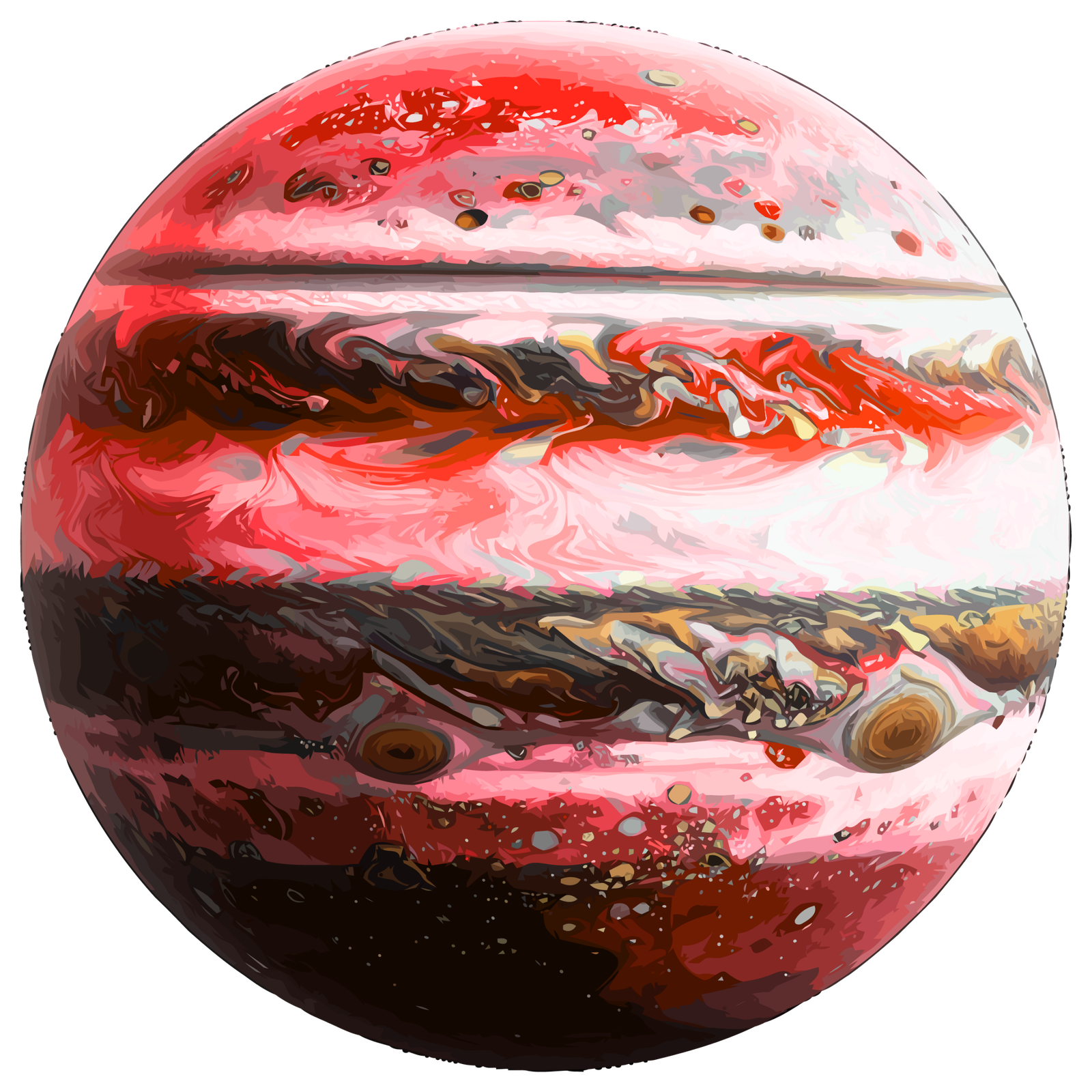
The giant planets flip the intuition the other way. Jupiter has more than 300 times Earth’s mass, which sounds like it should crush anything. But it’s a bloated ball of hydrogen and helium with low density, and its cloud-top “surface” sits enormously far from its centre. Both effects soften the pull, leaving it at a survivable-sounding 2.53 times Earth’s. Saturn is even more extreme. Despite being the second largest planet, its density is so low that its surface gravity is almost identical to Earth’s. If you’re curious how that same low density plays out elsewhere, our breakdown of Mars gravity versus Earth digs into the rocky-planet side of the comparison.
What Different Gravity Would Actually Feel Like
Numbers on a page are one thing. What they’d do to your body is another. On a low-gravity world like the Moon, every step becomes a float and every jump carries you several times higher, which is exactly what the tool above lets you test. On a high-gravity world, the opposite happens. Your legs would feel leaden, a short hop would be a struggle, and simply standing up all day would tire you out. Gravity quietly shapes everything, from how tall you could jump to how a dropped cup falls. We explored the flip side of this, what you’d actually weigh under each of these pulls, in our weight on other planets calculator. And for the classic case study, see why the Moon’s gravity is one-sixth of Earth’s.
Frequently Asked Questions
What is the surface gravity of Earth?
About 9.81 metres per second squared. That’s the acceleration any object gains as it falls freely near Earth’s surface, ignoring air resistance.
Which planet has the strongest gravity?
Jupiter, with a surface gravity around 24.79 m/s², roughly 2.53 times Earth’s. It’s the strongest of any planet, though far less than you might expect for its enormous size.
Why is the Moon’s gravity so weak?
The Moon has much less mass than Earth, only about 1.2% of it, so it pulls far more gently. Its surface gravity is about a sixth of ours, which is why astronauts could bounce across it.
How is surface gravity calculated?
It comes from a planet’s mass divided by the square of its radius, scaled by the gravitational constant. In practice, more mass raises gravity while a larger radius lowers it, so both figures matter.
Do Mars and Mercury really have the same gravity?
Yes, near enough. Both sit at about 0.38 times Earth’s gravity. Mercury is small but very dense, Mars is larger but less dense, and the two effects roughly cancel out.
For the official surface-gravity figures behind these numbers, NASA maintains a full Planetary Fact Sheet.
If you enjoyed this article, don’t forget to drop us a comment, it really helps support the site, and be sure to check out our other articles because we think you’re going to love them too.