
The solar system stretches from the Sun out to the far edge of the Oort Cloud, a distance of roughly 100,000 astronomical units, or nearly two light-years. That makes it a couple of light-years across when you measure to where the Sun’s gravity finally loses its grip. The eight planets you learned in school take up only a tiny sliver near the middle.
Think back to the picture of the solar system you grew up with. The Sun off to one side, the planets lined up next to it like beads on a string, everyone close enough to wave hello. It is a lovely image. It is also almost completely wrong, and not because your teacher lied to you. That picture exists because the truth will not fit on a page. Draw the solar system at its real proportions and you get a sheet of black paper with a few specks of dust you would need a magnifying glass to find. So let us take that cozy little family portrait apart, piece by piece, and see what our neighborhood actually looks like.
Key Takeaways
- Measured out to the Oort Cloud, the solar system is around two light-years across, though the eight planets sit within the first 30 astronomical units.
- It is overwhelmingly empty. If you shrank the Sun to a 10-centimeter grapefruit, Earth would be a 1-millimeter bead about 11 meters away, and Neptune would sit roughly three football pitches from the Sun.
- The asteroid belt is nothing like the movies. All of its rock combined weighs only a few percent of the Moon, spread across a gap tens of millions of kilometers wide.
- One astronomical unit (AU), the Earth to Sun distance, is the ruler astronomers use for everything else in the solar system.
- Voyager 1 has been flying since 1977 and still has not reached the inner edge of the Oort Cloud.
First, a Confession About That Classic Picture
Every diagram of the solar system cheats. It has to. There is no way to draw the planets at their real sizes and their real distances on the same image, because the two numbers live in completely different worlds.
Here is the problem in plain terms. If you shrink everything down so the planets are big enough to actually see, the distances between them explode off the edge of the page. If instead you keep the distances honest, the planets shrink to invisible dots long before you finish drawing. You can have accurate sizes or accurate distances. You cannot have both. Every textbook silently picks sizes and quietly throws the distances in the bin, which is why Mars looks like it is parked right next to Earth and Jupiter looks like a neighbor you could shout at over the fence.
We are not neighbors. We are tiny islands scattered across an ocean of dark, empty space, and most of us are much farther apart than that friendly little portrait ever let on. Our full beginner’s guide to the planets walks through each world in order, but here we are after something different. We want the emptiness.
The Grapefruit and the Football Pitch
Numbers in kilometers stop meaning anything past a certain point, so let us build a model we can actually stand inside.
Shrink the Sun down to a grapefruit, about 10 centimeters across, and set it on the goal line of a football pitch. Everything else scales down by the same amount. At that size, here is where the planets land and how big they turn out to be.
| Planet | Distance from the grapefruit Sun | Size in the model |
|---|---|---|
| Mercury | about 4 meters | a grain of sand (0.35 mm) |
| Venus | about 8 meters | a grain of sand (0.9 mm) |
| Earth | about 11 meters | a small bead (1 mm) |
| Mars | about 16 meters | a grain of sand (0.5 mm) |
| Jupiter | about 56 meters | a pea (1 cm) |
| Saturn | about 103 meters | a peppercorn (0.8 cm) |
| Uranus | about 206 meters | a pinhead (0.4 cm) |
| Neptune | about 323 meters | a pinhead (0.4 cm) |
Sit with that for a second. The Sun is a grapefruit on the goal line. Earth is a bead the size of this letter o, sitting near the penalty spot, eleven meters away. And between the grapefruit and the bead, there is nothing. Not “mostly nothing.” Nothing. Empty air the whole way.
Now walk to Neptune. You leave the pitch, cross the next one, cross most of a third, and roughly three football pitches from where you started you find a pinhead less than half a centimeter wide. That pinhead is the outermost planet. Everything humanity has ever done, every war and love song and civilization, happened on the 1-millimeter bead back near the goal line.
The Distance to the Moon Already Breaks Your Brain
Before we go any farther out, look closer to home, because even the Moon is farther than your instincts insist.
The Moon feels close. On a clear night it hangs there looking like you could reach up and pluck it down. It sits about 384,000 kilometers away, and that number is hard to feel until you do something strange with it. Take all eight planets, line them up side by side, and slide them into the gap between Earth and the Moon. They fit. Every planet in the solar system, shoulder to shoulder, spans roughly the same distance as the empty space between us and our own Moon, with barely any room left over.
That is the gap to the nearest thing in the sky. And we are about to leave the neighborhood entirely.
The Ruler That Runs the Whole Solar System
The distance from Earth to the Sun is roughly 150 million kilometers. Sunlight, which is the fastest thing there is, takes 8 minutes and 20 seconds to cross it. The sunshine on your face right now left the Sun before you sat down.
That distance is so useful that astronomers turned it into a unit. They call it the astronomical unit, or AU, and it becomes the ruler for measuring everything else out here. Earth sits at 1 AU by definition. Jupiter is a bit over 5 AU from the Sun. Neptune is about 30 AU. Once you start thinking in AU, the shape of the solar system gets easier to hold in your head, and the sheer reach of it starts to land. Here is the real thing, no scale model, just the actual distances and how long light itself takes to cross them.
| Planet | Distance from Sun (AU) | Distance (million km) | Light travel time from Sun |
|---|---|---|---|
| Mercury | 0.39 | 58 | about 3 minutes |
| Venus | 0.72 | 108 | about 6 minutes |
| Earth | 1.00 | 150 | 8.3 minutes |
| Mars | 1.52 | 228 | about 13 minutes |
| Jupiter | 5.20 | 778 | about 43 minutes |
| Saturn | 9.50 | 1,430 | about 1.3 hours |
| Uranus | 19.20 | 2,870 | about 2.7 hours |
| Neptune | 30.10 | 4,500 | about 4.1 hours |
Look at that last column. Light needs more than four hours just to reach Neptune. If you want to feel these numbers for yourself, our cosmic travel time calculator lets you punch in a destination and see how long the trip would take at different speeds.
The Asteroid Belt Is a Hollywood Lie
Between Mars and Jupiter sits the asteroid belt, and the movies have done it dirty.
On screen it is always a churning wall of tumbling boulders, the hero’s ship weaving and dodging while rocks smash together on every side. Real asteroid pilots would be bored. The belt is enormous, stretching across a gap tens of millions of kilometers wide, but the rocks inside it are absurdly spread out. If you were standing on one asteroid, the odds are good you could not see another one anywhere in the sky.
The truly humbling part is the total. Gather up every single object in the asteroid belt, from the dwarf planet Ceres down to the smallest pebble, weigh the whole lot, and you get only a few percent of the mass of our Moon. That is the entire belt. We have painted a picture of a crowded demolition derby, and the reality is a near-empty ring with a pinch of gravel scattered around it. If you want the fuller story, our guide to the asteroid belt digs into what those rocks actually are and where they came from.
Out Where the Giants Live
Cross the belt and the character of the solar system changes completely. The small rocky worlds are behind you. Ahead are the giants, and the distances between them stop being large and start being ridiculous.
Jupiter is the king, wide enough to swallow every other planet with room to spare, yet in our grapefruit model it is only a pea. Beyond it, Saturn floats with its rings. Then the gaps really open up. Getting from Saturn out to Uranus means covering more distance than the entire span from the Sun to Saturn. Then Neptune sits almost as far again past Uranus.
These worlds are so remote and so slow in their orbits that Neptune, discovered by careful mathematics in 1846, only completed its very first full lap around the Sun since we found it in the year 2011. A single Neptunian year is longer than the entire history of its own discovery.
Past Neptune, the Solar System Keeps Going
A lot of people file Neptune under “the end.” Last planet, close the book. But Neptune is nowhere near the edge. It is barely past the front porch.
Just beyond it lies the Kuiper Belt, a vast ring of icy bodies that makes the asteroid belt look tiny. This is Pluto’s home turf, and it is also the reason Pluto lost its planet status back in 2006. Pluto did nothing wrong. We simply discovered that it shares its neighborhood with thousands of other icy worlds, including Eris, which turned out to be about 27 percent more massive than Pluto itself. Once you find a bigger sibling in the same region, you either crown a whole crowd of new planets or you draw a clearer line, and astronomers chose the line. Our piece on the Kuiper Belt covers that icy frontier in full.
And even the Kuiper Belt is not the border. Far, far beyond it, wrapping the entire solar system like a shell, sits the Oort Cloud. We have never seen it directly. Its existence is inferred from the long-period comets that come falling in from every direction, taking thousands of years to complete a single orbit, which tells us they must originate from somewhere staggeringly far out. The Oort Cloud is thought to begin around a thousand AU from the Sun and stretch outward to something like 100,000 AU, close to two light-years away. NASA’s own scale-of-the-solar-system infographic puts the inner edge near 1,000 AU and the outer edge around 100,000 AU. That is the true outer wall of our solar system.
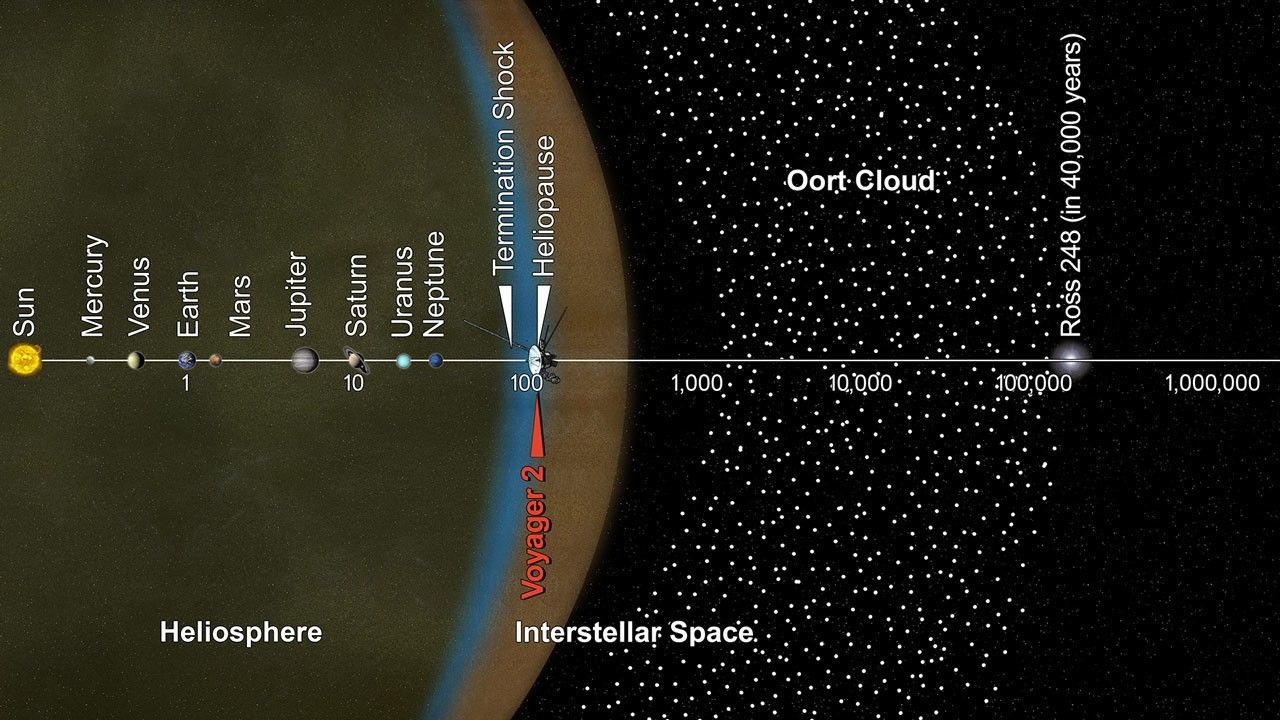 NASA’s scale infographic has to use a logarithmic ruler, where each step outward is ten times the last, just to fit the planets and the distant Oort Cloud onto a single page. (Image: NASA/JPL-Caltech)
So How Big Is the Solar System, Really?
It depends where you decide to draw the line, and that is a real scientific question rather than a dodge.
If you stop at Neptune, the solar system is about 60 AU across, which already takes light more than eight hours to cross end to end. If you include the Kuiper Belt, you roughly double that. But the honest answer, the one most astronomers use, runs all the way to the outer edge of the Oort Cloud, where the Sun’s gravity finally hands over control to neighboring stars. By that measure the solar system is close to two light-years wide, and the Sun’s gravitational reach extends nearly halfway to the next star, Proxima Centauri, which sits 4.24 light-years away.
Voyager 1 puts that in brutal perspective. We launched it in 1977. It is the most distant object humans have ever made, now more than 160 times farther from the Sun than Earth is, still racing outward every second. And after almost half a century of flight, it has not even reached the inner edge of the Oort Cloud. It will take roughly another 300 years to get there, and tens of thousands of years to pass through and leave the solar system behind for good.
That is the scale of the place we live. Mostly darkness, mostly silence, with a handful of tiny worlds catching the light of one ordinary star. And on one of those worlds, a 1-millimeter bead in the grapefruit model, we somehow built minds capable of measuring the whole thing. If that leaves you feeling small, fair enough. But it is a strange and wonderful kind of small. If you want to keep zooming out, our look at how vast the universe really is takes the next step past the solar system entirely.
Frequently Asked Questions
How big is the solar system in light-years? Measured out to the far edge of the Oort Cloud, where the Sun’s gravity gives way to other stars, the solar system is roughly two light-years across. If you only count out to Neptune, it is far smaller, about eight light-hours from one side to the other.
How long would it take to fly across the solar system? It depends entirely on the boundary and the speed. Light crosses from the Sun to Neptune in about four hours, but a real spacecraft moves far slower than light. Voyager 1 has flown for almost fifty years and still has centuries to go before it even reaches the inner Oort Cloud.
Is the solar system mostly empty space? Yes, and it is emptier than almost anyone imagines. In a model where the Sun is a grapefruit, Earth is a 1-millimeter bead eleven meters away, with nothing at all in between. The planets are vanishingly small compared to the distances separating them.
Where does the solar system actually end? There is no single fence. Astronomers usually place the edge at the outer boundary of the Oort Cloud, around 100,000 AU from the Sun, because that is roughly where the Sun’s gravity stops dominating and a passing star’s pull would win instead.
Why can’t diagrams show the solar system to scale? Because sizes and distances differ by such huge factors that they cannot share one image. Draw the planets big enough to see and the distances fly off the page. Keep the distances honest and the planets shrink to invisible specks. Every diagram quietly sacrifices one for the other.
If you enjoyed this article, don’t forget to drop us a comment, it really helps support the site, and be sure to check out our other articles because we think you’re going to love them too.