
Most people’s mental map of the solar system stops at Neptune, eight planets, done. But keep going past Neptune’s orbit and you’ll run into something a lot bigger than most people realize, a massive, doughnut shaped ring of icy debris called the Kuiper Belt, home to Pluto, hundreds of thousands of other frozen worlds, and some of the oldest, most untouched material left over from the birth of our solar system.
Where Exactly Is It?
The Kuiper Belt starts around the orbit of Neptune, roughly 30 astronomical units from the Sun, and stretches out to about 55 AU, meaning its outer edge sits more than 50 times farther from the Sun than Earth is. Sometimes called the “third zone” of the solar system, after the rocky inner planets and the gas giants, the Kuiper Belt is a genuinely massive region, estimated to be up to 20 times wider and possibly 20 to 200 times more massive than the more familiar asteroid belt sitting between Mars and Jupiter.
Its named after astronomer Gerard Kuiper, who theorized about a disk of icy material out past Neptune back in the 1950s, though astronomer Kenneth Edgeworth had floated a similar idea even earlier. Some scientists still call it the Edgeworth-Kuiper Belt as a nod to both of them.
What’s Actually Out There?
Astronomers estimate the Kuiper Belt contains millions of small icy bodies, including hundreds of thousands larger than 60 miles across, made up mostly of frozen water, along with other compounds like ammonia and methane that stay solid at temperatures this far from the Sun’s warmth. Unlike the rocky asteroid belt closer to home, the cold out here is intense enough to keep these volatile ices locked solid instead of boiling away.
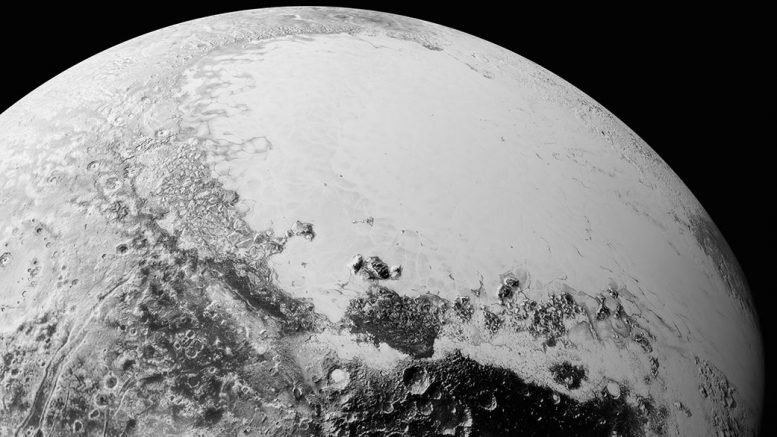
The Kuiper Belt is also home to four of the five officially recognized dwarf planets in our solar system, Pluto, Eris, Makemake, and Haumea, with only Ceres, out in the asteroid belt, sitting elsewhere. Pluto remains the largest known Kuiper Belt object, stretching about 1,476 miles across, and its the only one that held full planet status for over 70 years before being formally reclassified as a dwarf planet in 2006, once astronomers realized just how many similar objects were sharing its neighborhood.
Interestingly, Pluto’s orbit is locked in a stable rhythm with Neptune’s gravity, completing two full orbits around the Sun for every three that Neptune makes. That resonance keeps Pluto safely out of Neptune’s way, even though their orbits technically cross each other.
The Only Spacecraft to Actually Visit
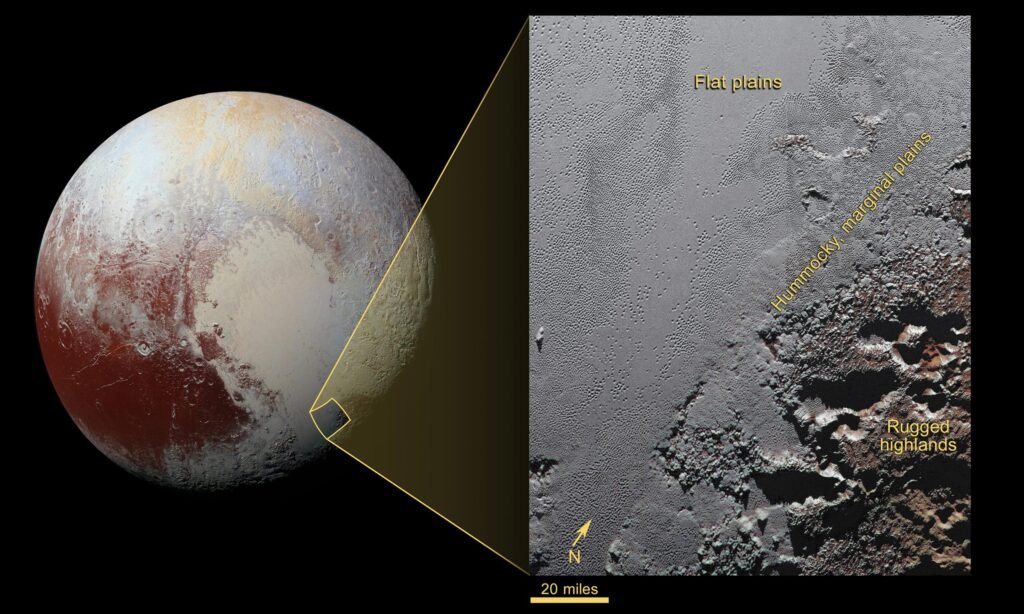
Almost everything we know up close about the Kuiper Belt comes from a single mission, NASA’s New Horizons spacecraft, launched in 2006. After a nine year journey, New Horizons flew past Pluto in July 2015, sending back the first detailed, close-up images ever taken of the dwarf planet, revealing towering water-ice mountains and vast nitrogen ice glaciers nobody had seen before.
New Horizons didn’t stop there. On January 1, 2019, it flew past a much smaller, more distant Kuiper Belt object nicknamed Arrokoth, sitting about a billion miles beyond Pluto. At the time, it became the most distant object ever explored up close by a spacecraft. Arrokoth turned out to be an oddly shaped, reddish world, roughly 22 miles long, made up of two lobes fused together, giving it a distinctive flattened, snowman-like silhouette unlike anything else humans had ever photographed that closely. If exploring how spacecraft manage journeys this vast interests you, our piece on Voyager 1’s record-setting distance from Earth covers a mission that’s traveled even farther out than New Horizons has.
Why Scientists Care So Much About a Bunch of Ice Chunks
The Kuiper Belt isn’t just a curiosity sitting at the edge of the solar system, its essentially a deep freeze time capsule. Because objects out here are so far from the Sun’s heat, they’ve barely changed since the solar system first formed about 4.6 billion years ago. Studying their composition gives scientists a genuinely rare, largely untouched glimpse into what raw material the solar system was actually built from, information thats mostly been erased on planets like Earth and Mars through billions of years of geological activity.
The Kuiper Belt is also the source of many short-period comets, the ones that swing back through the inner solar system on relatively predictable, decades-long cycles, distinct from the long-period comets believed to originate even farther out in the distant Oort Cloud.
A Frontier Still Being Mapped
Even with New Horizons’ historic flybys, the Kuiper Belt remains one of the least explored regions of our own solar system. Most of what astronomers know about its other objects comes from distant observations using Hubble and ground-based telescopes, where even the largest KBOs still show up as nothing more than faint points of light. With potentially hundreds of thousands of worlds out there still waiting to be properly studied, the Kuiper Belt stands as a genuine frontier, close enough to be part of our own solar system, yet still largely a mystery.
For more detailed data and imagery from the only mission to ever visit this region, check out the full breakdown from NASA Science and the mission overview from Johns Hopkins APL.
If you enjoyed this article, don’t forget to drop us a comment, it really helps support the site, and be sure to check out our other articles because we think you’re going to love them too.