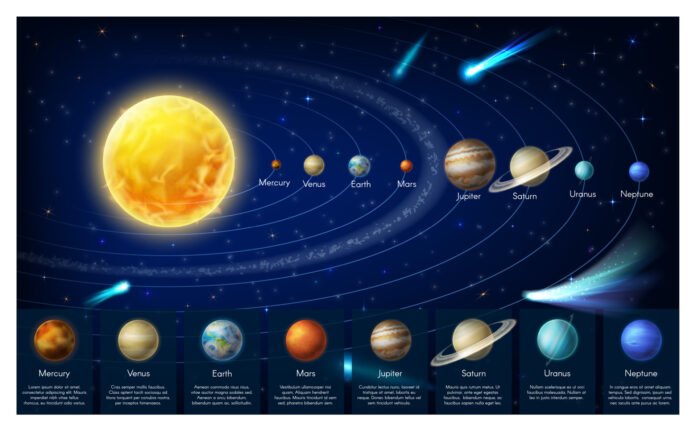

Getting into astronomy can feel a little overwhelming at first, theres just so much out there, black holes, galaxies, nebulae, comets, the list goes on. But almost everyone who gets hooked on space starts in the same place, right here in our own solar system. So welcome to Astronomy101 , consider this your friendly starting point for understanding the eight planets that call our Sun home, what makes each one unique, and why astronomers group them the way they do.
The Two Types of Planets
Before jumping into each planet individually, it helps to understand that our solar system’s planets fall into two very different categories. The first four planets, Mercury, Venus, Earth, and Mars, are called terrestrial planets, meaning they’re small, rocky, and have solid surfaces you could theoretically stand on. The outer four, Jupiter, Saturn, Uranus, and Neptune, are gas giants, or in the case of the two farthest out, sometimes called ice giants, and none of them have a solid surface at all, just layers of thick gas and, deeper down, extremely dense liquid and slush.
This split isn’t random, it comes down to how the solar system formed billions of years ago. Close to the young Sun, it was too hot for lightweight gases to stick around, so only rock and metal could clump together. Farther out, past a boundary scientists call the frost line, temperatures dropped enough for ice and gas to pile up in massive quantities, which is exactly why the outer planets grew so much bigger than the inner ones.
Mercury: The Speedy Little One
Mercury is the closest planet to the Sun and also the smallest in our solar system, not much bigger than Earth’s own Moon. Because its so close to the Sun, it zips around in a tight orbit, completing a full year in just 88 Earth days, the fastest of any planet. Despite baking under intense sunlight during the day, Mercury has almost no atmosphere to hold onto heat, so nighttime temperatures actually plunge to hundreds of degrees below freezing. Its a planet of extremes in basically every direction.
Venus: Earth’s Evil Twin
Venus is often called Earth’s twin because its almost identical to our planet in size, but the similarities stop pretty quickly after that. Venus has a thick, toxic atmosphere made mostly of carbon dioxide, trapping heat so effectively that its actually the hottest planet in the solar system, even hotter than Mercury, which sits closer to the Sun. Surface temperatures on Venus reach around 900 degrees Fahrenheit, hot enough to melt lead. Venus also spins backwards compared to most other planets, and it does so incredibly slowly, a single day on Venus actually lasts longer than its entire year.
Earth: Our Home Base
Then theres Earth, the only planet we know of, so far, that supports life. Sitting at just the right distance from the Sun, a spot scientists often call the habitable zone, Earth has liquid water on its surface, a protective atmosphere, and a magnetic field that shields us from harmful solar radiation. Its worth remembering just how unique that combination is, out of every planet astronomers have studied both inside and outside our solar system, Earth remains the only confirmed home for life.
Mars: The Red Planet
Mars gets its famous reddish color from iron oxide, basically rust, coating its dusty surface. Its become the most explored planet beyond Earth, with rovers like Curiosity and Perseverance actively studying its surface right now, searching for signs that the planet may have once supported microbial life billions of years ago when it had liquid water flowing across its surface. Mars is also home to Olympus Mons, the largest volcano in the entire solar system, nearly three times the height of Mount Everest.
If Mars exploration has you curious about what future missions might look like, its worth checking out our piece on O’Neill colonies and the broader conversation happening around long term human space settlement.
Jupiter: The King of the Planets
Crossing past the asteroid belt brings you to Jupiter, the largest planet in our solar system by a wide margin. Its so massive that it outweighs every other planet combined, and its famous Great Red Spot is a storm that’s been raging for at least 400 years, big enough to swallow Earth whole. Despite its size, Jupiter spins incredibly fast, completing a full rotation in under 10 hours, making its day the shortest of any planet even though its year takes almost 12 Earth years to complete.
For a deeper look at exactly how far Jupiter sits from the Sun and what that distance actually means, check out our full breakdown on Jupiter’s distance from the Sun.
Saturn: The One With the Rings
Saturn is instantly recognizable thanks to its stunning ring system, made up of countless chunks of ice and rock ranging from tiny grains to pieces the size of a house. While every gas giant technically has rings, Saturn’s are by far the brightest and most visible, even a small backyard telescope can pick them out on a clear night. Saturn is also the least dense planet in the solar system, its actually less dense than water, meaning if you somehow found an ocean big enough, Saturn would float.
Uranus: The Sideways Planet
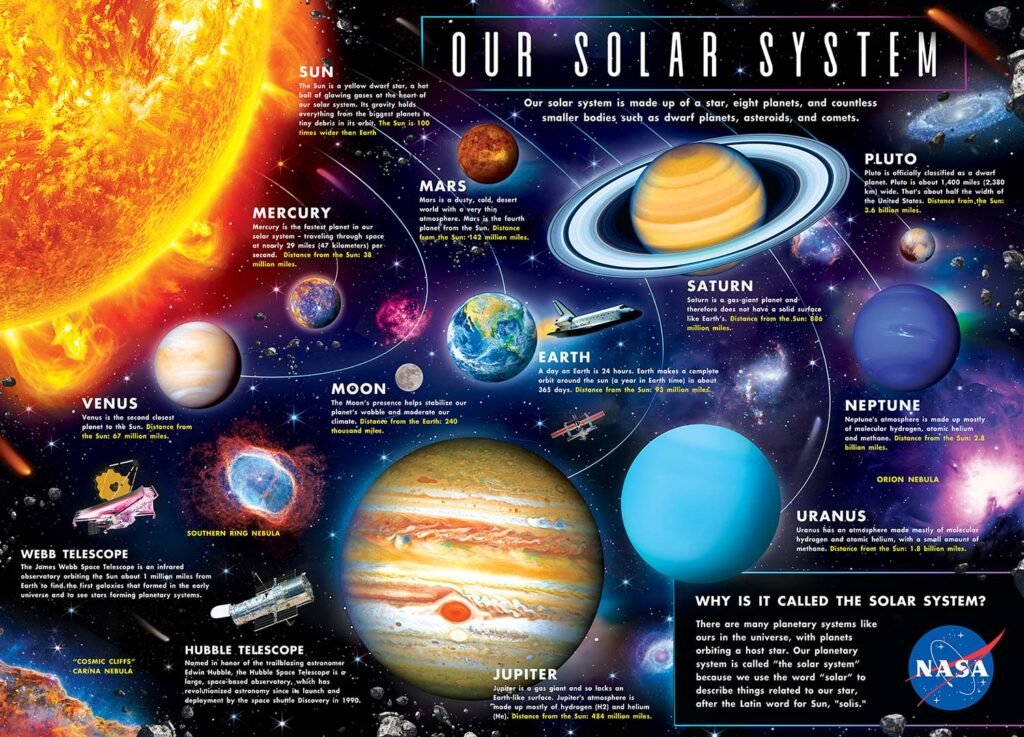
Uranus stands out for one strange reason, it rotates almost completely on its side, tilted about 98 degrees compared to its orbit. Scientists believe a massive collision earlier in the solar system’s history knocked it into this sideways spin. Uranus is classified as an ice giant, made largely of water, ammonia, and methane ices surrounding a small rocky core, and that methane in its atmosphere is exactly what gives the planet its pale blue-green color.
Neptune: The Windy Outer World
Neptune is the farthest official planet from the Sun, orbiting so far out that it takes about 165 Earth years to complete a single trip around the Sun. Despite receiving only a tiny fraction of the sunlight Earth gets, Neptune is home to the fastest winds ever recorded on any planet in the solar system, reaching speeds of over 1,200 miles per hour. Its deep blue color comes from methane in its atmosphere, similar to Uranus, just with a richer, more vivid hue.
Where Did Pluto Go?
No beginner’s guide to the planets feels complete without addressing the elephant in the room, Pluto. Discovered in 1930, Pluto was considered the ninth planet for over 70 years until 2006, when the International Astronomical Union reclassified it as a “dwarf planet” after new criteria were established for what officially counts as a full planet. Pluto simply doesn’t meet one of the three requirements, clearing its orbital path of other debris, so it lost its planetary status, even though it’s still a fascinating, actively studied world out on the solar system’s edge.
Start Small and Look Up
The beauty of Astronomy101 is that you don’t need an expensive telescope to get started, several of these planets are visible to the naked eye on any given night if you know when and where to look. Venus, Jupiter, and Mars are often bright enough to spot without any equipment at all, and Saturn’s rings become visible with even a modest beginner telescope. Our guide on what you can see in the night sky without a telescope tonight is a great next step once you’re ready to start putting names to the lights overhead.
Understanding these eight worlds is really just the first chapter in a much bigger story, one that stretches out to distant stars, entire galaxies, and mysteries we’re still working to solve. But every astronomer, professional or backyard hobbyist, started exactly where you are now, looking up and wondering what’s actually out there.
For more detailed planetary data straight from the source, check out NASA’s Solar System Exploration site and the planet comparison charts from NASA Science.
If you enjoyed this article, don’t forget to drop us a comment, it really helps support the site, and be sure to check out our other articles because we think you’re going to love them too. Astronomy101 Astronomy101 Astronomy101 Astronomy101 Astronomy101