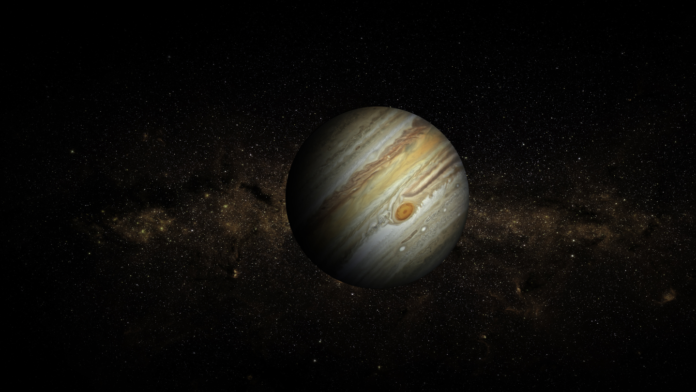

Theres something almost hard to wrap your head around when you start comparing distances across the solar system. We’re used to thinking in terms of driving distances, maybe flight times if we’re feeling adventurous, but once you start talking about planets, the numbers stop making intuitive sense pretty fast. Jupiter’s distance from the Sun is a perfect example, a number so large it barely means anything until you break it down piece by piece. So lets actually break it down.
The Basic Number
Jupiter orbits the Sun at an average distance of about 484 million miles, or 778 million kilometers. In astronomy, that number usually gets converted into astronomical units, or AU, a measurement based on the distance between Earth and the Sun. Jupiter sits at roughly 5.2 AU, meaning its more than five times farther from the Sun than we are here on Earth.
Does Jupiter’s Distance from the Sun Ever Change?
Yes, and this trips a lot of people up. Jupiter’s orbit isn’t a perfect circle, its slightly elongated, which astronomers call an elliptical orbit. Because of that shape, the actual distance between Jupiter and the Sun shifts throughout the year. At its closest approach, called perihelion, Jupiter comes within about 460 million miles of the Sun. At its farthest point, aphelion, that distance stretches out to roughly 508 million miles.
So when people ask about Jupiter’s distance from the sun, the honest answer is, it depends on exactly where Jupiter happens to be in its orbit, but 484 million miles is the reliable average astronomers use as the standard figure.
How Long Does Sunlight Take to Reach Jupiter?
This is one of the easiest ways to actually feel the scale involved. Sunlight takes about 8 minutes to travel from the Sun to Earth. To reach Jupiter, that same beam of light needs roughly 43 minutes, more than five times longer than the trip to our own planet. If the Sun somehow vanished right now, we wouldn’t even notice for 8 minutes, and Jupiter wouldn’t notice for the better part of an hour.
Why Does Jupiter Sit So Far From the Sun?
Jupiter’s placement isn’t random, it comes down to how the solar system formed billions of years ago. Close to the young Sun, temperatures were far too high for lightweight gases like hydrogen and helium to stick around, which is why the inner planets, Mercury, Venus, Earth, and Mars, all ended up small and rocky. Past a certain distance, known as the frost line, temperatures dropped enough that ice and gas could accumulate in massive amounts. That’s exactly the region where Jupiter formed, and its why it grew into such an enormous gas giant instead of staying small and rocky like the inner planets.
How Does the Distance Affect a Year on Jupiter?
Because Jupiter is so far from the Sun, it has a much longer path to travel to complete one full orbit. A single year on Jupiter takes almost 12 Earth years. So if you were tracking Jupiter’s position the day you were born, it wouldn’t circle back around to that same spot until you were closing in on your 12th birthday. Compare that to Jupiter’s day, which is under 10 hours thanks to its incredibly fast rotation, and you get a planet with one of the shortest days and longest years of anywhere in the solar system.
If you’re curious how these numbers stack up against the other planets, our light travel time calculator lets you compare distances and travel times across the entire solar system in a couple of clicks.
Does the Distance Affect Jupiter’s Temperature?
Definitely. Because Jupiter is so far out, sunlight reaching its cloud tops is only about 3 to 4 percent as intense as what reaches Earth. Light spreads out and weakens the farther it has to travel, so despite being the largest planet in the solar system, Jupiter’s upper atmosphere runs extremely cold, generally somewhere around negative 234 degrees Fahrenheit. Whatever internal heat Jupiter does generate mostly comes from its own gravitational compression rather than from sunlight at all.
Can You See Jupiter Even Though It’s So Far Away?
Surprisingly, yes, and pretty easily too. Despite sitting nearly half a billion miles out, Jupiter is one of the brightest objects in the night sky, usually outshined only by Venus. Its massive size and highly reflective cloud tops bounce back a huge portion of the sunlight it receives, making it an easy naked eye target on clear nights. Even a basic pair of binoculars can reveal its four largest moons lined up in a neat row beside it.
If you’re just getting into stargazing, check out our guide on what you can see in the night sky without a telescope tonight before working your way up to spotting details on Jupiter itself.
Quick Recap
Jupiter’s distance from the sun averages out to about 484 million miles, ranging anywhere from 460 million at its closest to 508 million at its farthest, depending on where it sits in its slightly elliptical orbit. That gap is so vast that sunlight itself needs 43 minutes just to cross it, a distance that shapes everything from Jupiter’s brutally cold temperatures to its nearly 12 year long orbit around the Sun.
For more official figures straight from the source, check out NASA’s Jupiter Facts page and the additional overview from NASA’s Solar System Exploration site.
If you enjoyed this article, don’t forget to drop us a comment, it really helps support the site, and be sure to check out our other articles because we think you’re going to love them too.