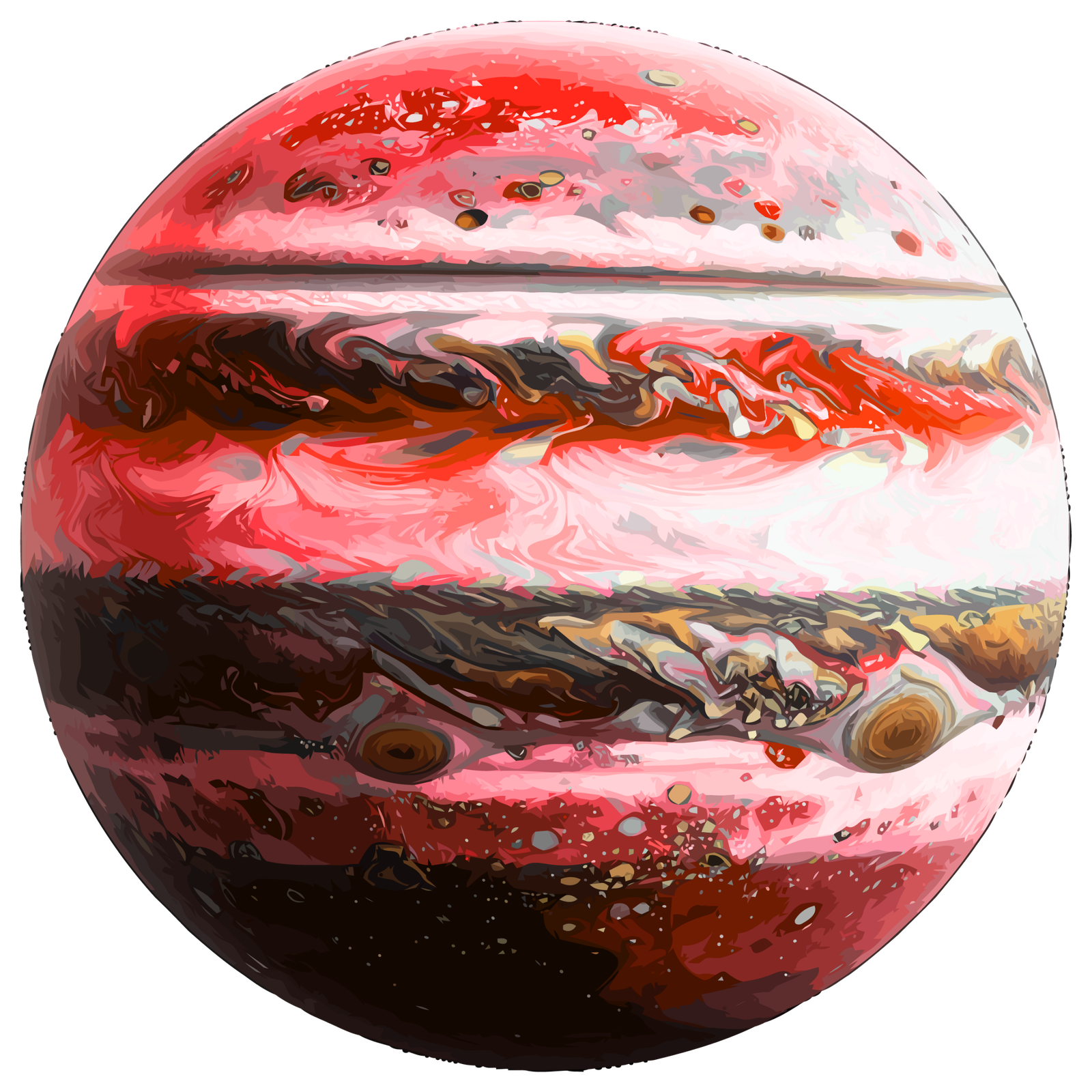

A star is a giant, glowing ball of hot plasma, mostly hydrogen and helium, held together by its own gravity, that shines because of nuclear fusion deep in its core. Our Sun is the nearest example, but the universe holds something like a septillion of them, each one a colossal furnace turning hydrogen into helium and pouring out light and heat in the process.
We tend to think of stars as tiny, delicate specks of light. They’re the opposite: they’re some of the largest, most powerful objects in existence, and every one you see is quietly waging an epic battle against its own crushing gravity. Let’s unpack what a star actually is, how one is born, and why it eventually dies.
What a Star Really Is
At its simplest, a star is an enormous sphere of superheated gas so hot that it exists as plasma, a state where atoms are torn apart into charged particles. That plasma is overwhelmingly hydrogen and helium, the two lightest and most common elements in the universe.
But a star isn’t just a hot ball of gas sitting there. It’s a working engine. In its incredibly hot, dense core, hydrogen atoms are squeezed together so violently that they fuse into helium, a process called nuclear fusion. Each fusion reaction releases a burst of energy, and the combined output of countless reactions is what makes a star shine. So a star isn’t “on fire” the way a campfire is. There’s no burning involved. It’s powered by nuclear reactions, the same basic process behind a hydrogen bomb, running steadily for millions or billions of years.
The Balancing Act That Keeps a Star Alive
Here’s the elegant part. A star’s entire life is a tug-of-war between two opposing forces.
On one side, gravity is relentlessly trying to crush all that mass inward, pulling everything toward the center. On the other side, the energy pouring out of the fusion core creates an outward pressure that pushes back. When these two forces are perfectly balanced, the star holds a stable size and shines steadily. Scientists call this standoff hydrostatic equilibrium, and it’s the secret to a star’s long life. A star lives for exactly as long as it can keep fusion going to resist gravity. The moment the fuel runs low and fusion falters, gravity starts to win, and the star’s death begins.
How Stars Are Born
Stars don’t just appear. They’re born inside vast clouds of gas and dust called nebulae, sometimes nicknamed stellar nurseries, exactly like the one in the image above.
Within these cold clouds, gravity slowly pulls pockets of gas together into ever denser clumps. As a clump collapses, it heats up, forming a hot young core called a protostar. If enough material piles on, the core’s temperature and pressure eventually climb high enough, around 10 million degrees, to ignite nuclear fusion. At that instant, a true star is born. There’s a catch, though: an object needs to gather at least about 8% of the Sun’s mass, roughly 80 times the mass of Jupiter, to ever ignite fusion. Fall short of that threshold, and you become a “failed star” called a brown dwarf, glowing dimly but never truly lighting up. Our guide to what a brown dwarf is explores these in-between objects.
Why Every Star Is Different
No two stars are quite alike, and it almost all comes down to one thing: mass. A star’s mass at birth decides how bright it is, what color it glows, how hot it burns, how long it lives, and how it will eventually die.
Massive stars are hot, blazingly bright, and blue, but they burn through their fuel recklessly and may last only a few million years. Small, low-mass stars are cool, dim, and red, and they sip their fuel so slowly they can shine for trillions of years. In fact, a star’s color is a direct clue to its temperature, with blue stars being the hottest and red stars the coolest. Our own Sun is a middling yellow star, comfortably average, as our profile of what sort of star the Sun is explains. If those colors fascinate you, our beginner’s guide to the sky’s colorful stars shows you how to spot the difference yourself.
How Stars Die
Eventually every star exhausts the hydrogen fuel in its core, and gravity finally gains the upper hand. What happens next, again, depends on mass.
A modest star like the Sun swells into a red giant, then gently sheds its outer layers and leaves behind a small, dense ember called a white dwarf, which slowly cools over billions of years. A truly massive star goes out with far more drama, collapsing and then detonating as a brilliant supernova. What’s left behind is one of the universe’s most extreme objects: either an ultra-dense neutron star or, if the star was heavy enough, a black hole.
A Star Is Not a Planet
One last point worth clearing up. Stars and planets are fundamentally different things. A star generates its own light and heat through fusion. A planet does neither. Planets are far too small to fuse anything, so they simply shine by reflecting the light of a nearby star. That’s the key difference between the Sun and the worlds that orbit it.
So the next time you look up at the night sky, remember that each of those pinpricks of light is a distant sun, a gigantic fusion furnace burning across the light-years. Our guide to the closest star systems to Earth shows just how far away even the nearest ones really are, and NASA’s own overview of stars is a great place to keep exploring.
If you enjoyed this article, don’t forget to drop us a comment, it really helps support the site, and be sure to check out our other articles because we think you’re going to love them too.