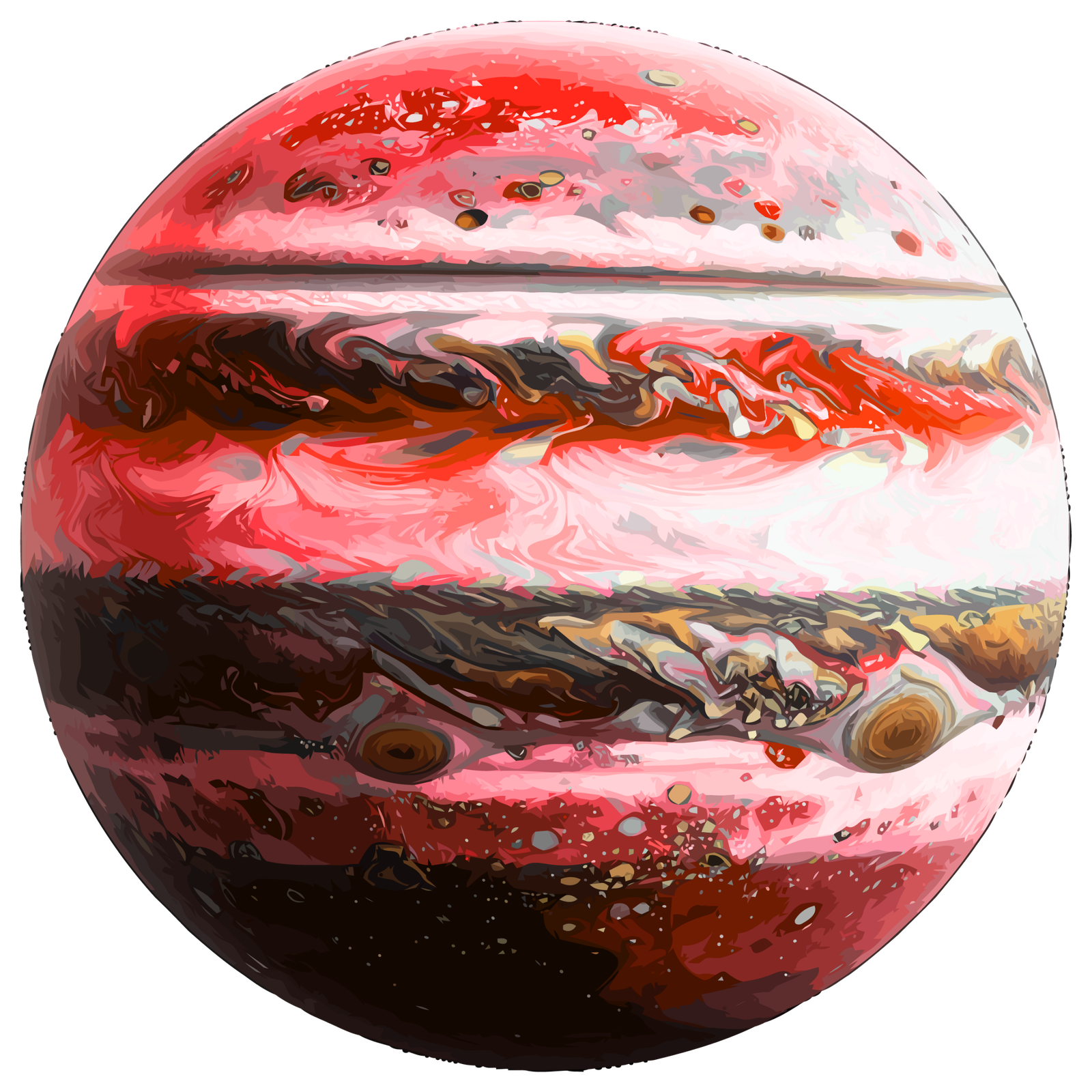

The Sun is made almost entirely of two ingredients: hydrogen and helium. By mass, it’s roughly 73% hydrogen and 25% helium, with the last 2% or so being a sprinkle of heavier elements like oxygen, carbon, iron, and neon. And all of it exists not as ordinary gas, but as a glowing, electrically charged state of matter called plasma.
That’s the whole recipe. What’s genuinely amazing is that we can know it so precisely for an object we’ve never touched, sitting 93 million miles away. So let’s break down what the Sun is really made of, why it counts as plasma rather than fire, and the clever detective work that let us read its ingredients from here on Earth.
Mostly Hydrogen and Helium
Break the Sun down by mass and the picture is beautifully simple. Two elements dominate almost completely, and everything else is a rounding error.
| Ingredient | Share of the Sun (by mass) |
|---|---|
| Hydrogen | about 73% |
| Helium | about 25% |
| Everything else combined | about 2% |
That final 2% is a thin scattering of heavier elements, mostly oxygen, carbon, neon, iron, nitrogen, silicon, magnesium, and sulfur. Interestingly, if you count by the number of atoms rather than by mass, hydrogen looks even more dominant, making up more than 90% of all the atoms in the Sun, because each hydrogen atom is so much lighter than a helium one.
It’s worth pausing on how ordinary those ingredients are. Hydrogen and helium are the two simplest, lightest elements in existence, and they’re also the two most abundant elements in the entire universe. Our Sun is a pretty typical example of what stars are made of, which is one reason studying it tells us so much about the kind of star the Sun is and about stars everywhere.
It’s Not Gas, and It’s Definitely Not Fire
Here’s a common misconception worth clearing up. The Sun isn’t on fire. There’s no burning in the way a campfire or a candle burns, because burning needs oxygen and there’s nothing out there to “burn” in that chemical sense.
Instead, the Sun’s material exists as plasma, often called the fourth state of matter alongside solid, liquid, and gas. When you heat a gas to extreme temperatures, the atoms get so energetic that their electrons are torn away, leaving a soup of electrically charged particles. That’s plasma. The Sun is so hot that its hydrogen and helium can’t hold onto their electrons, so nearly the entire star, from its core to its outer atmosphere, is this churning, electrically charged plasma.
And the reason it shines isn’t chemical burning at all. It’s nuclear fusion. Deep in the core, under crushing pressure and heat, hydrogen atoms are forced together to form helium, releasing staggering amounts of energy in the process. That energy is what makes the Sun blaze.
How Do We Even Know? A Great Detective Story
You might reasonably ask how anyone can be so confident about the makeup of something we can never sample directly. The answer is one of the most elegant tricks in all of science: reading sunlight.
When you split the Sun’s light into a rainbow spectrum, you find it’s crossed by dark lines. Each element absorbs light at its own specific set of wavelengths, leaving a unique fingerprint of dark lines behind. By matching those lines to elements we know, scientists can identify exactly what the Sun contains, and in what amounts, without ever leaving Earth.
This technique led to a wonderful discovery. In 1868, astronomers studying the Sun’s spectrum spotted a yellow line that matched no known element on Earth. They realized they’d found something new, and named it helium, after Helios, the Greek word for the Sun. Helium was literally discovered in the Sun before anyone found it on our own planet. Later, in 1925, a young astronomer named Cecilia Payne-Gaposchkin used this same spectral evidence to show that stars are made overwhelmingly of hydrogen and helium, an idea so surprising at the time that she was pressured to doubt her own brilliant conclusion.
The Recipe Is Slowly Changing
Here’s the final twist. The Sun’s composition isn’t fixed. Every second, its core fuses around 600 million tons of hydrogen into helium. That means, very slowly, the Sun is running down its hydrogen fuel and building up more helium in its heart.
For now, there’s plenty left, enough to keep the Sun shining steadily for billions more years. But eventually the core’s hydrogen will run low, and that shift in the Sun’s makeup will trigger dramatic changes. It will swell into a red giant and ultimately transform completely, a story we follow in our guide to how the Sun will die. NASA’s Sun overview is a great place to keep exploring our home star.
So the next time you feel the Sun on your skin, remember what’s actually up there: a colossal ball of hydrogen and helium plasma, quietly fusing itself into light, made of the very same simple ingredients that fill the entire universe.
If you enjoyed this article, don’t forget to drop us a comment, it really helps support the site, and be sure to check out our other articles because we think you’re going to love them too.