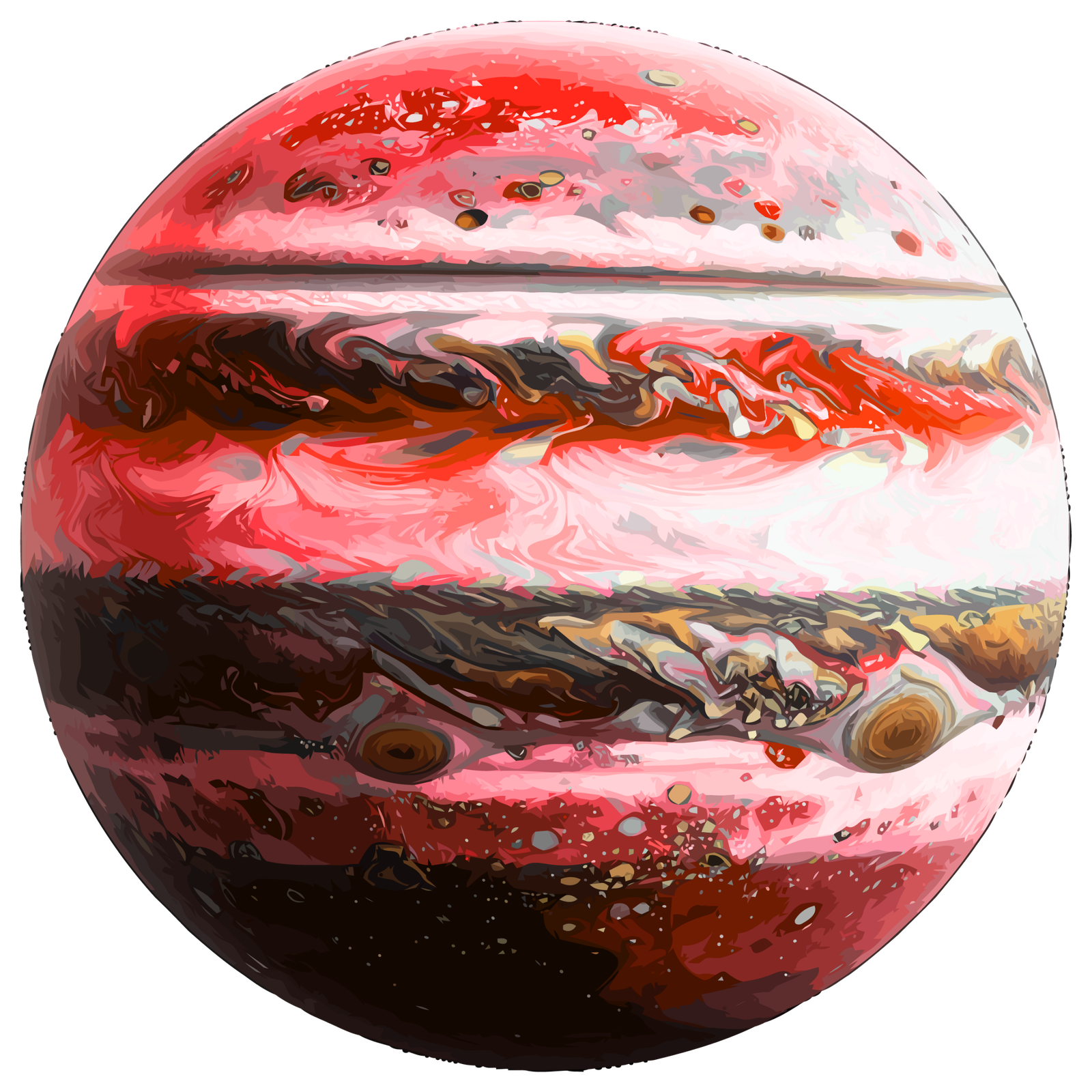

Eight planets orbit the Sun, and their order never changes: Mercury, Venus, Earth, Mars, Jupiter, Saturn, Uranus, Neptune, closest to farthest. That single sentence answers the most common question. Everything below fills in the details: how far apart they actually are, how big each one is, and what makes every single one of them genuinely strange in its own way.
The Quick Reference Table
| # | Planet | Distance from Sun (AU) | Distance (miles) | Diameter (miles) | Orbital Period |
|---|---|---|---|---|---|
| 1 | Mercury | 0.39 | 36 million | 3,032 | 88 days |
| 2 | Venus | 0.72 | 67 million | 7,521 | 225 days |
| 3 | Earth | 1.00 | 93 million | 7,926 | 365 days |
| 4 | Mars | 1.52 | 142 million | 4,212 | 687 days |
| 5 | Jupiter | 5.20 | 484 million | 86,881 | 11.9 years |
| 6 | Saturn | 9.50 | 886 million | 74,898 | 29.4 years |
| 7 | Uranus | 19.20 | 1.78 billion | 31,763 | 84 years |
| 8 | Neptune | 30.10 | 2.8 billion | 30,775 | 165 years |
One astronomical unit (AU) equals the distance from Earth to the Sun, about 93 million miles, the standard yardstick astronomers use once kilometers stop being useful.
Why This Order Never Changes
All eight planets formed from the same rotating disk of gas and dust roughly 4.6 billion years ago, and they’ve orbited the Sun in the same lanes ever since. Closer to the Sun, only rock and metal could survive the heat, building the four small, dense inner planets. Farther out, past what’s called the frost line, ice and gas could stick around too, building the four much larger outer worlds. That single dividing line explains almost everything about why the solar system looks the way it does.
The Inner Planets: Small, Rocky, Close to Home
Mercury, the closest planet to the Sun, is also the smallest, barely larger than our own Moon, and swings through the most extreme temperature range of any planet, over 1,100 degrees Fahrenheit between its scorching days and frozen nights. Our full profile of Mercury covers exactly why a planet so close to the Sun can still get bitterly cold.
Venus comes next, nearly Earth’s twin in size, yet transformed by a runaway greenhouse effect into the hottest planet in the solar system, hot enough to melt lead. It also spins backward compared to almost every other planet. See our full breakdown of Venus’s size, distance, and orbit for the details.
Earth, third from the Sun, sits in the narrow band of distance where water stays liquid, the only reason any of this is being read by someone rather than nothing at all.
Mars, the Red Planet, closes out the inner solar system, home to the largest volcano and the deepest canyon system anywhere in the solar system. Our profile of Mars’s size, distance, and orbit covers its two strange, doomed little moons in detail.
The Outer Planets: Giants Made Mostly of Gas and Ice
Jupiter, the largest planet by a wide margin, could swallow roughly 1,000 Earths and still have room left over. It hosts 115 confirmed moons and counting. Our full Jupiter profile and dedicated breakdown of Jupiter’s moons cover the specifics.
Saturn needs no introduction beyond its rings, though it isn’t the only ringed planet, just the only one with rings bright enough to see from Earth. Our Saturn profile and piece on what Saturn’s rings are actually made of dig into the details.
Uranus rolls around the Sun almost completely on its side, tilted about 98 degrees, likely the result of an ancient, massive collision. Our full guide to Uranus’s distance from the Sun explains what that sideways spin actually looks like from the ground.
Neptune, the farthest official planet, wasn’t found by accident, it was calculated mathematically before anyone ever saw it through a telescope. Our piece on Neptune’s distance from the Sun and the dramatic story of its discovery cover exactly how that happened.
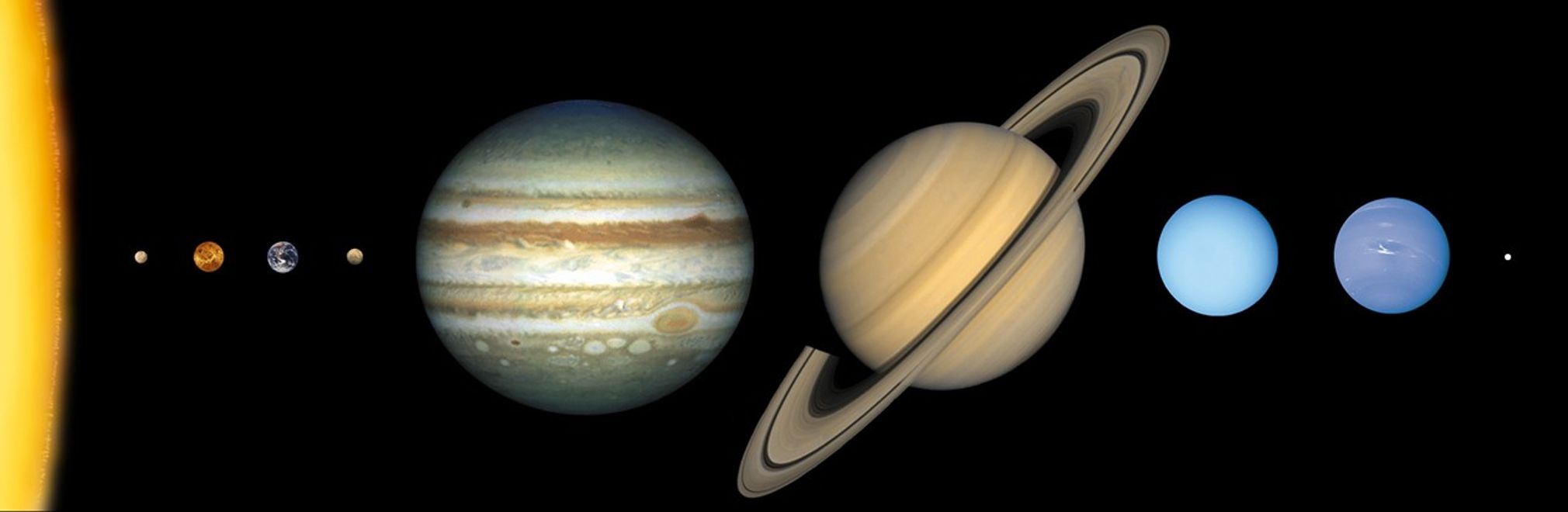 The planets of our solar system, shown to relative scale. Jupiter alone is wide enough to fit roughly 1,000 Earths inside it. (Image: NASA/Lunar and Planetary Institute)
A Note on Pluto
Pluto orbits beyond Neptune and was considered the ninth planet until 2006, when the International Astronomical Union reclassified it as a dwarf planet after astronomers realized it shares its region of space with thousands of similar icy bodies. Pluto still has plenty of fans, and its story is worth its own read in our profile of Clyde Tombaugh’s discovery of Pluto.
See the Numbers for Yourself
Reading a table is one thing, feeling the scale is another. Our Cosmic Travel Time Calculator lets you pick any planet and see how long it would actually take to get there at real-world speeds, and our Age on Planets Calculator shows how old you’d be if each planet’s own orbit counted as your year.
For more detailed data straight from the source, check out NASA’s Planetary Fact Sheet and the additional overview from NASA Science.
If you enjoyed this article, don’t forget to drop us a comment, it really helps support the site, and be sure to check out our other articles because we think you’re going to love them too.