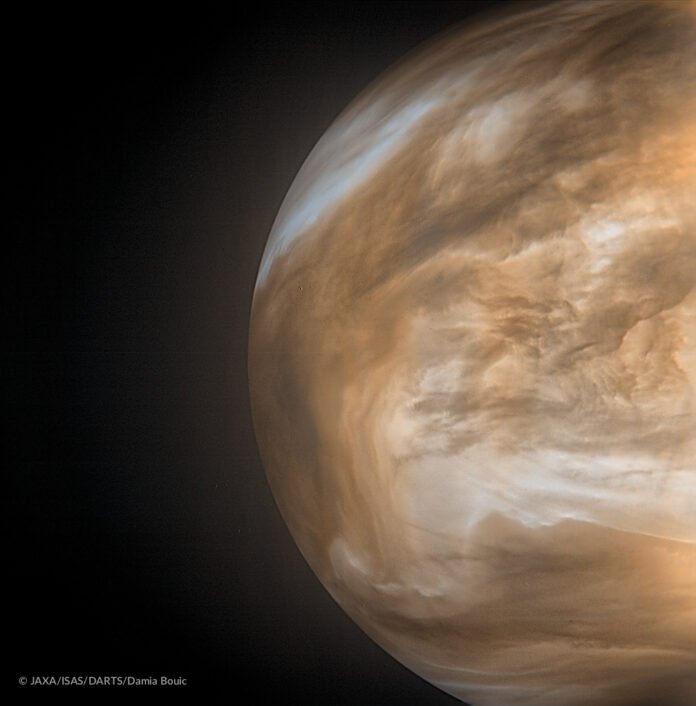

Venus is often called Earth’s twin, and on paper, that nickname makes sense, its nearly the same size, built from the same rocky ingredients, and sits just one planet closer to the Sun. In practice, Venus turned out so different from Earth that scientists now sometimes call it our evil twin instead.
Nearly Earth’s Size, Just a Bit Closer to the Sun
Venus orbits the Sun at an average distance of about 67 million miles, or 0.72 astronomical units, close enough that sunlight takes only six minutes to reach it, compared to eight minutes for Earth. At its closest approach, Venus comes within about 24 million miles of Earth, making it our nearest planetary neighbor by a wide margin, even closer than Mercury manages most of the time.
In size, Venus measures about 7,521 miles across, just under 95 percent of Earth’s own diameter. Its structure looks remarkably similar too, an iron core, a rocky mantle, and a thin outer crust, which is exactly why scientists once assumed Venus would turn out to be broadly Earth-like.
A Day Longer Than a Year, Spinning the Wrong Way
Venus’s orbit takes just 225 Earth days to complete, one of the shorter years in the solar system. Its rotation is the genuinely strange part, Venus spins on its axis once every 243 Earth days, meaning a single Venusian day actually lasts longer than its entire year. To make things stranger, Venus rotates backward compared to nearly every other planet, so if you could somehow watch a sunrise from its surface, the Sun would rise in the west and set in the east.
Venus also has almost no axial tilt, just 3 degrees compared to Earth’s 23, so unlike Earth, it experiences no meaningful seasons at all throughout its orbit.
Close Enough to Be Deceiving
Because Venus orbits closer to the Sun than Earth does, it never strays far from the Sun in our sky, appearing only as a brilliant morning or evening “star” rather than something visible at midnight. Ancient civilizations, including the Greeks and Egyptians, actually mistook these two appearances for separate objects entirely before realizing it was the same planet. Watched over months through a telescope, Venus even cycles through phases like our Moon does, a discovery Galileo made that helped prove Earth wasn’t the center of the solar system.
If you’re curious how Venus’s proximity compares to our other close planetary neighbor, our full profile of Mercury, the actual closest planet to the Sun, covers how that innermost world’s orbit stacks up.
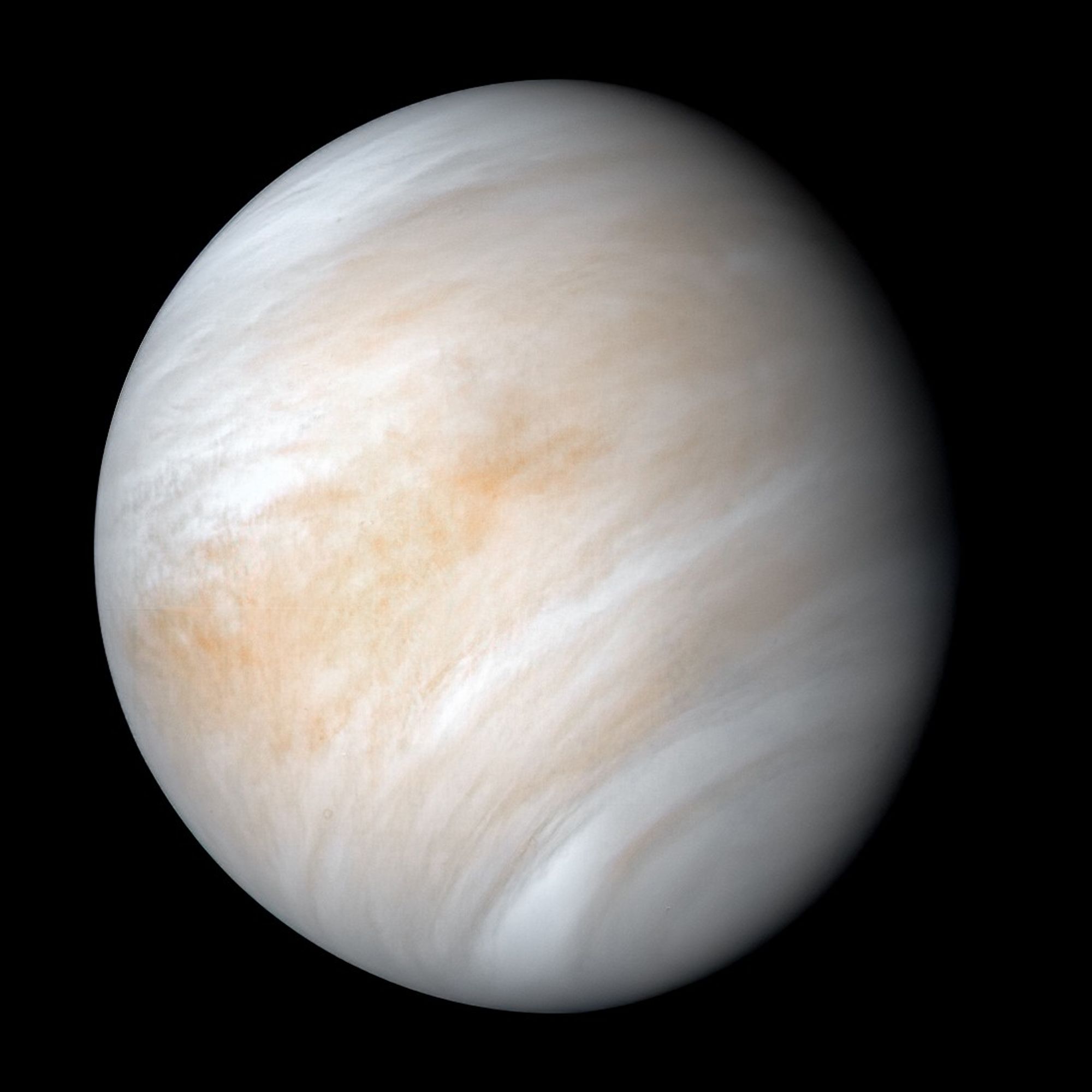 Venus, photographed by NASA’s Mariner 10 spacecraft in February 1974. Beneath those serene-looking clouds sits a surface hot enough to melt lead. (Image: NASA/JPL-Caltech)
Why Two Similar Planets Turned Out So Differently
Despite their shared starting conditions, Venus and Earth split onto wildly different paths. A runaway greenhouse effect eventually locked Venus into surface temperatures around 872 degrees Fahrenheit, hot enough to melt lead, with crushing atmospheric pressure equivalent to being 3,000 feet underwater on Earth. NASA’s Magellan spacecraft mapped 98 percent of that scorched surface using radar between 1990 and 1994, revealing thousands of volcanoes and mountain ranges taller than Everest, all hidden beneath permanent clouds of sulfuric acid.
For more detailed data straight from the source, check out NASA’s Venus Facts page and the additional overview from Astronomy.com.
If you enjoyed this article, don’t forget to drop us a comment, it really helps support the site, and be sure to check out our other articles because we think you’re going to love them too.