
Mercury doesn’t get nearly as much attention as flashier neighbors like Mars or Saturn, and honestly, that’s a little unfair. It’s the closest planet to the Sun, the fastest planet in the entire solar system, and a genuinely bizarre little world once you start digging into the numbers. Here’s a full rundown of exactly how big Mercury is, how far it actually sits from the Sun, and what its strange, lopsided orbit really looks like.
Just How Small Is Mercury?
Mercury holds the title of smallest planet in the solar system, with a radius of about 1,516 miles, a little more than a third the width of Earth. NASA likes to put it in perspective this way, if Earth were shrunk down to the size of a nickel, Mercury would be roughly the size of a blueberry sitting next to it. Its actually only slightly larger than our own Moon, small enough that some of Jupiter’s and Saturn’s largest moons technically outsize it.
Despite that modest size, Mercury is surprisingly dense, second only to Earth among all the planets. That density comes down to its interior structure, nearly two thirds of Mercury’s total mass is packed into a massive metallic core, one that extends out to about 85 percent of the planet’s entire radius. By comparison, Earth’s core takes up a much smaller share of our own planet’s interior.
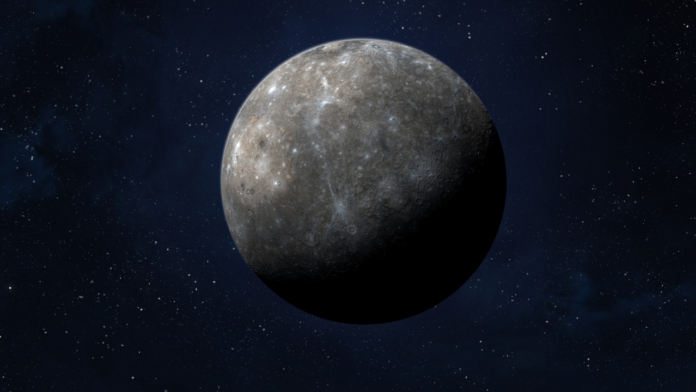
 Mercury’s heavily cratered surface, photographed by NASA’s MESSENGER spacecraft. The bright streaks radiating outward are crater rays, made of finely crushed rock thrown outward during an impact. (Image: NASA/Johns Hopkins University Applied Physics Laboratory/Carnegie Institution of Washington)
Why Mercury Is the Closest Planet to the Sun
Mercury orbits at an average distance of about 36 million miles from the Sun, making it, unsurprisingly, the closest planet to the Sun by a wide margin. In astronomical terms, that puts Mercury at just 0.4 astronomical units out, less than half the distance separating Earth from the Sun. Sunlight that takes about 8 minutes to reach Earth only needs 3.2 minutes to reach Mercury.
That closeness comes with real consequences. From Mercury’s surface, the Sun would appear more than three times larger in the sky than it does from Earth, and sunlight would hit the ground up to seven times brighter. Combine that intense solar exposure with virtually no atmosphere to spread the heat around, and you get some of the most extreme daytime temperatures anywhere in the solar system, up to 800 degrees Fahrenheit under direct sunlight.
A Genuinely Lopsided Orbit
Here’s where Mercury gets strange. Its orbit isn’t just elliptical, it’s the most eccentric, or stretched out, orbit of any planet in the solar system, with an eccentricity of about 0.206. Because of that, Mercury’s actual distance from the Sun swings dramatically over the course of a single orbit. At its closest point, called perihelion, Mercury comes within about 29 million miles of the Sun. At its farthest point, aphelion, that distance stretches out to roughly 43 million miles, nearly 50 percent farther than perihelion.
That same eccentric orbit also makes Mercury the fastest planet in the solar system, hurtling around the Sun at nearly 29 miles per second, faster than any other planet manages. A full orbit, one Mercury year, takes just 88 Earth days to complete, the shortest year of any planet by far.
A Day Longer Than a Year
Mercury’s rotation is where things get genuinely counterintuitive. The planet spins extremely slowly on its axis, completing one full rotation every 59 Earth days. Combine that slow spin with Mercury’s fast, eccentric orbit, and something strange happens, a single Mercury solar day, meaning one complete sunrise to sunrise cycle, actually works out to 176 Earth days, more than two full Mercury years.
The eccentric orbit creates an even stranger effect on parts of the planet’s surface. When Mercury is moving fastest through its orbit, right around perihelion, the Sun can appear to briefly rise, pause, sink back down, and then rise again before continuing on its way, a bizarre optical effect caused by Mercury’s orbital speed briefly outpacing its rotation.
No Moons, No Rings, and a Frozen Secret
Unlike most planets, Mercury has no moons and no ring system at all, likely because its proximity to the Sun’s powerful gravity makes it nearly impossible to hold onto orbiting debris over long timescales. What Mercury does have is a genuinely surprising secret for a planet that reaches 800 degree daytime highs, evidence of water ice, tucked into permanently shadowed craters near its north and south poles, regions the sunlight simply never reaches, cold enough to keep that ice locked in place indefinitely despite the extreme heat baking the rest of the planet.
If you’re curious how Mercury’s brutal conditions compare to the rest of the solar system’s planets, our beginner friendly overview in Astronomy 101 walks through how each planet stacks up in terms of size, distance, and orbit.
A New Mission Is About to Get a Much Closer Look
Only two spacecraft have ever studied Mercury up close, NASA’s Mariner 10 in the mid 1970s, and NASA’s MESSENGER orbiter, which mapped the planet in detail between 2011 and 2015. That’s about to change. BepiColombo, a joint mission between the European Space Agency and Japan’s space agency JAXA, is scheduled to be captured into orbit around Mercury in November 2026, with its two separate orbiters expected to begin full science operations in early 2027. Once active, BepiColombo is expected to deliver the most detailed data on Mercury’s surface, magnetic field, and interior structure since MESSENGER wrapped up its own mission over a decade ago.
Why This Tiny, Scorched Planet Still Matters
Mercury might not have the visual drama of Saturn’s rings or the ongoing habitability debates surrounding Mars, but studying the closest planet to the Sun gives scientists a genuinely valuable look at how rocky, terrestrial planets form and evolve under the most extreme possible conditions. Its unusually dense core, its bizarre day-year relationship, and even that hidden polar ice all offer clues about planetary formation that apply well beyond our own solar system, helping researchers understand rocky worlds discovered around other stars entirely.
For more detailed data straight from the source, check out NASA’s Mercury Facts page and the additional overview from Astronomy.com.
If you enjoyed this article, don’t forget to drop us a comment, it really helps support the site, and be sure to check out our other articles because we think you’re going to love them too.