
Neptune sits so far out in the solar system that it took mathematics, not a telescope, to actually find it. Astronomers calculated exactly where it had to be based on strange wobbles in Uranus’s orbit, then pointed a telescope at that precise spot and found it waiting there on the very first night of searching. That distance is still the defining fact about Neptune today, so lets break down exactly how far it really sits, and what that kind of distance actually does to a planet.
The Numbers Behind Neptune’s Distance
Neptune orbits the Sun at an average distance of about 2.8 billion miles, or roughly 4.5 billion kilometers. In astronomical units, the standard measurement based on the Earth to Sun distance, that works out to about 30 AU, meaning Neptune sits 30 times farther from the Sun than Earth does. Its the eighth and most distant official planet in our solar system, and the distance is genuinely difficult to picture in any practical terms.
Sunlight, which takes about 8 minutes to reach Earth, needs roughly 4 hours to make the same trip out to Neptune. If the Sun somehow vanished this instant, we wouldn’t notice for 8 minutes, and Neptune wouldn’t notice for the better part of an afternoon.
An Orbit So Slow It Hasn’t Finished One Trip Since Discovery
Because Neptune sits so far out, it has an enormous amount of ground to cover just to complete a single orbit. One full trip around the Sun, a Neptunian year, takes about 165 Earth years. Neptune was discovered in 1846, which means the planet has only just completed one single orbit since astronomers first found it, crossing that milestone relatively recently in 2011.
Neptune’s orbit isn’t a perfect circle either, its slightly elliptical, so the exact distance from the Sun shifts a bit depending on where the planet sits at any given point. At its closest, Neptune comes within about 2.7 billion miles of the Sun; at its farthest, that stretches out to nearly 2.8 billion miles. That elongated orbit produces one genuinely strange effect, for a 20 year stretch roughly every 248 years, the dwarf planet Pluto’s own even more eccentric orbit actually swings inside Neptune’s path, briefly making Pluto closer to the Sun than Neptune is. That last happened between 1979 and 1999, and it won’t happen again for well over a century.
Despite that painfully slow orbit, Neptune actually spins quite fast on its axis, completing a full rotation, one Neptunian day, in just 16 hours, giving it one of the shortest days paired with the longest year of any planet in the solar system.
Why Neptune Ended Up So Far From the Sun
Neptune’s distance isn’t an accident of formation, it lines up with how the early solar system took shape. Close to the young Sun, temperatures were too high for lightweight gases and ices to stick around, which is why the rocky inner planets stayed small. Farther out, past a boundary scientists call the frost line, conditions cooled enough for ice and gas to accumulate in massive quantities. Neptune formed well beyond that line, which is exactly why it grew into an ice giant, made up largely of water, ammonia, and methane ices surrounding a small rocky core, rather than staying compact and rocky like Mercury, Venus, Earth, or Mars.
If you’re curious how Neptune’s distance compares to its immediate neighbor, our full breakdown of Uranus’s distance from the Sun covers the ice giant sitting just one planet closer to home.
What That Distance Does to the Planet Itself
Sitting nearly 2.8 billion miles from the Sun has real consequences for Neptune’s environment. Sunlight reaching the planet is incredibly faint, roughly 900 times weaker than what Earth receives, and combined with limited internal heat generation, Neptune ends up as one of the coldest planets in the solar system, with cloud top temperatures dropping to around minus 370 degrees Fahrenheit. Its signature deep blue color comes from methane in its atmosphere, which absorbs red light while reflecting blue wavelengths back out toward any telescope pointed its way.
Oddly enough, that extreme cold and distance doesn’t mean Neptune is calm. It actually holds the record for the strongest winds ever measured on any planet in the solar system, with gusts reaching over 1,200 miles per hour, a genuinely wild contradiction for a planet receiving so little energy from the Sun in the first place.
Why Neptune Was the Last Planet Discovered
Neptune’s extreme distance is directly responsible for it being the final classical planet discovered, and the only one found through mathematical prediction rather than direct observation. After astronomers noticed Uranus wasn’t orbiting exactly the way Newton’s laws predicted, French mathematician Urbain Le Verrier calculated where an unseen planet’s gravity would have to be tugging on Uranus to explain the discrepancy. When German astronomer Johann Galle pointed a telescope at that exact predicted location in September 1846, Neptune was sitting almost precisely where the math said it should be.
Only one spacecraft has ever visited Neptune up close. NASA’s Voyager 2 flew past in the summer of 1989, passing about 3,000 miles above Neptune’s north pole in what remains the closest any spacecraft has come to a planet since leaving Earth, before continuing on toward interstellar space. Everything we know about Neptune’s atmosphere, rings, and largest moon Triton up close still traces back to that single flyby over three decades ago.
If you want to see just how Neptune’s extreme distance stacks up against the rest of the solar system, our light travel time calculator is a fun way to compare how long sunlight takes to reach every planet, Neptune included.
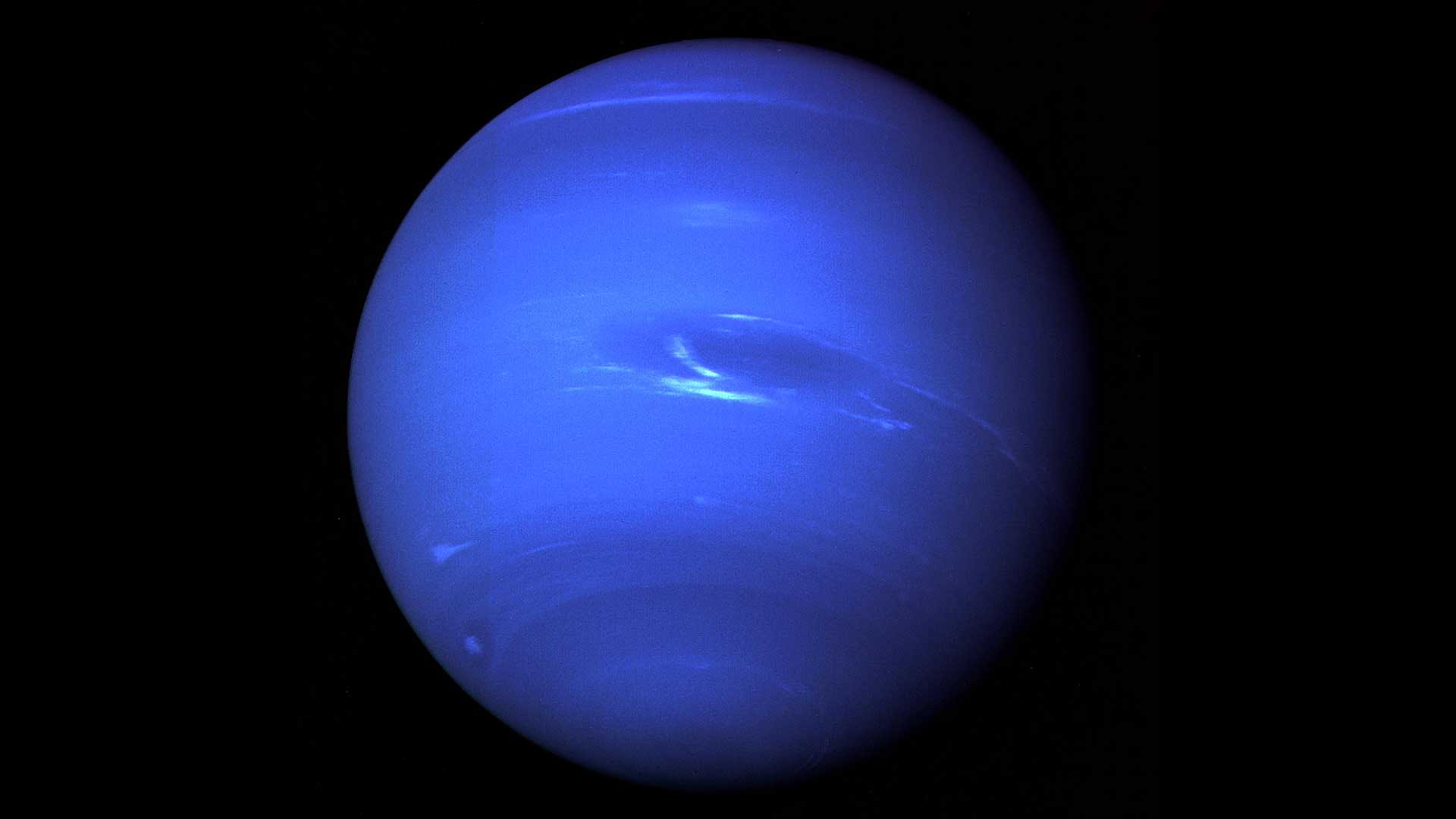 Neptune’s deep blue, banded atmosphere, photographed by NASA’s Voyager 2 during its 1989 flyby, still the only spacecraft to ever visit the planet up close. (Image: NASA/JPL-Caltech)
The Bottom Line
Neptune’s distance from the Sun averages out to about 2.8 billion miles, or 30 astronomical units, a gap so vast that sunlight itself needs 4 hours to cross it, and a single Neptunian year still stretches out to 165 Earth years. That distance shapes nearly everything about the planet, its brutal cold, its status as the last planet ever discovered, and the fact that humanity has only ever seen it up close once, for a matter of hours, more than three decades ago.
For more detailed data straight from the source, check out NASA’s Neptune Facts page and the additional overview from Astronomy.com.
If you enjoyed this article, don’t forget to drop us a comment, it really helps support the site, and be sure to check out our other articles because we think you’re going to love them too.