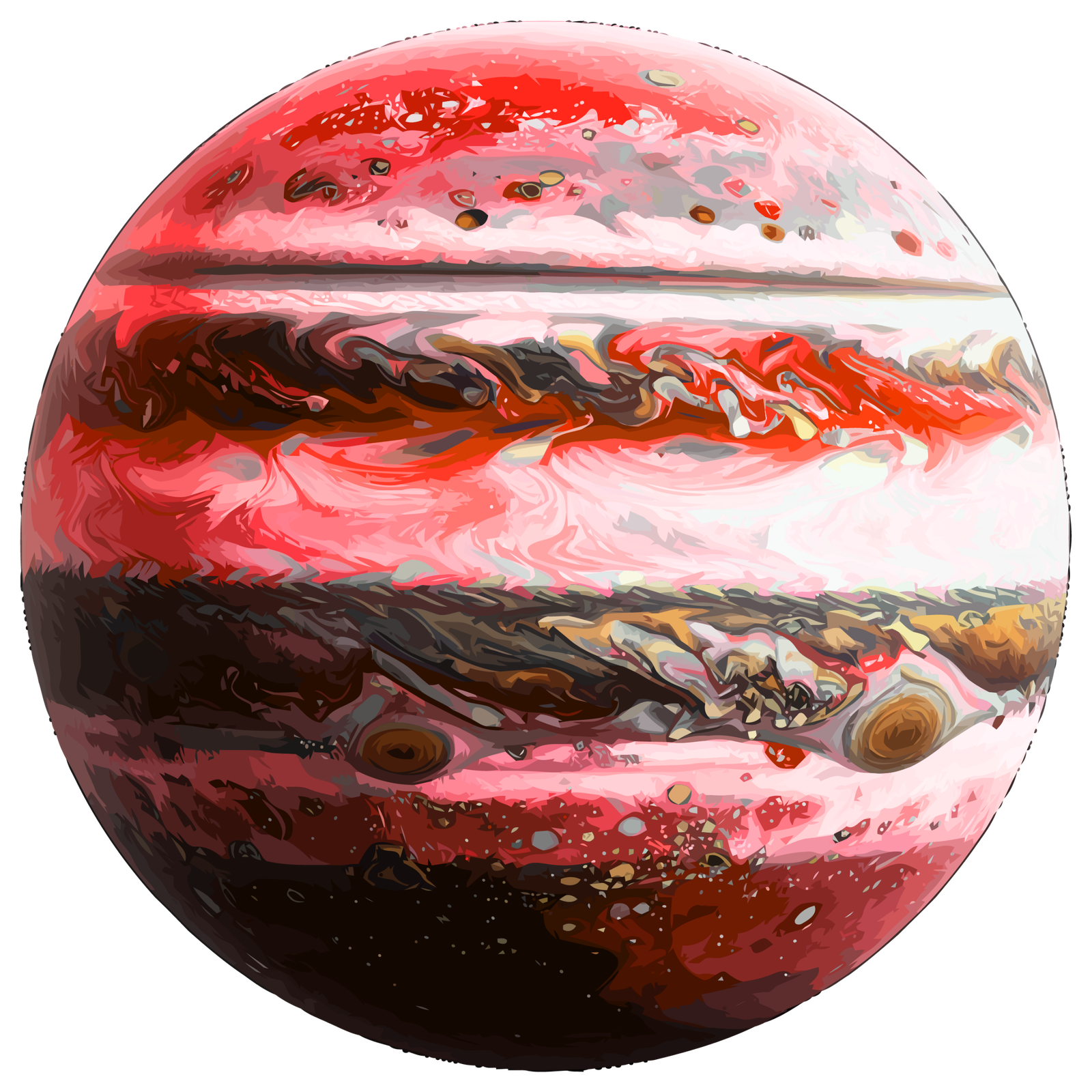

A planet is a world that orbits the Sun, is round, and has swept its own path through space mostly clear of other objects. Tick all three of those boxes and you’re a planet. Miss even one, as Pluto famously does, and you’re something else. That’s the whole definition in a nutshell, and it’s the reason our solar system officially has eight planets rather than nine.
It sounds simple, but that third rule caused one of the biggest arguments in modern astronomy, broke a lot of hearts, and rewrote every science textbook on the planet. And believe it or not, the vote that made it official happened almost exactly twenty years ago this week.
The Official Definition
For most of history, “planet” just meant one of the bright wandering lights that moved against the fixed stars. The word itself comes from the Greek for “wanderer.” There was no strict rulebook, which was fine until telescopes started turning up more and more round worlds out beyond Neptune, and astronomers realized they had no clear way to say what did and didn’t count.
So in 2006 the International Astronomical Union, the body that officially names things in space, sat down and hammered out a proper definition. To be a planet in our solar system, an object must do three things:
- Orbit the Sun. It has to circle our star, not another planet. That rules out moons.
- Be round. It needs enough mass for its own gravity to pull it into a ball, a state scientists call hydrostatic equilibrium. Small lumpy asteroids don’t qualify.
- Clear its neighborhood. It has to be gravitationally dominant, having swept up, flung away, or absorbed the other sizable objects sharing its orbit.
The first two are easy for lots of objects. It’s that third rule that does the heavy lifting, and it’s exactly where Pluto came up short. You can read the criteria straight from NASA on its dwarf planets page.
Why Pluto Got Demoted
Pluto was discovered in 1930 and happily counted as the ninth planet for 76 years. So what changed? We did. Our telescopes got better, and astronomers started finding other icy worlds out in the same distant region Pluto calls home, the Kuiper Belt.
The breaking point came in 2005 with the discovery of Eris, an object out past Pluto that turned out to be roughly the same size and even a bit heavier. That forced an awkward question. If Pluto is a planet, then Eris must be too, and so are all the other big Kuiper Belt objects we keep finding. Suddenly we were looking at ten, twelve, maybe dozens of planets. Astronomers had to either open the gates to a flood of new planets or tighten the definition.
They tightened it. Pluto passes rules one and two easily, but it fails rule three. It’s just one modest resident among thousands of icy bodies in the Kuiper Belt, sharing its lane rather than ruling it. Neptune, by contrast, gravitationally dominates its own zone completely. So on August 24, 2006, in Prague, the IAU voted, and Pluto was reclassified as a dwarf planet. The public backlash was loud and lasted years. People genuinely mourned.
Planet, Dwarf Planet, or Something Else
The 2006 decision actually sorted the solar system into a tidy three-tier system.
At the top sit the eight planets, from little Mercury closest in, out through Earth and the giants to Neptune. You can meet them all in our beginner’s guide to the planets.
Then come the dwarf planets, worlds that are round and orbit the Sun but never cleared their neighborhoods. The IAU officially recognizes five of them: Ceres, which lives in the asteroid belt between Mars and Jupiter, plus Pluto, Haumea, Makemake, and Eris out in the frozen Kuiper Belt. And the count won’t stop there. Astronomers suspect there could be a hundred or more dwarf planets still waiting to be found in the outer dark.
Everything else, the asteroids, the comets, the countless small icy chunks, gets filed under “small solar system bodies.” Not round enough, not massive enough, just rubble and ice going about its business.
What About Planets Around Other Stars?
Here’s a subtle point that trips people up. The IAU’s three rules technically only describe planets in our own solar system, because rule one specifically says “orbit the Sun.” Worlds circling other stars are called exoplanets, and they get their own working definition, mostly built around mass rather than a cleared orbit.
That distinction matters more every year, because we’ve now confirmed thousands of exoplanets, and some of them look genuinely promising as places to search for life. If that idea grabs you, start with our explainer on what an exoplanet actually is, then take a look at Proxima Centauri b, the closest one to us.
So the next time someone asks what makes a planet a planet, you can give them the short version with total confidence. Orbit the Sun, be round, and clear your path. Pluto nailed two out of three, and in astronomy, two out of three just isn’t enough.
If you enjoyed this article, don’t forget to drop us a comment, it really helps support the site, and be sure to check out our other articles because we think you’re going to love them too.