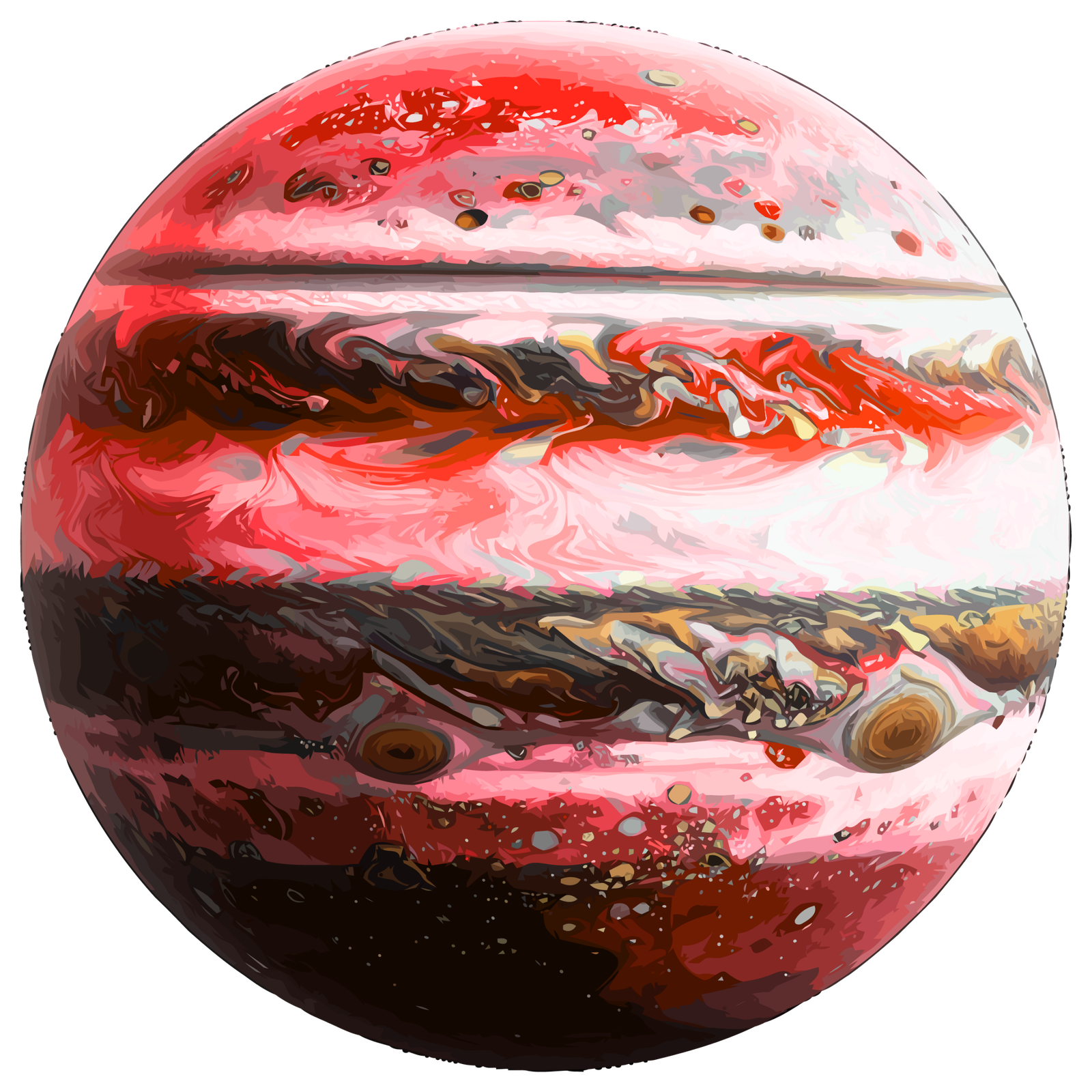

For seven days in July 1994, astronomers around the world barely slept. Twenty-one pieces of a shattered comet, lined up like beads on a string, were about to slam into Jupiter one after another, and for the first time in recorded history, humanity actually knew it was coming. Nobody had ever watched two worlds collide before. This time, everyone did.
A Comet That Was Already Broken
Astronomers Carolyn and Eugene Shoemaker, along with David Levy, spotted something strange in a photograph taken at Palomar Observatory in March 1993, a comet that wasn’t a single object at all, but a chain of at least a dozen fragments strung out in a line. The Shoemakers were no strangers to comet hunting, having found 32 of them together over their careers, but this one was different. Working out its orbit revealed why it looked so broken, the comet had passed too close to Jupiter back in July 1992, and the planet’s gravity had simply torn it apart.
By May 1993, astronomer Brian Marsden had calculated something that made front-page news around the world, the shattered comet, now named Shoemaker-Levy 9, was on a collision course with Jupiter itself. Impact was expected in mid-July 1994. For the first time, scientists had over a year of advance warning before two solar system bodies would crash into each other.
A Front-Row Seat, Purely by Accident
When the impacts finally began on July 16, 1994, they struck Jupiter’s far side, invisible to Earth-based telescopes until the planet’s rotation brought the scars into view. But one spacecraft had an accidental front-row seat. NASA’s Galileo probe, already en route to Jupiter after launching in 1989, happened to be positioned at exactly the right angle, 148 million miles from Jupiter, to directly photograph the flashes as fragments slammed into the planet’s night side. Every 2.3 seconds, its cameras caught another frame of light blooming and fading in the darkness.
Hubble delivered the sharpest views, tracking massive plumes of debris rising and then collapsing back onto Jupiter’s cloud tops. Heidi Hammel, who led Hubble’s observations, admitted she’d genuinely doubted the telescope would see much of anything given how small the comet was compared to Jupiter’s vast bulk. “I was astonished, and then I was elated,” she said. She barely slept for days as the images kept arriving.
Scars the Size of Earth
Over that single week, the 21 fragments released energy equivalent to roughly 300 million atomic bombs, some individual impacts alone briefly outshining the entire planet in infrared light. The largest impact scar left behind was bigger than Earth itself, dark bruises punched into Jupiter’s atmosphere that remained visible through telescopes for months afterward. Scientists later confirmed the comet had deposited water directly into Jupiter’s stratosphere, water that researchers could still detect there as late as 2019, a quarter century later.
If you’re curious about the very region of the solar system comets like this one originally come from, our explainer on what the Oort Cloud actually is covers the distant, icy source that keeps sending fresh comets sunward.
“A Sort of Punch in the Gut”
Beyond the spectacle, the impacts fundamentally changed how seriously humanity took the threat of cosmic collisions. Before 1994, the phrase “planetary defense” didn’t meaningfully exist as an organized effort. “Shoemaker-Levy 9 was a sort of punch in the gut,” Hammel later said. “It really invigorated our understanding of how important it is to monitor our local neighborhood, and to understand what the potential is for impacts on Earth in the future.” By 1998, Congress formally directed NASA to locate 90 percent of asteroids a kilometer or larger near Earth, a goal the agency met by 2010. Lindley Johnson, who became NASA’s first Planetary Defense Officer, put the lesson plainly: these impacts happen in the present, not just in some distant, ancient past, and finding hazardous objects early remains the only real defense humanity has.
For more on the event, check out the full retrospective from NASA and the detailed account from BBC Sky at Night Magazine.