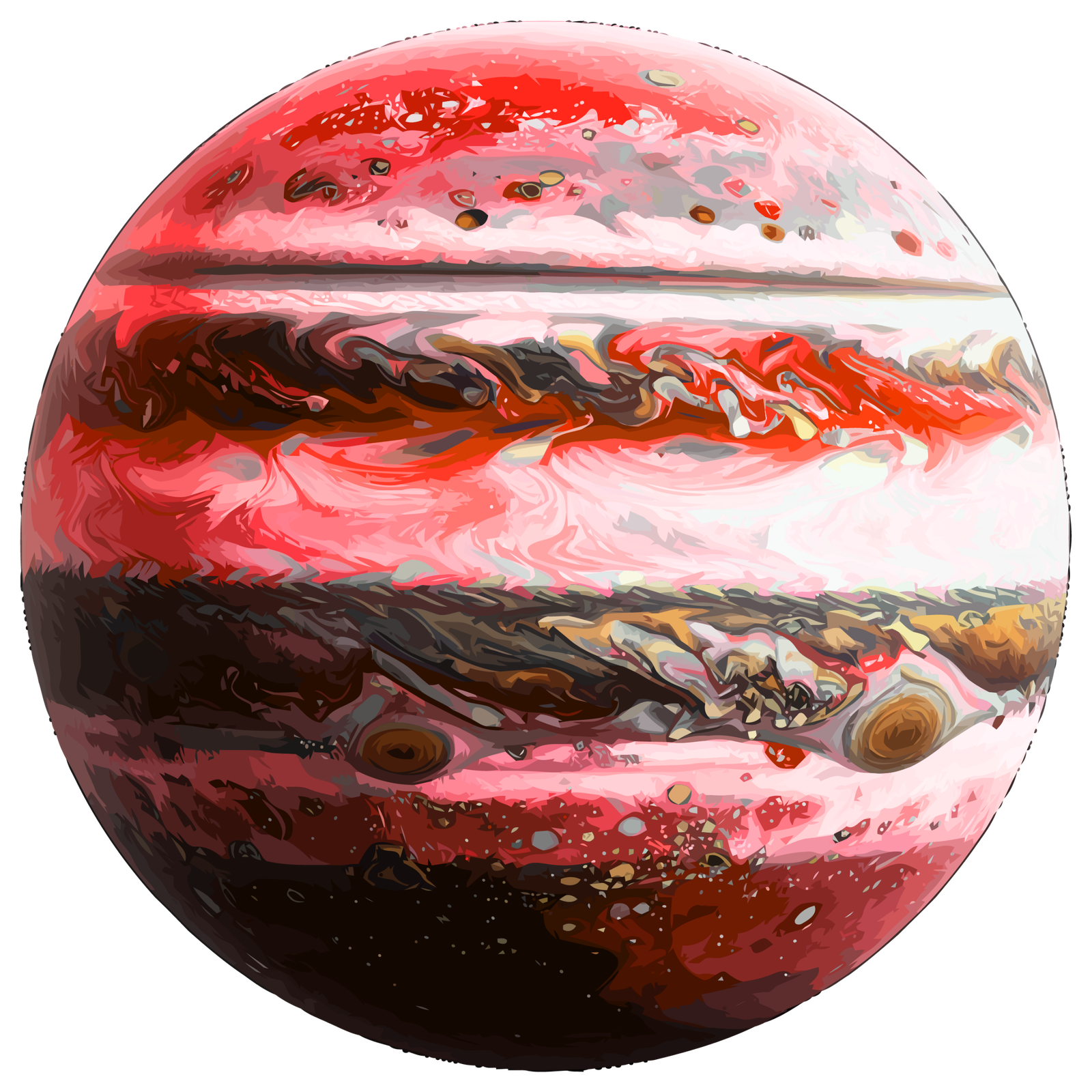

From here on Earth, Venus is a thing of beauty. It’s the dazzling “morning star” and “evening star,” the brightest point of light in our sky after the Moon, glowing softly at dusk and dawn. For centuries people gazed at it and imagined a warm, cloudy sister world, maybe even a tropical paradise hiding beneath the haze. The reality, once our spacecraft finally peeled back those clouds, turned out to be one of the most brutal environments anywhere in the solar system. Venus is gorgeous from a distance and an absolute nightmare up close.
Earth’s Twin That Turned Into a Nightmare
On paper, Venus and Earth look like siblings. Venus is almost exactly the same size as our planet, just a touch smaller, with a similar rocky composition and comparable gravity. If you lined the two up side by side, you’d struggle to tell them apart by size alone. That’s why Venus is so often called Earth’s twin.
But the resemblance ends there. Somewhere in their shared history, these two worlds went down wildly different paths, and Venus ended up as a scorched, crushing, poisonous world where nothing we know could survive for more than a moment. Understanding why is one of the most sobering lessons in planetary science.
Hot Enough to Melt Lead
Let’s start with the headline. Venus is the hottest planet in the entire solar system, with a surface temperature of around 465 degrees Celsius, roughly 870 degrees Fahrenheit. That’s not a summer-afternoon kind of hot. That is hot enough to melt lead, and it stays that way everywhere, all the time. Day or night, poles or equator, the surface barely cools at all.
Stand on Venus, and setting aside the fact that you’d be flattened and poisoned first, you would essentially be standing inside an oven that never switches off. There are no cool nights, no gentle mornings, no shade to escape to. The heat is relentless and uniform, wrapped around the whole planet like a blanket that refuses to let go.
Why Venus Beats Mercury for the Title of Hottest Planet
Here’s the part that surprises almost everyone. Mercury sits far closer to the Sun than Venus does, so you’d expect Mercury to be the hottest world around. It isn’t. Venus is hotter, and by a wide margin. The reason is a runaway greenhouse effect, and it’s a genuine planetary cautionary tale.
Venus is wrapped in an incredibly thick atmosphere made almost entirely of carbon dioxide. Sunlight filters down and warms the surface, but when that heat tries to radiate back out into space, the carbon dioxide traps it, over and over, building up until the whole planet bakes. Mercury, with almost no atmosphere at all, lets its heat escape freely into space every night and cools dramatically. Venus can’t. Its atmosphere holds the warmth in so effectively that it overwhelms the advantage Mercury gets from being closer to the Sun. If you’d like to see how the supposedly hottest neighbor actually behaves, our full profile of Mercury, the closest planet to the Sun tells that side of the story.
An Atmosphere That Would Crush and Choke You
The heat isn’t even the only thing trying to kill you on Venus. The atmosphere itself is monstrous in almost every way imaginable.
For a start, it’s crushing. The air pressure at the surface is more than 90 times what we feel at sea level on Earth. That’s roughly the pressure you’d experience nearly a kilometer deep in the ocean, enough to flatten an unprotected spacecraft. On top of that, the clouds that make Venus look so soft and pretty from afar aren’t made of water at all. They’re clouds of sulfuric acid, thick enough to hide the surface completely and corrosive enough to eat through metal. So the full picture is a world that is simultaneously baking, crushing, and drenched in acid. Beautiful from Earth, unimaginably hostile up close.
A Volcanic World Beneath the Clouds
Because those clouds block every last bit of visible light, we couldn’t actually see Venus’s surface until NASA’s Magellan spacecraft mapped it with radar in the early 1990s. Radar can punch straight through the haze, and what it revealed was a landscape shaped overwhelmingly by fire.
Venus is covered in volcanoes, more of them than any other planet in the solar system. Vast plains of ancient lava stretch across the globe, cut by long winding channels where molten rock once flowed. There are strange flat-topped features nicknamed “pancake domes,” towering highland regions that rise like continents, and a mountain called Maxwell Montes that stands even taller than Mount Everest. Curiously, the surface has very few impact craters, which tells scientists it’s geologically young, likely repaved by volcanic activity within the last several hundred million years. Some researchers even think a few of those volcanoes may still be active today. For the wider story of the planet, including its bizarre backward spin, our article on Venus’s size, distance, and backward orbit fills in the rest.
The Landers That Died Within an Hour
We do have a handful of actual photographs from the surface, and the story behind them is remarkable. In the 1970s and 1980s, the Soviet Union managed to land several Venera probes on Venus, an astonishing feat given the conditions. These were built like armored diving bells, and even so, the heat and pressure destroyed them fast. The toughest of them survived for only about two hours before falling silent, and most lasted far less. In that brief window they beamed back the first and still some of the only pictures ever taken from the ground of Venus, showing a bleak, rocky, orange-lit plain under a heavy sky.
It’s worth pausing on that. We have rovers that have roamed Mars for years, yet on Venus our machines have never lasted more than a couple of hours. And unlike Earth, Venus has no moon at all to keep it company, just that endless, smothering shroud of cloud.
Venus is a warning as much as a world. It shows what a runaway greenhouse effect can do to a planet that started out remarkably like our own. The next time you spot that brilliant point of light glowing in the twilight, it’s worth remembering the ferocious world hiding behind the glow. You can explore more about the mission that mapped it on NASA’s Magellan page.
If you enjoyed this article, don’t forget to drop us a comment, it really helps support the site, and be sure to check out our other articles because we think you’re going to love them too.