
In the summer of 1967, a 24 year old graduate student named Jocelyn Bell Burnell was combing through reams of paper printouts from a brand new radio telescope at Cambridge, hundreds of feet of data every single week, when she noticed something odd. A tiny, repeating blip, spaced out with almost impossible precision, showing up in the same spot in the sky night after night. She jokingly nicknamed it “LGM-1,” short for Little Green Men, half wondering if she’d stumbled onto a signal from an alien civilization. What she’d actually found was something nobody had ever detected before, a pulsar, and the discovery would go on to reshape modern astrophysics.
So What Exactly Is a Pulsar?
A pulsar is a type of neutron star, the incredibly dense, collapsed remnant left behind after a massive star explodes as a supernova. Neutron stars on their own are already almost unbelievably compact, cramming more mass than our Sun into a sphere often no wider than a mid sized city, roughly 12 to 15 miles across. What makes a pulsar special is the way it behaves, it spins rapidly, sometimes hundreds of times per second, and it blasts out narrow, focused beams of radiation from its magnetic poles.
Because a pulsar’s magnetic poles usually don’t line up perfectly with its spin axis, those beams sweep around the sky as the star rotates, similar to the rotating beam of a lighthouse. If Earth happens to sit in the path of that sweeping beam, we detect it as a regular, rhythmic pulse of radio waves, flickering on and off with astonishing precision every time the beam swings back around. That’s exactly the “scruff” Bell Burnell noticed, a pulse repeating every 1.337 seconds, far too fast and far too regular to be explained by anything astronomers had ever documented before.
Why the Discovery Was Such a Big Deal
Neutron stars had been theorized decades earlier, but nobody had actually detected one until Bell Burnell’s discovery provided the first real evidence they existed. Within months, she’d found three more of these mysterious pulsing sources scattered across different parts of the sky, ruling out the little green men explanation for good, since an alien civilization broadcasting from four completely different directions seemed a lot less likely than a natural, if genuinely bizarre, astrophysical phenomenon.
The 1974 Nobel Prize in Physics was ultimately awarded for the discovery of pulsars, though it went to Bell Burnell’s supervisor, Anthony Hewish, along with astronomer Martin Ryle, a decision that’s remained controversial among scientists ever since given how central her own work was to the finding. Bell Burnell herself has remained remarkably gracious about the whole thing over the decades, and in 2018 she was awarded a $3 million Breakthrough Prize in recognition of her role in the discovery, all of which she donated to help fund physics students from underrepresented backgrounds.
Cosmic Clocks More Precise Than Almost Anything on Earth
What makes pulsars so scientifically valuable today isn’t just their strange discovery story, its how astonishingly precise their timing actually is. Some pulsars, known as millisecond pulsars, spin hundreds of times per second with a regularity that rivals, and in some cases exceeds, the best atomic clocks humans have ever built. That precision has turned pulsars into genuinely useful scientific tools rather than just an astronomical curiosity.
Astronomers use networks of pulsars, called pulsar timing arrays, to search for gravitational waves rippling through the galaxy, watching for the incredibly tiny timing shifts that a passing wave would cause in a pulsar’s otherwise metronome-like pulses. Pulsars have even been proposed as a kind of natural GPS system for deep space navigation, since their signals are so predictable that a spacecraft could theoretically calculate its exact position in the galaxy just by comparing the timing of several pulsars at once. In fact, a diagram showing the position of 14 pulsars relative to our Sun was engraved onto the Golden Records carried aboard both Voyager spacecraft, meant to help any future civilization figure out exactly where in the galaxy the probes came from. If that kind of long distance cosmic messaging interests you, our piece on Voyager 1’s record-setting journey out of the solar system covers the rest of that spacecraft’s remarkable story.
Not All Neutron Stars Pulse
Its worth clearing up one common mix-up, not every neutron star is a pulsar. Whether we detect a neutron star as a pulsar comes down almost entirely to geometry, specifically, whether its beam happens to sweep across Earth’s line of sight at all. Plenty of neutron stars out there are spinning and emitting radiation in exactly the same way, we simply never see the pulse because their beam never points our direction. Astronomers have catalogued thousands of confirmed pulsars since 1967, and that number keeps climbing as radio telescopes get more sensitive.
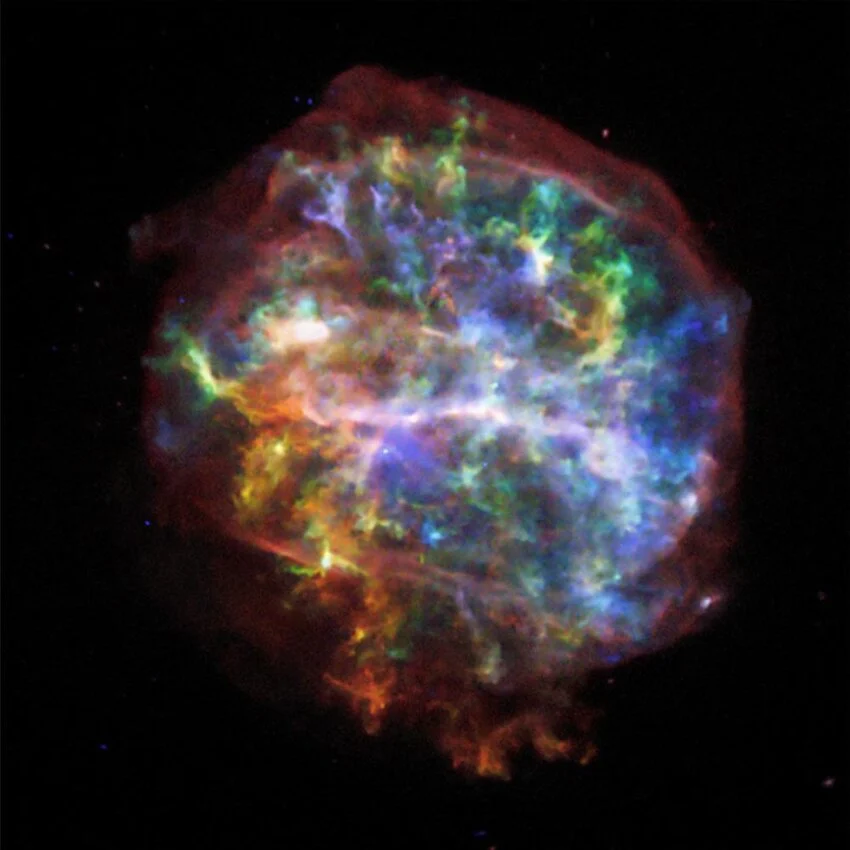
For more on the object type pulsars belong to, our breakdown of what a supernova actually is covers the explosive process responsible for creating neutron stars in the first place.
A Discovery That Started With Patience
More than fifty years later, pulsars remain one of the best reminders in astronomy that some of the biggest discoveries start with someone patiently noticing something that doesn’t quite fit the pattern. What began as a strange little “bit of scruff” on a stack of paper printouts turned into an entirely new class of object, one that today helps scientists hunt for gravitational waves, test Einstein’s theory of relativity under extreme conditions, and potentially even guide spacecraft across the galaxy someday.
For more on the history of this discovery and how pulsars are used in modern astrophysics, check out the detailed account from Smithsonian Magazine and the biography from Sky & Telescope.
If you enjoyed this article, don’t forget to drop us a comment, it really helps support the site, and be sure to check out our other articles because we think you’re going to love them too.