
For a few brief weeks, a supernova can outshine an entire galaxy containing hundreds of billions of stars. Its one of the most violent, energetic events the universe produces, and its also, strangely enough, one of the most important. Without supernovae, the elements that make up your own body, along with just about every planet and living thing in existence, likely wouldn’t exist at all. So what is a supernova, exactly, and how does a single dying star manage to briefly outshine everything around it?
The Basic Idea
A supernova is the explosive death of a star, an event so powerful that it can release more energy in a matter of seconds than our Sun will produce over its entire multi billion year lifetime. Not every star ends its life this way, our own Sun, for instance, is headed toward a much gentler ending. Supernovae are reserved for stars that meet specific conditions, either being significantly more massive than the Sun, or existing in a particular kind of close binary star system. Astronomers classify supernovae into two broad categories, and understanding the difference helps explain just how many different ways a star can meet a dramatic end.
Type II: When Massive Stars Run Out of Fuel
The more intuitive type is the core-collapse supernova, officially labeled Type II. This happens to stars that are considerably more massive than our Sun, generally at least eight times heavier, sometimes reaching up to 200 solar masses. These massive stars burn through their fuel at a dramatically faster rate than smaller stars like ours, often lasting only a few million years before running into serious trouble, compared to the billions of years smaller stars like the Sun get to enjoy.
As a massive star exhausts its hydrogen, it starts fusing progressively heavier elements in its core, helium, then carbon, then oxygen, working its way up the periodic table. This process can continue all the way up to iron, but thats where the chain stops for good. Fusing iron actually consumes energy instead of releasing it, so once a massive star’s core turns to iron, fusion can no longer support the star against its own crushing gravity. The core collapses in on itself in a fraction of a second, triggering a colossal rebound explosion that blows the star’s outer layers violently outward into space, while the core itself compresses into either an ultra dense neutron star or, for the most massive stars, collapses even further into a black hole.
Type Ia: The Explosive Binary Star System
The second major category, Type Ia supernovae, works completely differently, and involves an entirely different kind of star altogether, a white dwarf. White dwarfs are the compact, burned out remnants left behind after Sun-like stars finish their normal life cycle. On their own, white dwarfs are stable and relatively quiet. But in a close binary system, where a white dwarf orbits tightly alongside a companion star, things can get considerably more dramatic.
Over time, the white dwarf’s gravity gradually pulls material away from its companion star, slowly adding mass to itself in a process called accretion. Theres a hard limit to how much mass a white dwarf can support before it becomes unstable, known as the Chandrasekhar limit, sitting at about 1.4 times the mass of our Sun. Once the white dwarf crosses that threshold, it triggers a runaway thermonuclear reaction that completely disintegrates the star in a single, catastrophic explosion, leaving nothing behind at all, unlike Type II supernovae, which leave a neutron star or black hole in their wake.
If you’re curious about the quieter alternative white dwarfs experience without a nearby companion to feed on, our piece on how the Sun will eventually die covers exactly what happens to a solitary white dwarf like the one our own Sun will eventually become.
Why Astronomers Love Type Ia Supernovae Specifically
Type Ia supernovae hold a special place in astronomy for a reason that goes well beyond just their explosive nature. Because they always detonate at almost exactly the same mass, the 1.4 solar mass Chandrasekhar limit, they tend to release remarkably consistent amounts of energy and reach very similar peak brightness every single time. That consistency makes them incredibly useful as whats called a “standard candle,” astronomers can measure how bright a Type Ia supernova appears from Earth, compare that to its known actual brightness, and calculate precisely how far away it is.
This technique has been absolutely essential for measuring vast cosmic distances and, famously, helped astronomers discover in the late 1990s that the universe’s expansion is actually accelerating, a finding that led directly to the concept of dark energy and earned its discoverers a Nobel Prize.
The Aftermath: Nebulae and Neutron Stars
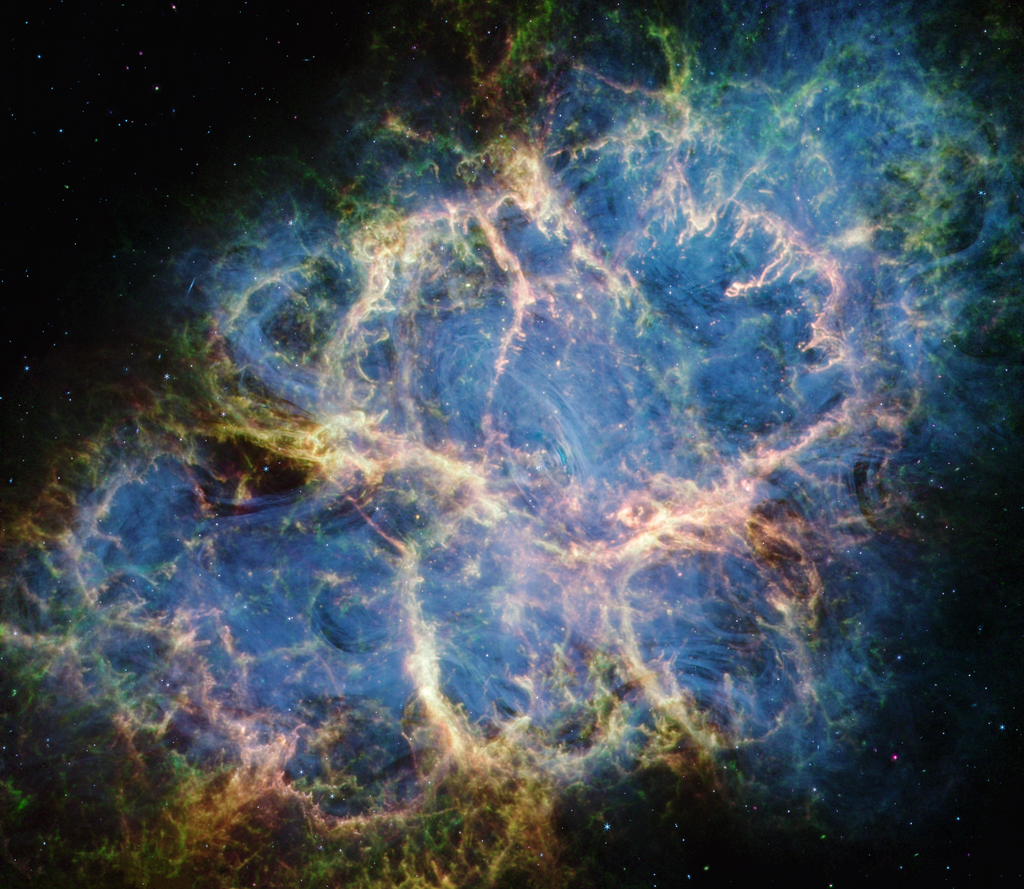
Whatever remains after a supernova explosion doesn’t just disappear, it becomes some of the most studied and photographed objects in the night sky. The expanding shell of debris and gas left behind is known as a supernova remnant, and it can remain visible, glowing and expanding, for thousands of years afterward. The Crab Nebula is easily the most famous example, the still expanding wreckage of a supernova that Chinese astronomers actually documented observing back in the year 1054, visible even in broad daylight at the time.
At the center of many Type II supernova remnants sits an incredibly dense neutron star, an object so compact that a single teaspoon of its material would weigh billions of tons. Some neutron stars spin rapidly and emit powerful beams of radiation, earning the nickname pulsars, detectable as remarkably precise, rhythmic pulses of radio waves as that beam sweeps past Earth like a cosmic lighthouse. For the most massive collapsing stars, the core doesn’t stop at a neutron star at all, it keeps collapsing further, forming a black hole instead.
If you want to explore what some of the closest known black holes to Earth actually look like today, our detailed rundown of the nearest black holes to Earth covers several objects that likely began their existence exactly this way, as the collapsed remnant of a massive star’s supernova.
How Often Do Supernovae Actually Happen?
Within our own Milky Way galaxy, astronomers estimate a supernova occurs roughly once every 50 years on average, though dust and gas throughout the galaxy often block our view of many of these events from Earth. The last confirmed supernova visible to the naked eye from Earth within our own galaxy was recorded back in 1604, observed by astronomer Johannes Kepler, though astronomers have detected the remnants of several more recent explosions using X-ray and radio telescopes since then. Supernovae in other, more distant galaxies are spotted far more regularly, with dedicated survey telescopes now discovering hundreds of them across the observable universe every single year.
Why Supernovae Matter to Literally Everything
Perhaps the most remarkable thing about supernovae isn’t the explosion itself, its what that explosion leaves scattered across the universe afterward. Stars are responsible for fusing lighter elements into heavier ones throughout their lives, but many of the heaviest elements in the universe, including gold, silver, and uranium, can only be forged during the extreme conditions of a supernova explosion itself, or in the neutron star collisions that sometimes follow. Every one of those elements then gets blasted outward into space, eventually becoming part of the raw material for new stars, new planets, and, ultimately, new life.
Its a genuinely humbling thought, but its scientifically accurate, the iron in your blood, the calcium in your bones, likely trace their origin back to a star that exploded as a supernova long before our own solar system even existed. Supernovae aren’t just spectacular explosions, they’re the universe’s way of building the ingredients needed for everything that comes after.
For more detailed classifications and imagery of famous supernova remnants, check out the full breakdown from Astronomy.com and the additional overview from Space.com.
If you enjoyed this article, don’t forget to drop us a comment, it really helps support the site, and be sure to check out our other articles because we think you’re going to love them too.