
Some of the most breathtaking photos in all of astronomy, the ones that end up as phone wallpapers and framed prints and desktop backgrounds, are nebulae. Glowing pillars of colorful gas, swirling clouds lit up in deep reds and blues, star forming regions that look almost painted rather than photographed. But what is a nebula actually made of, and why does the same word get used to describe both the birthplace of new stars and the wreckage left behind after one dies?
The Basic Definition
At its core, a nebula is simply a giant cloud of gas and dust floating out in interstellar space, made up mostly of hydrogen and helium, mixed with smaller amounts of heavier elements like carbon, oxygen, and iron. That’s really it at the most basic level, just an enormous, diffuse cloud, often stretching across dozens or even hundreds of light-years. What makes nebulae so endlessly fascinating to astronomers and casual stargazers alike is what’s actually happening inside them, because depending on the type, a nebula can represent either the very beginning or the very end of a star’s life.
Emission Nebulae: Stellar Nurseries in Action
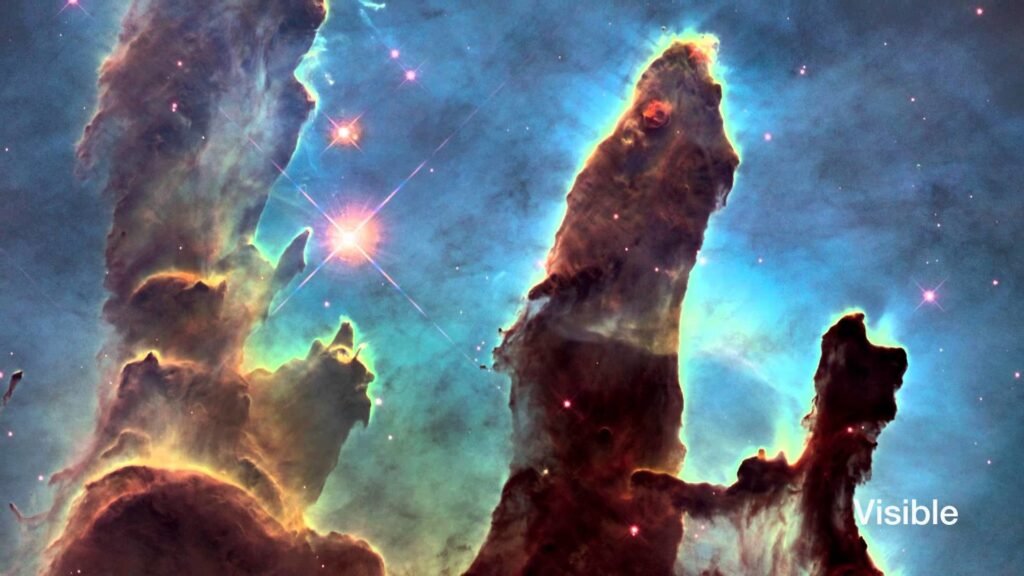
Emission nebulae, sometimes called H II regions by astronomers, are clouds of gas that glow because they’re actively producing their own light, energized by intense ultraviolet radiation pouring off nearby young, hot stars. As that radiation strips electrons away from hydrogen atoms in the cloud, the gas becomes ionized, and as those electrons eventually recombine, they release a distinctive reddish glow, similar in basic principle to how a neon sign works.
The most famous emission nebula by far is the Orion Nebula, visible even to the naked eye as a fuzzy patch in Orion’s sword, and one of the closest and most actively studied stellar nurseries in the entire sky. Emission nebulae like Orion are essentially stellar delivery rooms, dense pockets within the cloud collapse under their own gravity, gradually heating up until nuclear fusion ignites and a brand new star is born.
Reflection Nebulae: Borrowed Light
Reflection nebulae work on a completely different principle. Unlike emission nebulae, they don’t generate their own glow at all, they simply reflect the light of nearby bright stars, the same basic way a cloud on Earth lights up when sunlight bounces off it. Because blue light scatters more efficiently than other colors, a phenomenon called Rayleigh scattering, the same effect responsible for Earth’s blue sky, reflection nebulae typically appear as soft, ghostly blue clouds when photographed. The Witch Head Nebula is a well known example, an eerie, wispy blue cloud lit up by the nearby star Rigel.
Reflection and emission nebulae often show up together in the same region of space, since both tend to form near young, hot stars, and astronomers frequently group them under the broader label of “diffuse nebulae.”
Dark Nebulae: Clouds You See By What They Block
Not every nebula glows at all. Dark nebulae, sometimes called absorption nebulae, are dense clouds of gas and dust thick enough to completely block the light of whatever lies behind them. Rather than shining, these nebulae reveal themselves as strange, inky silhouettes cut against a brighter background of stars or glowing gas. The most iconic example is the Horsehead Nebula in Orion, a dark, horse shaped silhouette set dramatically against a much brighter emission nebula glowing behind it.
Dark nebulae play an important role in star formation too, since these dense pockets of gas and dust are often exactly where new stars eventually begin to form, hidden from view until enough radiation eventually breaks through to light up the surrounding cloud from the inside.
Planetary Nebulae: A Star’s Farewell
Despite the name, planetary nebulae have absolutely nothing to do with planets, early astronomers just thought their round, glowing shapes resembled planets when viewed through primitive telescopes, and the misleading name simply stuck around. These nebulae form during the final chapter of a Sun-like star’s life, once a star exhausts the hydrogen fuel in its core and swells into a red giant, it eventually sheds its outer layers into space, exposing a hot, compact white dwarf at its center. Radiation from that exposed core then lights up the expanding shell of gas, creating the glowing, often symmetrical shapes that give planetary nebulae their name.
These nebulae are also remarkably short lived by cosmic standards, typically lasting only about 10,000 years before fading away entirely, which is part of why there are only a few thousand known examples despite the Milky Way containing hundreds of billions of stars. If you want a closer, more detailed look at exactly what one of these looks like up close, our deep dive into the Dumbbell Nebula covers one of the very first planetary nebulae ever discovered, and one of the easiest to spot from your own backyard.
Supernova Remnants: The Explosive Alternative
Not every star fades away as gently as a planetary nebula. Stars much more massive than our Sun meet a far more violent end, exploding as supernovae, and the wreckage left behind forms whats known as a supernova remnant. Unlike planetary nebulae, which form from a relatively gentle stellar wind gradually shedding outer layers, supernova remnants are created almost instantly by a shockwave from a catastrophic explosion, heating surrounding gas to temperatures well above a million degrees.
The most famous example is the Crab Nebula, the still expanding wreckage of a supernova that Chinese astronomers actually recorded observing back in the year 1054. At the center of many supernova remnants sits an incredibly dense neutron star, or occasionally a black hole, the collapsed remains of the star’s core, left behind after everything else was blasted outward into space.
Why Nebulae Matter Beyond Just Looking Beautiful
Beyond their obvious visual appeal, nebulae play a genuinely essential role in the ongoing life cycle of the entire universe. Every heavier element, carbon, oxygen, nitrogen, iron, the same elements that eventually make up planets and, ultimately, living things, gets created inside stars and then released back out into space through exactly these kinds of nebulae, either gently through a planetary nebula or violently through a supernova remnant. That recycled material eventually gets pulled together again by gravity, forming the next generation of stars and planets.
In a very real sense, nebulae are the universe’s way of recycling itself, and every atom of carbon in your own body was almost certainly forged inside a star and scattered across space by a nebula at some point in the deep past.
If you’re interested in what our own Sun’s eventual nebula phase will look like billions of years from now, our detailed breakdown of how the Sun will eventually die walks through that exact red giant to planetary nebula transformation step by step.
Spotting Nebulae for Yourself
Several nebulae are genuinely accessible to backyard stargazers, no professional observatory required. The Orion Nebula is bright enough to spot with just binoculars under reasonably dark skies, appearing as a soft, fuzzy smudge in Orion’s sword during winter months. The Ring Nebula and Dumbbell Nebula, both planetary nebulae, are similarly reachable with a modest amateur telescope during summer evenings.
If you’re just getting started with locating deep sky objects like these, our guide on what you can see in the night sky without a telescope tonight is a solid place to build up some confidence before working your way toward fainter targets like these glowing clouds of gas and dust.
Clouds That Tell the Whole Story of a Star
From the glowing stellar nurseries of emission nebulae to the quiet, expanding remnants left behind by a star’s final breath, nebulae essentially bookend the entire life story of a star, birth on one end, death on the other, with billions of years of stable fusion happening in between. Next time you come across a stunning nebula photo online or through a telescope eyepiece, its worth remembering exactly what you’re looking at, either the very beginning of something new, or the last visible trace of something that came before it.
For more detailed imagery and classifications of different nebula types, check out the full breakdown from AstroBackyard and the observing guide from Go Astronomy.
If you enjoyed this article, don’t forget to drop us a comment, it really helps support the site, and be sure to check out our other articles because we think you’re going to love them too.