
Almost everyone has spotted the Big Dipper at some point, even people who swear they know nothing about the night sky. It’s that seven-star shape that looks like a ladle or a saucepan, hanging up there so plainly that you don’t need a telescope, an app, or any training to pick it out. You just look north on a clear night and there it is.
What most people don’t realize is that this familiar little pattern is one of the most useful things in the entire sky. Learn to read it and you can find true north without a compass, track down the North Star, and even hop your way to a handful of other constellations. For thousands of years people have leaned on the Big Dipper to navigate, tell time, and find their way home. Let’s get to know it properly.
Wait, Is the Big Dipper Even a Constellation?
Here’s a fact that surprises a lot of people. The Big Dipper is not actually a constellation. It’s what astronomers call an asterism, which just means a recognizable pattern of stars that sits inside a larger, official constellation.
The constellation it belongs to is Ursa Major, the Great Bear, which happens to be the third-largest of all 88 constellations. The Dipper only makes up part of it. Those seven bright stars trace the Bear’s back and its long tail, while the fainter stars filling out the legs and head are much harder to see unless your sky is properly dark. So when you find the Big Dipper, you’ve really found the brightest, most obvious chunk of the Great Bear.
The seven stars each have their own names, carried down mostly from medieval Arabic astronomy: Dubhe, Merak, Phecda, Megrez, Alioth, Mizar, and Alkaid. Four of them form the bowl and three form the curving handle. They sit at wildly different distances from us, roughly 80 to 125 light-years away, so they only look like a group by chance from our particular spot in the galaxy.
How to Use the Big Dipper to Find Polaris, the North Star
This is the trick worth memorizing, and it’s genuinely easy.
Look at the two stars that form the outer edge of the Dipper’s bowl, the side farthest from the handle. Those two are Dubhe and Merak, and they’re known as the pointer stars. Draw an imaginary line starting at Merak, running up through Dubhe, and keep extending it out into the sky. Stretch that line to about five times the gap between the two pointers and you’ll land almost exactly on a moderately bright star sitting more or less by itself. That star is Polaris, the North Star.
Polaris isn’t dazzling. People often expect the North Star to be the brightest thing up there, but it’s fairly ordinary in brightness. What makes it special is its position. Polaris sits almost perfectly above Earth’s north pole, along the line our planet spins around. Because of that, it barely moves all night while everything else appears to wheel slowly around it. Face Polaris and you are facing true north, which is why sailors, travelers, and lost hikers have trusted it for centuries. You can dig into the details of that in our companion guide to the closest star systems to Earth, and if you want to see exactly which stars are up tonight, our roundup of what you can see without a telescope is a friendly starting point.
Finding the Little Dipper Too
Once you’ve got Polaris, you’ve basically found a second star pattern for free. Polaris marks the very tip of the handle of the Little Dipper, the smaller and dimmer cousin of the Big one. The Little Dipper is the bright part of Ursa Minor, the Little Bear.
Fair warning though, the Little Dipper is much fainter and trickier to trace, especially from a city where light pollution swallows its weaker stars. On a dark night away from streetlights, the full ladle shape reveals itself curving away from Polaris. From a bright suburb you might only catch Polaris and the two brightest bowl stars, Kochab and Pherkad, sometimes nicknamed the Guardians of the Pole.
A Hidden Double Star in the Handle
Here’s a fun test for your eyesight the next time you’re out. Look at the middle star of the Big Dipper’s handle, called Mizar. If your vision is sharp and the sky is dark, you’ll notice a faint second star sitting right beside it. That companion is named Alcor, and the pair has been used as an informal eye test for thousands of years.
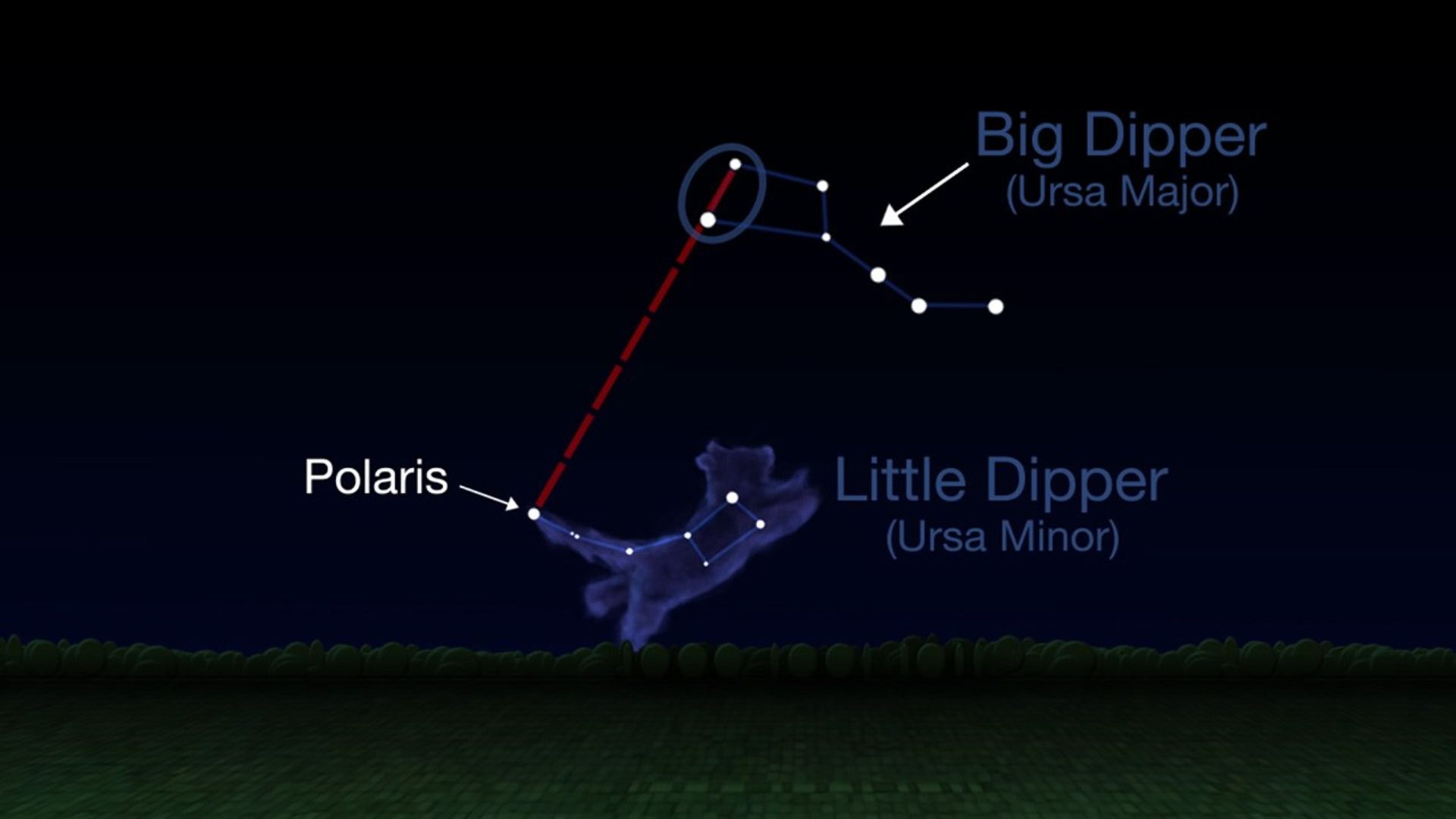 Follow the two pointer stars on the outer edge of the Big Dipper’s bowl and they lead you straight to Polaris. (Illustration: NASA/JPL-Caltech)
The really neat part is what telescopes revealed later. Mizar itself is a system of several stars orbiting one another, and Alcor turned out to have a companion too. So what looks like one modest point of light in the handle is actually a whole cluster of suns tangled together. Not bad for a star you can pick out with the naked eye.
Why the Big Dipper Never Seems to Set
If you watch the Dipper across a full year, you’ll notice it never disappears below the horizon, at least from most of the Northern Hemisphere. Instead it slowly rotates around Polaris, swinging high overhead in spring evenings and sinking low toward the horizon in autumn. Astronomers call stars that behave this way circumpolar, meaning they circle the pole and stay up all night, every night.
That constant visibility is a big part of why so many cultures built stories and tools around it. The pattern has collected countless names over the centuries. In Britain and Ireland it’s the Plough. Some call it the Saucepan. In the American South it became known as the Drinking Gourd, and people escaping slavery followed it northward to freedom, using those same pointer stars to keep Polaris ahead of them.
One last thing worth knowing. The Dipper won’t keep this exact shape forever. The stars are all drifting through space at their own speeds, and over tens of thousands of years the familiar ladle will slowly stretch and warp into something unrecognizable. And Polaris won’t always be our North Star either. Earth wobbles like a spinning top over a cycle of about 26,000 years, so the pole gradually drifts toward different stars. The sky you’re looking at is a snapshot of this particular moment in a very long, slow dance.
For more on locating Polaris and the science behind it, NASA has a great plain-language explainer on what the North Star is and how to find it.
If you enjoyed this article, don’t forget to drop us a comment, it really helps support the site, and be sure to check out our other articles because we think you’re going to love them too.