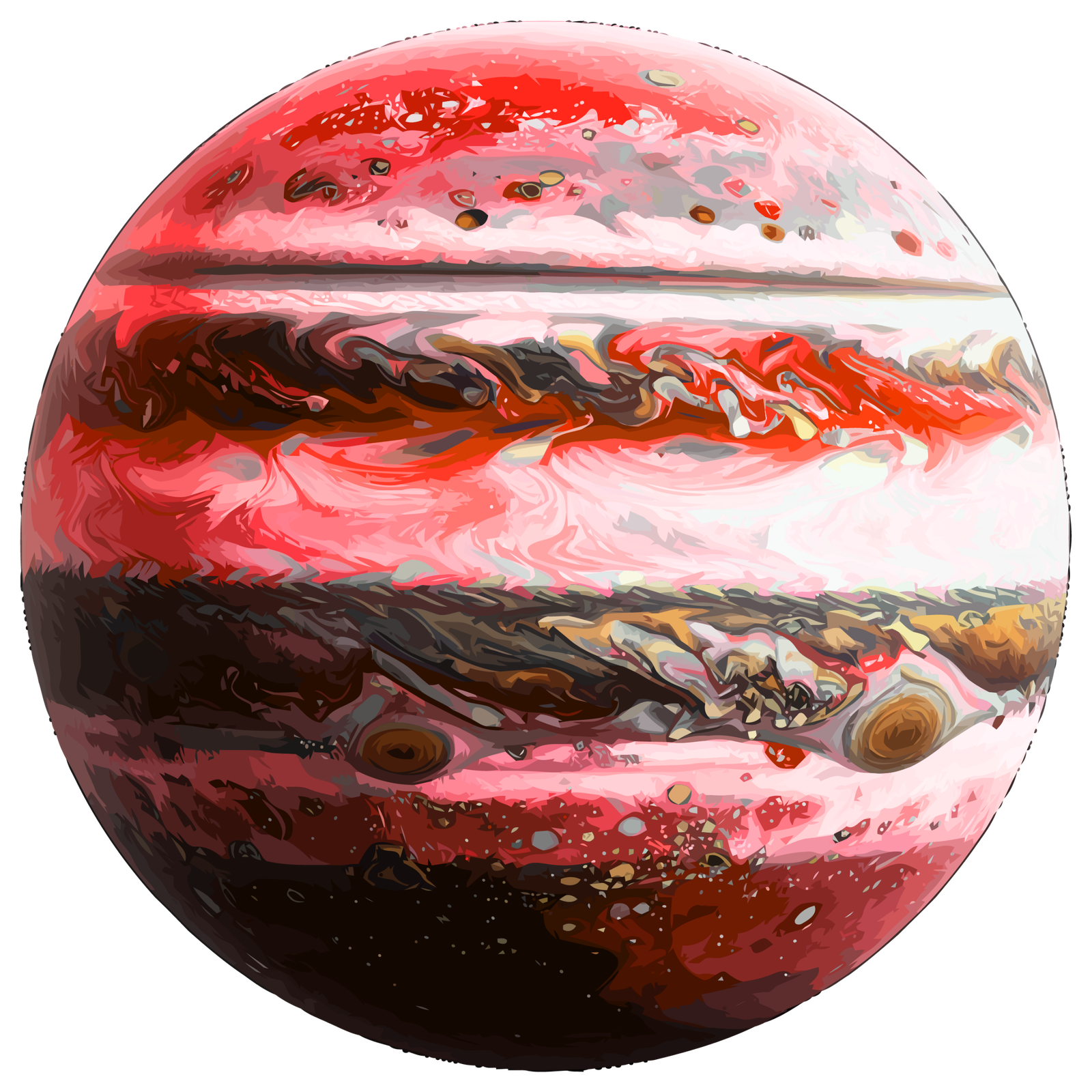

Stir cream into coffee and watch the edges curl into tiny spirals. Wind blowing across a lake does the same thing to the water’s surface. Jupiter’s banded clouds owe their shape to it too. Now, using the most powerful solar telescope ever built, scientists have caught that exact same swirling pattern happening constantly across the surface of the Sun, and it may finally help explain a mystery that’s puzzled solar physicists for the better part of a century.
A Detail 20 Kilometers Wide, From 93 Million Miles Away
The effect is called Kelvin-Helmholtz instability, first described by physicists Lord Kelvin and Hermann von Helmholtz around 1870. It shows up wherever two fluids slide past each other at different speeds, the resulting friction, or shear, curls the boundary between them into small, wave-like vortices. Solar physicists had long suspected this same instability should occur on the Sun, at the edges of its magnetic structures, but actually seeing it required resolving detail on a scale of about 20 kilometers, a level of precision that sat right at the limit of even the world’s best instruments.
The NSF’s Daniel K. Inouye Solar Telescope, built on Maui’s Haleakalā with a four-meter mirror, finally cleared that bar. A team led by David Kuridze of the National Solar Observatory, working with researchers from the High Altitude Observatory and Germany’s Max Planck Institute for Solar System Research, captured the highest-resolution images of the Sun’s surface ever taken, image detail equivalent to spotting a single one-euro coin from 180 kilometers away.
Confirmed by Comparing Reality Against a Simulation
Published August 5 in Nature, the study didn’t rely on the telescope images alone. The team compared their observations directly against independent computer simulations built from pure physics equations, and the two matched with striking precision, down to the average 50 to 65 kilometer spacing between individual vortices in both the real data and the simulated version. The remarkable agreement between the two allowed the team to confirm the origin of the Kelvin-Helmholtz instability with confidence, effectively removing any doubt about what they were actually looking at.
Dr. David Boboltz, deputy director of the National Solar Observatory, called it “a major step forward in our understanding of the dynamics and evolution of solar and stellar plasma.” The vortices, it turns out, aren’t rare or occasional. They appear constantly, everywhere the Sun’s magnetic field is strong enough to create the right conditions.
A Missing Piece in a Century-Old Puzzle
Here’s why this matters beyond a striking picture. Solar physicists have long known the Sun’s outer atmosphere, the corona, runs roughly a million degrees hotter than the visible surface directly beneath it, a genuinely counterintuitive puzzle that’s remained unresolved for decades. One leading theory, called flux braiding, holds that magnetic field lines get twisted around each other like braided hair, building up tension that eventually snaps and releases energy as heat and flares. What nobody could fully explain was what actually caused that twisting in the first place.
“Kelvin-Helmholtz instability is likely a mechanism that contributes to the heating of the outer atmosphere and is part of the solution of the longstanding enigma of why stars have a million degrees Kelvin hot corona,” said Thomas Rimmele, the observatory’s chief technologist. If you’re curious about the star doing all this twisting and braiding in the first place, our profile of what sort of star the Sun actually is covers the basics of the churning, magnetically restless object these vortices call home.
Solving a Second Mystery Along the Way
The discovery may resolve a separate puzzle too. The Sun’s magnetic cycle flips roughly every 11 years, a remarkably fast pace that requires old magnetic flux to dissipate efficiently, something existing models have struggled to fully account for. Kuridze suggested these newly confirmed vortices might be exactly the missing mechanism, efficiently mixing magnetized and non-magnetized plasma and helping magnetic fields spread outward far faster than previously understood.
Researchers are now building automated tools to catalog these swirls across the Inouye telescope’s ever-growing archive of high-resolution data, hoping to measure precisely how much energy they actually carry into the corona. As NSF program director Jacqueline Keane put it, decades of solar physicists knew this kind of small-scale process had to be driving the Sun’s behavior somewhere, they simply lacked an instrument sharp enough to actually see it.
For more on the discovery, check out the full press release from the National Solar Observatory and the published study in Nature.