
You’ve probably done it without even thinking. You glance up on your way inside, notice one point of light that’s blazing far brighter than everything else, and wonder for a second whether it’s a star, a plane, or something else entirely. More often than not, that brilliant “star” is actually a planet. Our solar system’s neighbors are surprisingly easy to spot once you know a few simple tricks, and the best part is you don’t need a telescope, an app, or any experience at all. Just your eyes and a clear patch of sky.
The Easiest Trick: Planets Don’t Twinkle
If you learn only one thing from this guide, make it this. Stars twinkle. Planets don’t.
That famous flickering of the stars happens because a star is so unimaginably far away that it arrives as a single, razor-thin point of light. As that pinpoint passes through our turbulent atmosphere, it gets bounced around and appears to shimmer and flash. Planets are far closer, so they show up as tiny disks rather than points. That little bit of extra size smooths out the twinkling, so a planet shines with a steady, calm, almost confident glow. Next time you’re unsure whether you’re looking at a star or a planet, watch it for a few seconds. If it holds rock steady, you’ve very likely found a planet.
The Five Planets You Can Actually See
There are five planets bright enough to spot without any equipment: Venus, Jupiter, Mars, Saturn, and Mercury. Each one has its own personality in the sky, and learning their signatures makes identifying them almost effortless.
Venus is the showstopper. It’s the brightest planet by far, so bright it can look like a landing light, and it only ever appears low in the west after sunset or low in the east before sunrise. That’s why it’s nicknamed the Evening Star and the Morning Star. If you see a dazzling white “star” hanging in the twilight, it’s almost certainly Venus.
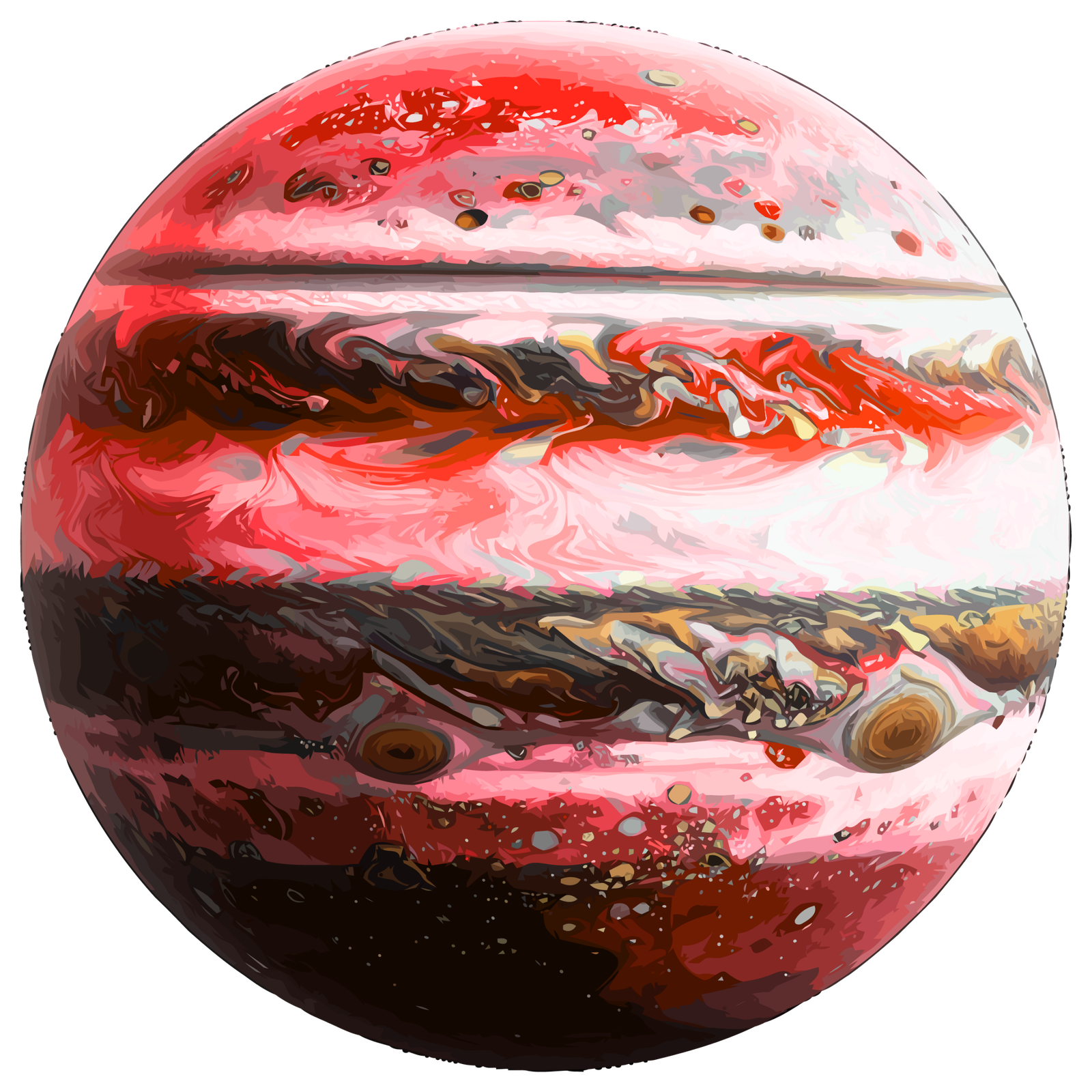
Jupiter is the next brightest and a completely different customer. Unlike Venus, it can ride high in the sky and stay up for much of the night, glowing a steady creamy white. Mars is subtler and gives itself away by color, with a distinct rusty, orange-red tint that earns it the name the Red Planet. Saturn is the faintest of the bright five, shining with a calm, slightly golden light, easy to overlook next to its flashier siblings. And then there’s Mercury, the tricky one. It hugs the horizon so tightly in the glow of dawn or dusk that it only pops into view for a week or two at a time, so catching it feels like a genuine little victory. To get to know each of these worlds in more depth, our beginner’s guide to the planets is the perfect next read.
Where to Look: Follow the Invisible Line
Here’s a wonderful shortcut. The planets never wander all over the sky at random. They’re always strung along a single gently curving line called the ecliptic, the very same path the Sun travels during the day and the Moon follows at night.
So if you want to find the planets, trace that line in your mind. Note roughly where the Sun set, or where the Moon is hanging, and follow that arc across the sky. Any bright, steady, non-twinkling points sitting along it are your candidates. This works because every planet orbits the Sun on nearly the same flat plane, so from our seat here on Earth, they all line up along that same track. Our complete guide to observing the night sky goes deeper into reading the sky like this.
Timing Matters: Not Every Planet Is Up Every Night
One thing to keep in mind is that the visible planets change from month to month as they and Earth move along their orbits. Some nights you might catch three or four at once, and other stretches you may only see one. Venus and Mercury, being closer to the Sun than we are, only ever appear in the twilight around sunrise or sunset. The outer planets, Mars, Jupiter, and Saturn, can climb higher and stay up well into the night.
There’s also one more thing to rule out. If your bright “planet” is slowly gliding across the sky, it isn’t a planet at all, it’s likely a satellite or the International Space Station cruising overhead. Real planets appear to hold still over the course of an evening, drifting only very slowly against the background stars from night to night.
The Fastest Way to Check Tonight’s Lineup
While the tricks above will serve you for life, sometimes you just want to know exactly what’s up right now. The simplest solution is a free stargazing app. Point your phone at the sky and it will label every planet, star, and constellation in real time, which is a brilliant way to confirm your naked-eye guesses and learn the sky faster.
For a trustworthy, hype-free heads-up on what’s visible each month, NASA’s skywatching hub publishes a friendly monthly guide to the planets and other sights. Pair that with the twinkle test and the ecliptic trick, and you’ll never look up at a bright light again without knowing exactly what you’re seeing. For even more easy targets to enjoy without gear, don’t miss our guide to what you can see in the night sky without a telescope.
So tonight, when the sky darkens, step outside and put it to the test. Find the brightest light, watch whether it twinkles, trace the ecliptic, and see how many of our planetary neighbors you can name. It’s one of the simplest, most quietly thrilling things you can do with a clear night.
If you enjoyed this article, don’t forget to drop us a comment, it really helps support the site, and be sure to check out our other articles because we think you’re going to love them too.