
A galaxy is an enormous collection of stars, gas, dust, and dark matter, all bound together by gravity into a single system. Our own galaxy, the Milky Way, holds somewhere between 100 and 400 billion stars, and it’s just one of trillions scattered across the universe. When you picture a galaxy, picture an island: a vast, glowing island of stars floating in the dark, separated from the next one by almost unimaginable gulfs of empty space.
That’s the short answer. But galaxies come in wildly different shapes and sizes, they hide monsters at their centers, and understanding them is really the first step to understanding the whole universe. Let’s take the tour.
The Simple Definition
Strip everything down and a galaxy is defined by one thing: gravity holding an enormous amount of matter together in one system. That matter includes the stars we can see, along with vast clouds of gas and dust between them, and a huge amount of invisible dark matter whose gravity quietly holds the whole thing in place.
The scale varies enormously. Small dwarf galaxies might contain as few as 100 million stars, which sounds like a lot until you learn that giant galaxies can hold more than a trillion. Our Milky Way, with its few hundred billion stars, sits comfortably in the middle. The word “galaxy” itself comes from the Greek for “milky,” a nod to the pale band of the Milky Way arching across a dark night sky.
A Galaxy Is Not a Solar System
This is the mix-up worth clearing up first, because people use the two words interchangeably all the time, and they shouldn’t.
A solar system is a single star with the planets, moons, and debris orbiting it. Our solar system has exactly one star, the Sun. A galaxy is on a completely different level. It contains hundreds of billions of stars, and a great many of those stars have their own planets, which means a single galaxy holds billions of solar systems inside it. Our guide to how many solar systems are in the Milky Way drives home just how staggering that number really is. So the Sun and its planets are one small household. The galaxy is the entire city, and then some.
The Three Main Types
Astronomers sort galaxies into three broad shapes, a system that traces back to Edwin Hubble.
Spiral galaxies are the ones most people picture: a bright central bulge with graceful arms winding outward like a pinwheel, threaded with bright young stars and dark dust lanes. The Milky Way is a spiral, and so is our big neighbor Andromeda. Elliptical galaxies are smooth, featureless blobs ranging from nearly round to stretched-out ovals. They tend to be the biggest and most common galaxies in the universe, packed mostly with older stars and little of the gas needed to make new ones. Irregular galaxies are the oddballs with no clear shape at all, often small and chaotic, and they were far more common in the early universe before collisions and mergers smoothed many of them into spirals and ellipticals.
What’s Hiding at the Center
Here’s the part that never fails to unsettle people. Nearly every large galaxy has a supermassive black hole lurking at its heart, weighing millions or even billions of times as much as our Sun.
The Milky Way is no exception. At the very center of our galaxy sits a black hole called Sagittarius A*, tipping the scales at around four million solar masses. It doesn’t roam around eating stars like a cosmic villain, though. It mostly sits quietly, anchoring the galaxy’s core while everything, including our Sun, slowly orbits around it. Our profile of Sagittarius A*, the monster at the center of our galaxy takes a closer look at this strange resident.
Our Galaxy, and the Countless Others
The Milky Way is home, but it has plenty of company. It belongs to a small cluster of galaxies called the Local Group, whose largest member is the Andromeda galaxy, a grand spiral about 2.5 million light-years away. Andromeda is actually drifting toward us, and in a few billion years the two galaxies will merge into one. These clusters, in turn, gather into even larger superclusters, forming a vast cosmic web of galaxies stretched across the universe.
And just how many galaxies are out there? The estimates are almost absurd. The observable universe is thought to contain somewhere between 100 billion and 2 trillion galaxies, each one its own island of hundreds of billions of stars. When you sit with that number, the sky starts to feel a lot bigger. Our piece on how vast the universe really is tries to do that scale justice, and NASA’s own overview of galaxies is a wonderful place to keep exploring.
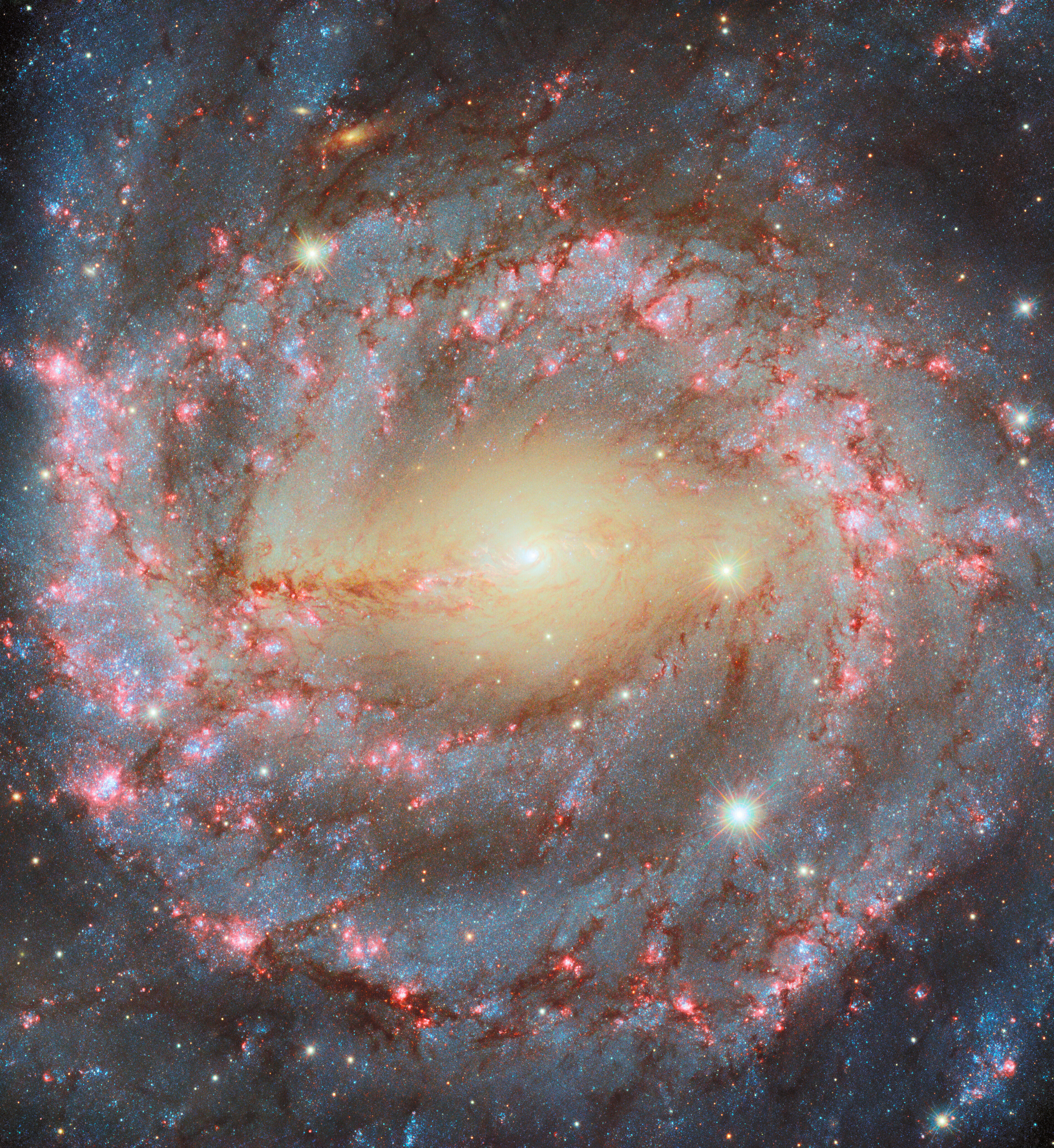 The spiral galaxy NGC 5643, about 40 million light-years away, is a textbook example of what many galaxies look like: a bright core, sweeping arms, and billions of stars bound by gravity. (Image: ESA/Hubble & NASA, A. Riess, D. Thilker, D. De Martin, M. Zamani)
So the next time you look up, remember you’re not just seeing stars. You’re looking out from inside one enormous island of them, one of trillions, each spinning slowly through the dark. That’s a galaxy.
If you enjoyed this article, don’t forget to drop us a comment, it really helps support the site, and be sure to check out our other articles because we think you’re going to love them too.