
Every time you look up at the band of the Milky Way stretching across the night sky, you’re looking, in a roundabout way, toward one of the strangest objects in the entire galaxy, a supermassive black hole sitting quietly at the very center of everything, holding our entire galaxy’s spiral arms in orbit around it. Its name is Sagittarius A*, and in 2022, humanity finally got to see what it actually looks like.
Hiding in Plain Sight for Decades
Astronomers had strong reason to suspect something massive and invisible was sitting at the Milky Way’s center for years before anyone actually confirmed it. Starting in the 1990s, two independent research teams began tracking a cluster of stars orbiting an apparently empty patch of sky near the constellation Sagittarius, and the way those stars moved gave the game away. One particular star, known as S2, was observed whipping around that empty point in space at incredible speed, on an orbit that only made sense if something with millions of times the mass of our Sun was tucked into that seemingly empty spot, tugging on it with tremendous gravity.
That painstaking work earned astronomers Andrea Ghez and Reinhard Genzel a share of the 2020 Nobel Prize in Physics, for effectively proving a supermassive black hole was sitting at our galaxy’s center years before anyone actually managed to photograph it.
Finally Getting a Picture
In May 2022, the Event Horizon Telescope collaboration, the same international team that produced the first ever image of a black hole back in 2019, revealed something even more personal, the first direct image of Sagittarius A* itself. Using a network of eight radio observatories scattered across the planet, linked together to effectively function as one telescope the size of Earth, the team captured a now familiar sight, a glowing, asymmetric ring of light surrounding a dark central shadow, the silhouette cast by the black hole against the superheated gas swirling around it.
Imaging Sgr A* actually turned out to be harder than photographing the much more distant M87* black hole the same team imaged three years earlier, despite Sgr A* being dramatically closer. The gas swirling around Sgr A* changes on timescales of minutes, faster than the light itself takes to complete a single orbit around the black hole, which meant the image kept blurring during the long exposures needed to capture it, a bit like trying to photograph a running toddler using a camera that needs several seconds to take one frame.
Just How Big Are We Talking?
Sgr A* carries a mass of about 4 million times that of our Sun, all packed into a region roughly the size of Mercury’s orbit. Its event horizon, the boundary beyond which nothing, not even light, can escape, has a radius of about 7 million miles. Despite that genuinely staggering mass, Sgr A* is actually considered a relatively modest supermassive black hole by galactic standards, some other galaxies host central black holes weighing billions of solar masses, dwarfing our own galaxy’s centerpiece by comparison.
Sgr A* sits roughly 26,000 light-years from Earth, deep in the direction of the constellation Sagittarius, tucked behind thick clouds of gas and dust that block it from being seen with ordinary optical telescopes. That distance and obstruction is exactly why it took radio and infrared observations, wavelengths that can punch through cosmic dust, to actually study it in any detail.
A Surprisingly Quiet Neighbor
Despite its enormous mass, Sgr A* is what astronomers call a dormant, or quiescent, black hole. Unlike the dramatically active supermassive black holes found at the centers of some other galaxies, which blaze brightly as they violently consume surrounding gas and dust, Sgr A* feeds on very little material most of the time, making it comparatively faint and hard to detect. It does occasionally flare up, though, sudden bursts of X-ray and infrared brightness thought to be driven by magnetic processes similar to solar flares, just tens of millions of times more powerful, that occur roughly once a day as small clumps of gas fall past the point of no return.
If you’re curious about smaller, closer black holes scattered throughout our own stellar neighborhood, our full rundown of the nearest black holes to Earth covers several stellar mass black holes considerably closer to home than Sgr A*, though none anywhere near as massive.
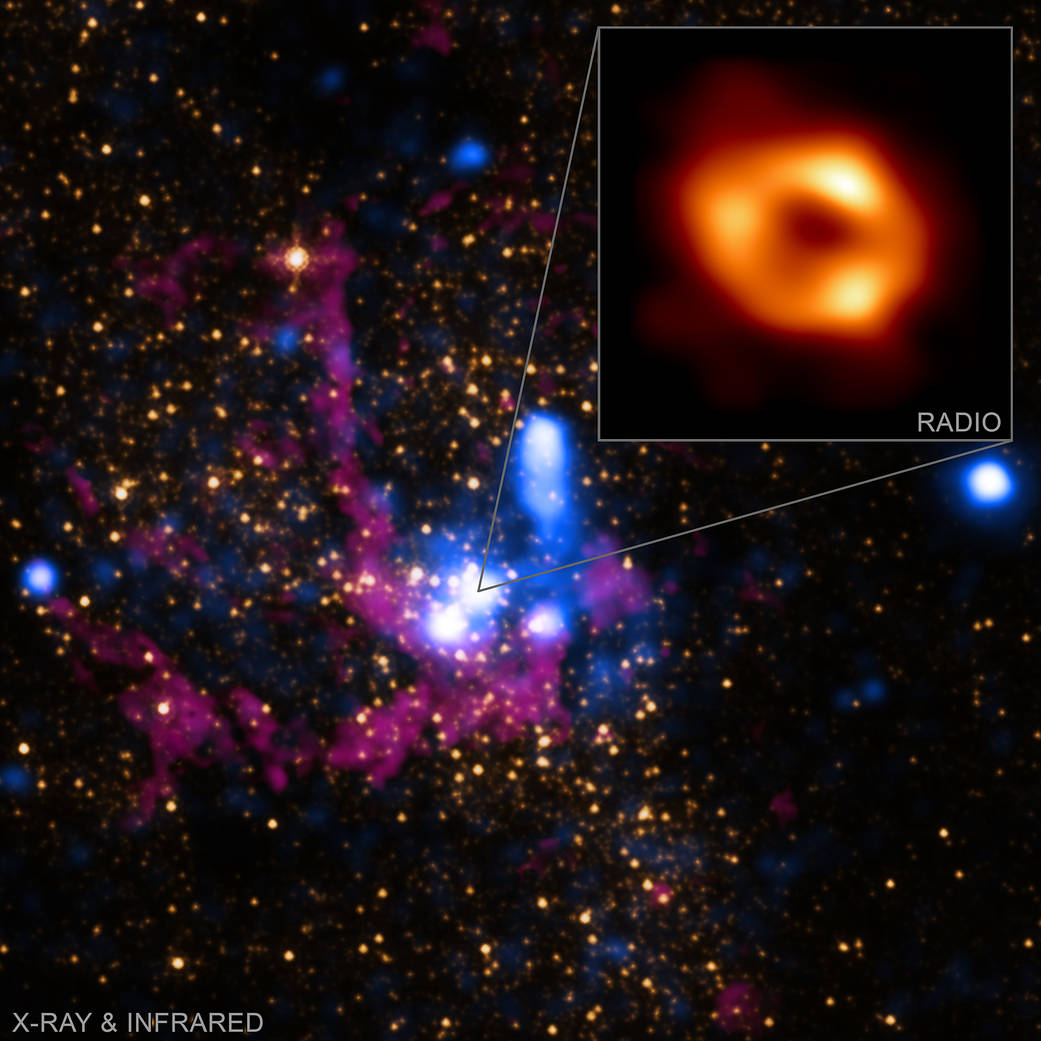 A composite view of the region surrounding Sagittarius A, combining X-ray data from NASA’s Chandra Observatory (blue), infrared data from Hubble (orange and purple), and, in the small inset, the actual Event Horizon Telescope image of the black hole itself. (Image: X-ray: NASA/CXC/SAO; IR: NASA/HST/STScI. Inset: Radio, EHT Collaboration)*
Why the Milky Way’s Black Hole Matters So Much
Studying Sgr A* gives astronomers something genuinely rare, a supermassive black hole close enough to actually observe in real detail, unlike the vast majority of similar objects sitting in far more distant galaxies. Nearly every large galaxy in the universe is now believed to host a supermassive black hole at its center, and understanding how ours behaves, how it feeds, how its magnetic fields behave, how strongly it interacts with the stars and gas around it, offers a genuinely close up window into a phenomenon that shapes galaxies throughout the entire universe.
It also connects directly to a question we opened earlier in a different piece, how many solar systems exist within the Milky Way. Every one of those hundreds of billions of stars, and any planets orbiting them, are all technically in orbit around this same distant, invisible anchor point, slowly circling the galactic center over the course of hundreds of millions of years, our own Sun included.
A Quiet Giant at the Heart of Everything
Sagittarius A* doesn’t dominate the sky the way a supernova or a comet might, its invisible to the naked eye, tucked behind clouds of dust, and relatively calm compared to some of the more violent black holes scattered throughout the universe. But its role is genuinely foundational, a silent, massive anchor that our entire galaxy, every star, every planet, every person who has ever looked up at the night sky, has been quietly orbiting the whole time.
For more detailed coverage of the imaging campaign and ongoing research, check out the official announcement from the Event Horizon Telescope Collaboration and the multiwavelength research summary from NASA.
If you enjoyed this article, don’t forget to drop us a comment, it really helps support the site, and be sure to check out our other articles because we think you’re going to love them too.