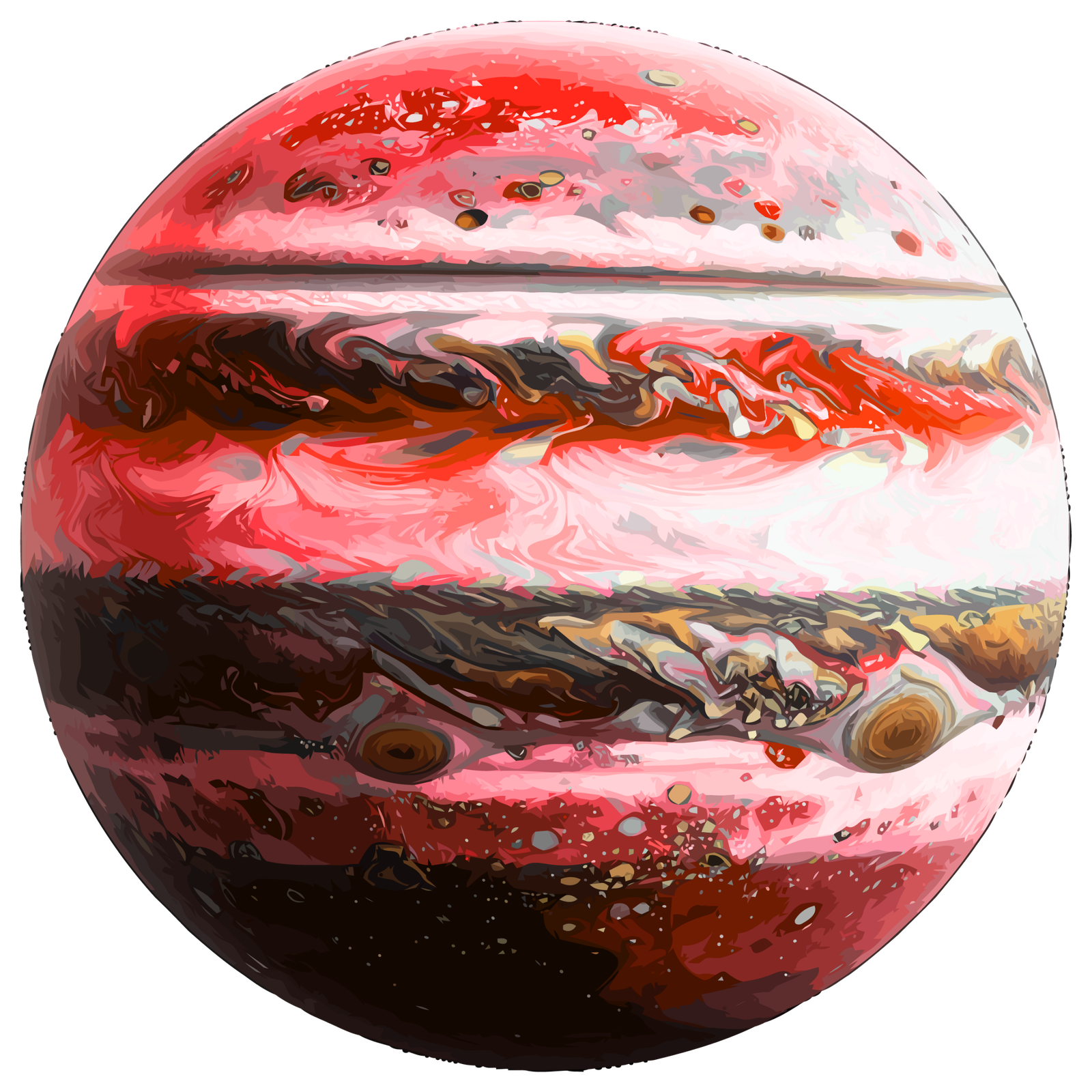

Here are the planets ranked by size, largest to smallest: Jupiter, Saturn, Uranus, Neptune, Earth, Venus, Mars, and Mercury. Jupiter is the undisputed giant and Mercury is the runt, and the gap between them is far bigger than most people ever picture.
What makes this ranking fun is that it’s completely different from the order you probably learned in school. That list runs by distance from the Sun. Line the planets up by sheer bulk instead and everything reshuffles, with the four outer giants crowding the top and the four rocky worlds huddled at the bottom.
The Full Ranking at a Glance
Astronomers usually compare planets using equatorial diameter, the width measured around the middle. Here is the whole lineup, using NASA’s figures, with each planet stacked against Earth so you can feel the scale.
| Rank | Planet | Equatorial diameter | Compared to Earth |
|---|---|---|---|
| 1 | Jupiter | 142,984 km | About 11× wider |
| 2 | Saturn | 120,536 km | About 9.5× wider |
| 3 | Uranus | 51,118 km | About 4× wider |
| 4 | Neptune | 49,528 km | About 3.9× wider |
| 5 | Earth | 12,756 km | The benchmark |
| 6 | Venus | 12,104 km | About 0.95× (near twin) |
| 7 | Mars | 6,792 km | About half |
| 8 | Mercury | 4,879 km | A little over a third |
The numbers come straight from NASA’s Planetary Fact Sheet, and NASA lays out the same size ranking in plain language on its planet sizes page.
Jupiter and Saturn: The Two That Dwarf Everything
The top of this list isn’t close.
Jupiter is so large that it’s more massive than every other planet in the solar system put together, with room to spare. You could line up more than 1,300 Earths and pour them inside Jupiter before it filled up. It runs the show at the top of any size ranking, and it isn’t going to be challenged. If you want the full tour of the king of planets, our guide to Jupiter’s size, distance, and orbit digs into what makes it such a monster.
Saturn comes second, about nine and a half times wider than Earth. What’s striking about Saturn is how little it weighs for its size. It’s so low in density that, if you could find a bathtub big enough, Saturn would float. Together, Jupiter and Saturn make up the bulk of all the planetary material orbiting the Sun, and everything below them on this list is, frankly, small change by comparison.
The Twist Between Uranus and Neptune
Here’s the detail that trips people up, and it’s a great one to know.
Uranus takes third place by width and Neptune fourth, but only just. They’re nearly the same size, separated by less than the width of Earth. Yet if you ranked them by weight instead of width, they’d swap. Neptune is the more massive of the two, packing more material into a slightly smaller ball. So Uranus is the bigger planet and Neptune is the heavier one. It’s a neat reminder that “size” and “mass” are not the same thing, and that ranking worlds depends on exactly what you choose to measure.
Both are ice giants, cold and blue and far away, and both were only ever visited once, by Voyager 2 in the 1980s.
Earth, Venus, and the Rocky Also-Rans
Now the drop-off. Slide down from Neptune to Earth and the diameter falls by almost a factor of four. This is where the small, solid worlds live.
Earth lands in fifth, which surprises people who assume our home planet must be somewhere near average. It isn’t. Earth is the largest of the four rocky planets, and after it the sizes only shrink. Venus is right on our heels in sixth, almost exactly Earth’s width, which is why it gets called Earth’s twin so often. Mars is seventh, roughly half our diameter, a genuinely small world that still manages to hold the largest volcano and one of the deepest canyons in the solar system.
Mercury: Smaller Than Some Moons
Dead last is Mercury, a scorched little ball barely more than a third of Earth’s width. It’s so small that two moons in our own solar system, Jupiter’s Ganymede and Saturn’s Titan, are actually wider than it is. Mercury only counts as a planet, and those moons don’t, because of what they orbit, not how big they are. For a closer look at the little world that anchors the bottom of this ranking, our complete guide to Mercury, the closest planet to the Sun is worth a read.
Why the Size Order and the Distance Order Disagree
It’s worth pausing on why this ranking looks nothing like the familiar “My Very Educated Mother” order of the planets.
Distance from the Sun and physical size are set by different things. A planet’s spot in the lineup depends on where material happened to gather as the solar system formed. Its size depends on how much of that material it managed to grab and hold onto. The inner solar system was hot, so the small rocky worlds baked close to the Sun could only keep heavy, rock-forming stuff. Out in the cold, the giants scooped up vast amounts of gas and ice and swelled to enormous sizes. That’s why the biggest planets sit far out and the smallest hug the Sun. If you’d like to see the planets sorted the traditional way, by their journey outward from the Sun, our beginner’s guide to the planets in our solar system walks through them in order.
And once you know the sizes, there’s a fun way to feel them for yourself. Bigger planets tend to pull harder, so your body weight would swing wildly from world to world. You can try the numbers on our weight on other planets calculator and watch yourself balloon on Jupiter and shrink on Mars.
Rank the planets by size and you end up with a solar system that feels lopsided, four giants and four midgets, with our own Earth sitting quietly in the middle of the pack. It’s a humbling little list once you really sit with it.
If you enjoyed this article, don’t forget to drop us a comment, it really helps support the site, and be sure to check out our other articles because we think you’re going to love them too.