
Find Orion on a winter night and look at the hunter’s shoulder, the bright star sitting up and to the left of his famous belt. Notice how it glows with a warm, orange-red tint, quite different from the cold white sparkle of most stars. That’s Betelgeuse, and it is one of the most extraordinary objects you can see without a telescope.
Betelgeuse is a monster. It’s a red supergiant nearing the end of its life, so bloated and unstable that astronomers genuinely expect it to detonate as a supernova. When it does, it will be one of the most spectacular sky events in recorded human history. The only real mystery is when. A few years ago it gave the world a scare by suddenly dimming, and just recently it surrendered a century-old secret. Let’s meet the doomed giant of Orion.
Just How Enormous Is Betelgeuse?
It’s genuinely hard to put the scale of this star into words, so let’s use our own solar system as a ruler.
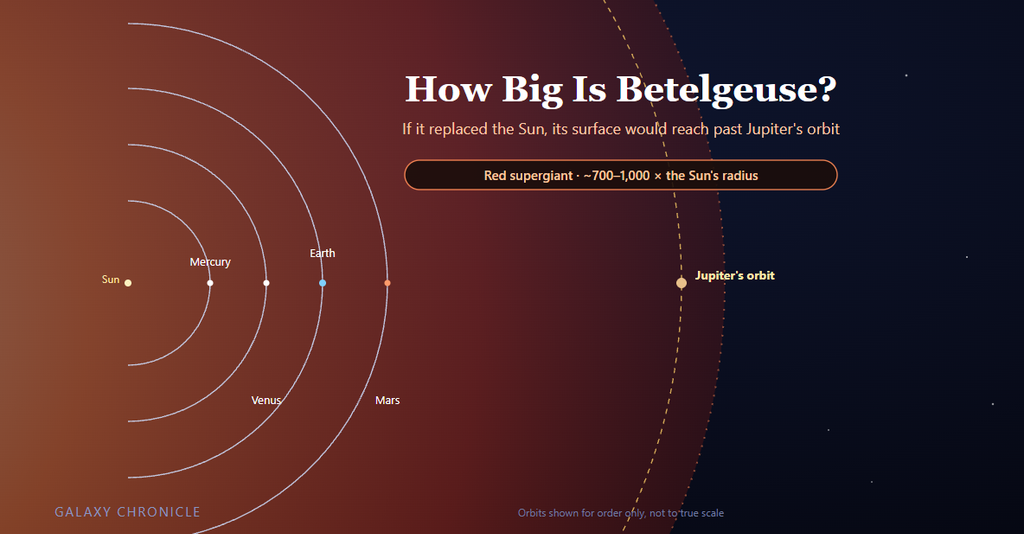
If you plucked the Sun out of the center of the solar system and dropped Betelgeuse in its place, its surface would swallow Mercury, Venus, Earth, and Mars, and stretch out past the orbit of Jupiter. Our entire inner solar system would be inside the star. It’s a red supergiant with a radius somewhere around 700 to 1,000 times that of the Sun, and it carries roughly 15 to 20 times the Sun’s mass.
That combination of huge size and relatively modest mass means Betelgeuse is puffed up to an extraordinarily low density. It’s less like a solid ball and more like a colossal, glowing cloud of thin gas. Interestingly, Betelgeuse was also the very first star other than the Sun to have its surface directly imaged, when Hubble resolved hot spots on its face back in 1996.
Why Is Betelgeuse Reddish?
The warm color you see with your own eyes is a real clue about the star’s condition. Color in stars is tied to temperature. The hottest stars shine blue-white, while cooler stars glow orange and red. Betelgeuse is relatively cool as stars go, with a surface far cooler than our yellow Sun, which is exactly why it looks ruddy.
That coolness is a symptom of old age. Betelgeuse has already burned through the hydrogen fuel in its core and swelled into the bloated supergiant stage. It’s the same fate, on a far grander scale, that awaits many stars once their central fires start to sputter. If you’re curious about that swelling process, our explainer on what a red giant is walks through how sun-like stars balloon near the end. Betelgeuse is essentially that story turned up to its most extreme setting.
The Great Dimming: When Betelgeuse Blew Its Top
In late 2019, something bizarre happened. Betelgeuse started fading, and it kept fading. By February 2020 it had lost more than two-thirds of its usual brightness, enough that anyone familiar with Orion could see the change with the naked eye. The internet lit up with speculation that the star was about to explode.
The truth, pieced together mostly from Hubble data, turned out to be almost as dramatic. Betelgeuse had quite literally blown off a piece of itself. Astronomers concluded that a gigantic blob of hot material, weighing several times as much as our Moon, erupted from the star’s surface in what they called a Surface Mass Ejection. For comparison, our Sun regularly sheds small puffs of its outer atmosphere, but this Betelgeuse outburst flung off roughly 400 billion times more mass than a typical solar eruption. As that ejected material drifted outward and cooled, it condensed into a dust cloud that blocked much of the star’s light from our view. By April 2020, Betelgeuse had returned to its normal brightness.
So the Great Dimming was not a countdown to a supernova. It was a colossal, never-before-seen convulsion in a dying star, and we got to watch it happen in real time.
Betelgeuse Has a Hidden Companion
Here’s the newest twist, and it’s a good one. For about a hundred years, astronomers suspected Betelgeuse might have a companion star, partly because of subtle rhythms in its brightness that a single star couldn’t easily explain. But the supergiant’s overwhelming glare kept any faint neighbor hidden.
That changed recently. In 2025, a team led by a NASA scientist reported the first direct detection of the elusive companion, and observations with the European Southern Observatory’s Very Large Telescope captured the sharpest look yet at it. Nicknamed Betelgeuse B, the little partner appears to be a star of roughly two to three times the Sun’s mass, orbiting surprisingly close to the giant. Astronomers still want to confirm it fully by catching it again on the other side of its orbit, but it’s a remarkable find around such a famous, well-studied star.
Will Betelgeuse Explode, and Should We Worry?
Yes, Betelgeuse will explode. As a massive star running low on fuel, its fate is sealed: eventually its core will collapse and it will erupt as a Type II supernova, leaving behind a dense stellar remnant. You can read about that violent process in our guide to what a supernova actually is, and about the crushed core it leaves behind in our piece on neutron stars.
The big question everyone asks is when. Honestly, nobody knows. On a human timescale it could be tonight, or it could be a hundred thousand years from now. In astronomy, “any moment” can comfortably span the next several thousand centuries, so don’t hold your breath.
And no, it would not harm us. Betelgeuse sits roughly 550 light-years away, far beyond the distance at which a supernova could threaten Earth. Instead, when it finally goes, we’d be treated to an incredible show. The explosion would blaze so brilliantly that it would be visible in broad daylight and might rival the Moon in the night sky for weeks or months before slowly fading. Whoever is around to witness it will see something no human has seen in centuries.
For now, Betelgeuse hangs there in Orion’s shoulder, glowing red and biding its time. Every time I look up at it, I can’t help thinking I’m staring at a cosmic countdown, one whose final number nobody can read.
For more on the Great Dimming and the star’s strange recent behavior, NASA has a detailed writeup on Betelgeuse recovering after blowing its top.
If you enjoyed this article, don’t forget to drop us a comment, it really helps support the site, and be sure to check out our other articles because we think you’re going to love them too.