
Pluto sits so far from the Sun that sunlight takes more than five hours to reach it, and its surface hovers at a bone-numbing minus 230 degrees Celsius. It is about the last place in the solar system where you’d expect to find anything flowing, dripping, or wet. And yet that is exactly what scientists now believe is happening. A fresh look at old spacecraft images has turned up the first evidence that liquid has recently oozed across Pluto’s surface, and the little world at the edge of everything has once again refused to sit still.
A Frozen World That Just Did Something Nobody Expected
The discovery comes from a study led by Dr. Alan Stern of the Southwest Research Institute, the same scientist who led NASA’s New Horizons mission that flew past Pluto back in 2015. Published at the end of July 2026 in the Planetary Science Journal, the work points to liquid nitrogen rising up through cracks near the northern edge of Pluto’s famous heart-shaped glacier.
Stern summed up the mood nicely. “Pluto never stops surprising us,” he said, and this result certainly delivers. It is the first time anyone has found signs of liquid recently moving across the surface of this distant world, and it hints at a kind of restless, changing landscape that few people imagined a frozen dwarf planet could have.
Meet Sputnik Planitia, Pluto’s Enormous Icy Heart
To understand the finding, you have to picture the setting. When New Horizons swept past Pluto, its cameras revealed a giant bright region shaped remarkably like a heart. The left lobe of that heart is a vast, smooth plain called Sputnik Planitia, and it is not made of water ice like the glaciers back home. It is a colossal sheet of frozen nitrogen, larger than Texas and Oklahoma combined.
Look closely at that plain and it isn’t perfectly smooth at all. Its surface is broken into countless irregular polygons, like a cracked tile floor stretching for hundreds of miles. These are the tops of slow-moving convection cells, city-sized cells of nitrogen ice churning upward and sinking back down over enormous spans of time. It’s the same physics you see in a simmering pot of soup, only running in ultra slow motion across an entire glacier. Pluto lives out in the Kuiper Belt, the icy frontier beyond Neptune, and if that region is new to you, our guide to the Kuiper Belt is a good place to get your bearings.
So How Can Anything Be Liquid at Minus 230 Degrees?
Here is the puzzle. Pluto is far too cold and its air far too thin for nitrogen rain to fall from the sky. If you can’t rain liquid down from above, where does the wet stuff come from?
The answer, the team argues, is from below. Deep inside the glacier, a combination of pressure and gentle heat can melt nitrogen ice in a process scientists call basal melting. That liquid nitrogen then works its way up through cracks and seeps out along the surface, darkening the ice much like water darkens sand at the edge of a wave. It doesn’t pour out in rivers. It appears to wet the ground occasionally and temporarily, then freeze again, leaving behind the telltale dark streaks and patches that first caught the researchers’ attention.
How Detectives Spotted It From a Decade-Old Photo
What makes this story so satisfying is that the evidence was sitting in the New Horizons image library for years before anyone pieced it together. The dark, narrow lines and smudgy dark patches around those convection cells had been noticed back in 2015, but their cause stayed uncertain.
The breakthrough came from comparing Pluto to Earth. The team lined up the New Horizons pictures against satellite imagery of the Greenland Ice Sheet, where similar dark features appear precisely where liquid water wets the ice and snow. The resemblance was striking. On Greenland the culprit is water. On Pluto, the same visual fingerprint points to liquid nitrogen bleeding up from underneath. Co-author Dr. Kelsi Singer noted that this stretch of Sputnik Planitia is geologically young, likely less than a million years old, which means these wet features didn’t form in some ancient past. They are, in cosmic terms, remarkably recent.
Why This Actually Matters
It might seem like a small thing, a few dark smudges on a world billions of miles away. But it reshapes how we think about Pluto. Instead of a dead, static ball of ice, we’re looking at a place with an active, evolving surface where material still moves and changes today. That puts Pluto in surprisingly good company. Neptune’s big moon Triton, another nitrogen-covered world, shows signs of similar behavior, hinting that these frozen outer worlds may be far livelier than their frigid temperatures suggest.
It’s also a lovely reminder of how much science can still squeeze out of a mission that flew by more than a decade ago. New Horizons spent just hours near Pluto, yet its data keeps yielding fresh surprises years later. To see where Pluto fits among its planetary siblings, our beginner’s guide to the planets walks through the whole solar system, dwarf planets included.
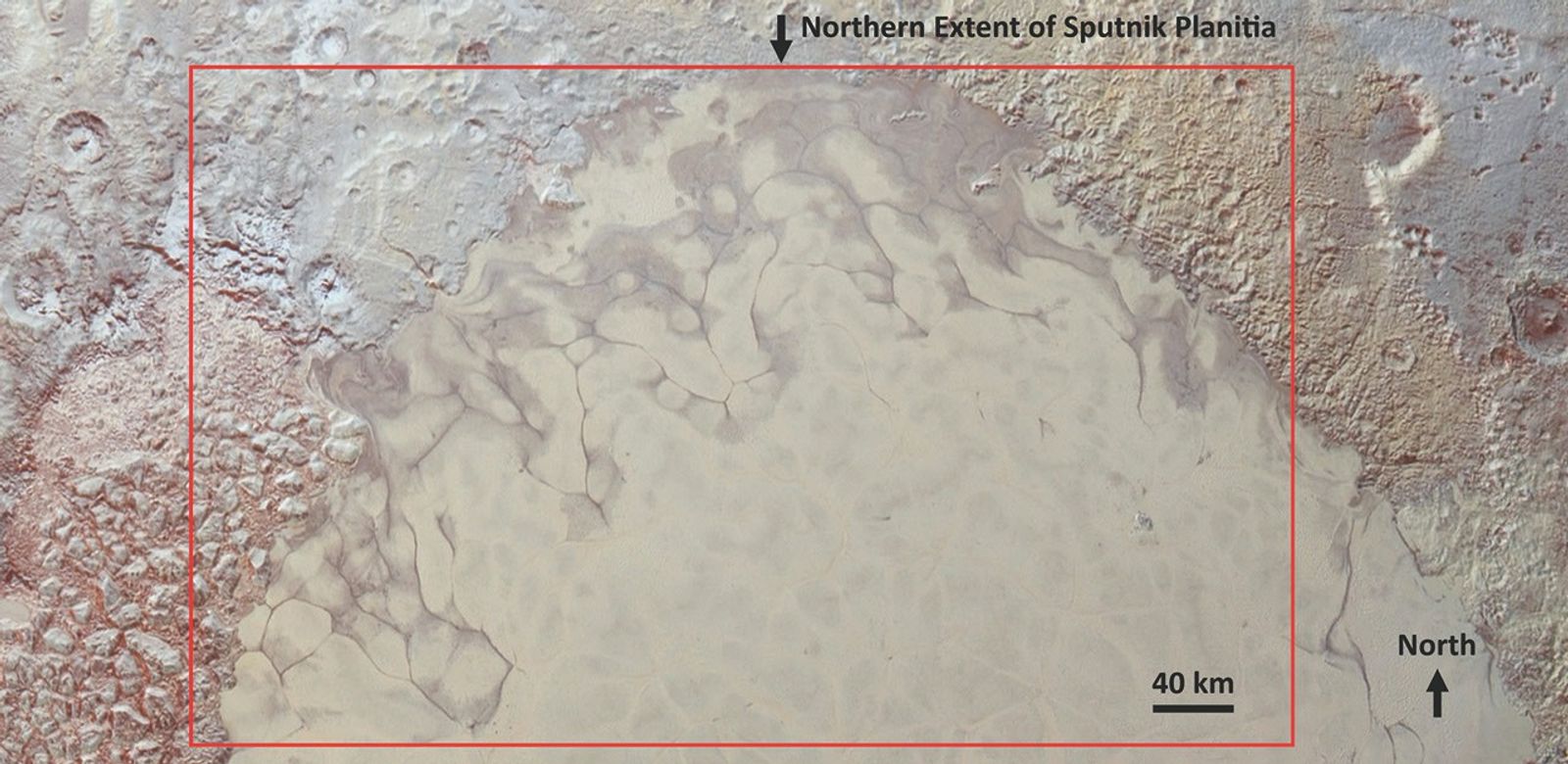 The northern edge of Pluto’s Sputnik Planitia glacier, imaged by NASA’s New Horizons. The red box marks the region where dark features appear to be wetted by liquid nitrogen welling up from below. (Image: NASA/Johns Hopkins APL/SwRI)
For now, the takeaway is simple and a little bit wonderful. On a world where the Sun is just a bright star and the cold is almost beyond imagining, something is still flowing. You can read NASA’s full announcement of the discovery on the NASA Science blog.
If you enjoyed this article, don’t forget to drop us a comment, it really helps support the site, and be sure to check out our other articles because we think you’re going to love them too.