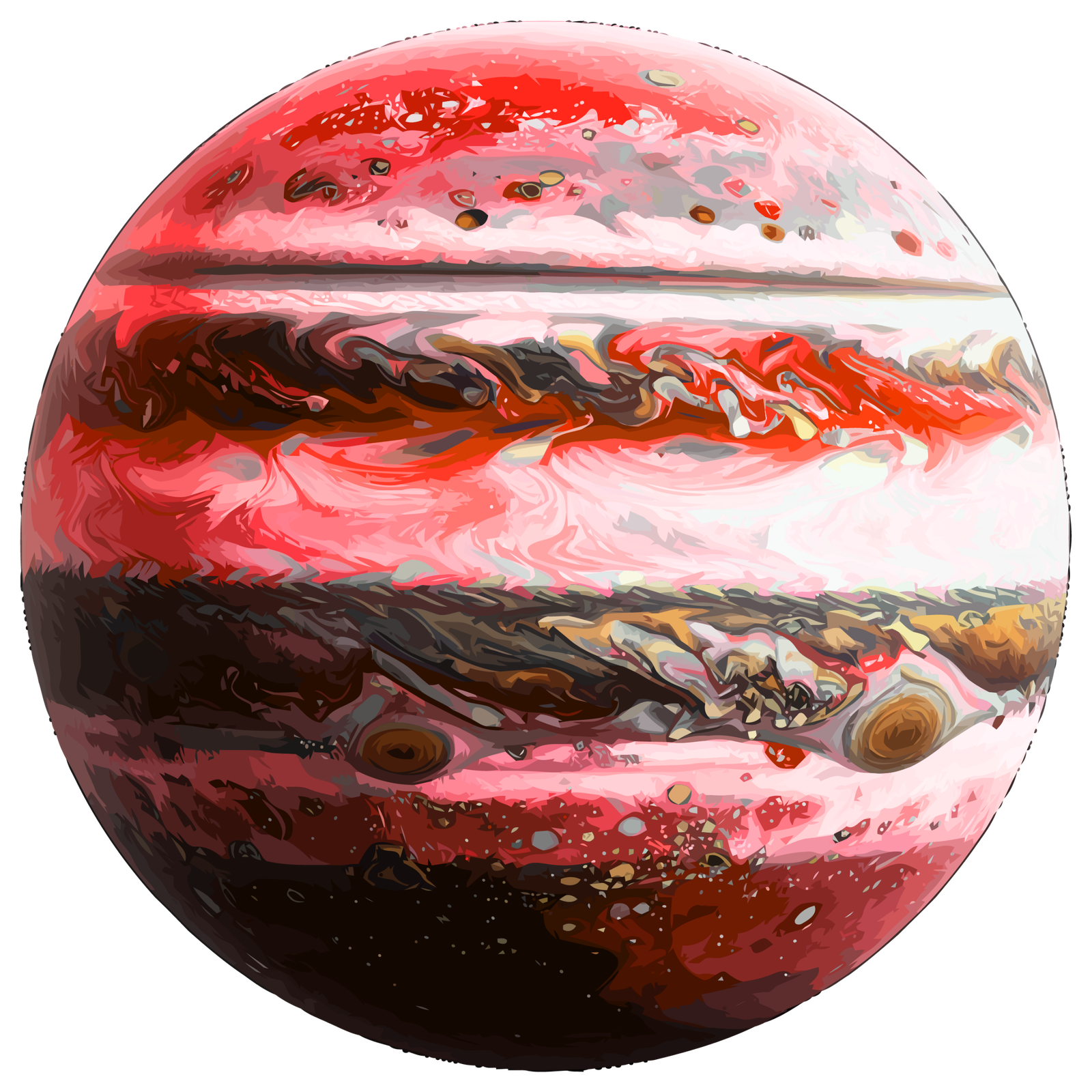

Most of what we know about stars fits into a fairly predictable pattern, they’re born, they fuse hydrogen for millions or billions of years, and they eventually die as a white dwarf, a neutron star, or a black hole depending on how much mass they started with. But tucked away in the far corners of theoretical astrophysics sits a much stranger lineup of possibilities, objects so bizarre that scientists still aren’t sure whether they actually exist anywhere in the universe. Ask an astrophysicist about the weirdest hypothetical stars out there and this is exactly the kind of list they’ll pull out, objects that push the boundaries of known physics and, in some cases, might already be hiding in plain sight.
Thorne-Żytkow Objects: A Star Inside a Star
First proposed back in 1975 by physicist Kip Thorne and astronomer Anna Żytkow, a Thorne-Żytkow object is essentially a stellar Russian nesting doll, a dense neutron star sitting inside the core of a much larger red supergiant. The idea is that if a neutron star, the collapsed remnant left behind after a supernova, ends up in a tight binary system with a red supergiant, it can eventually spiral inward and get swallowed whole, continuing to exist embedded deep inside its much larger host.
From the outside, a Thorne-Żytkow object would look almost identical to an ordinary red supergiant, similar to a familiar star like Betelgeuse.
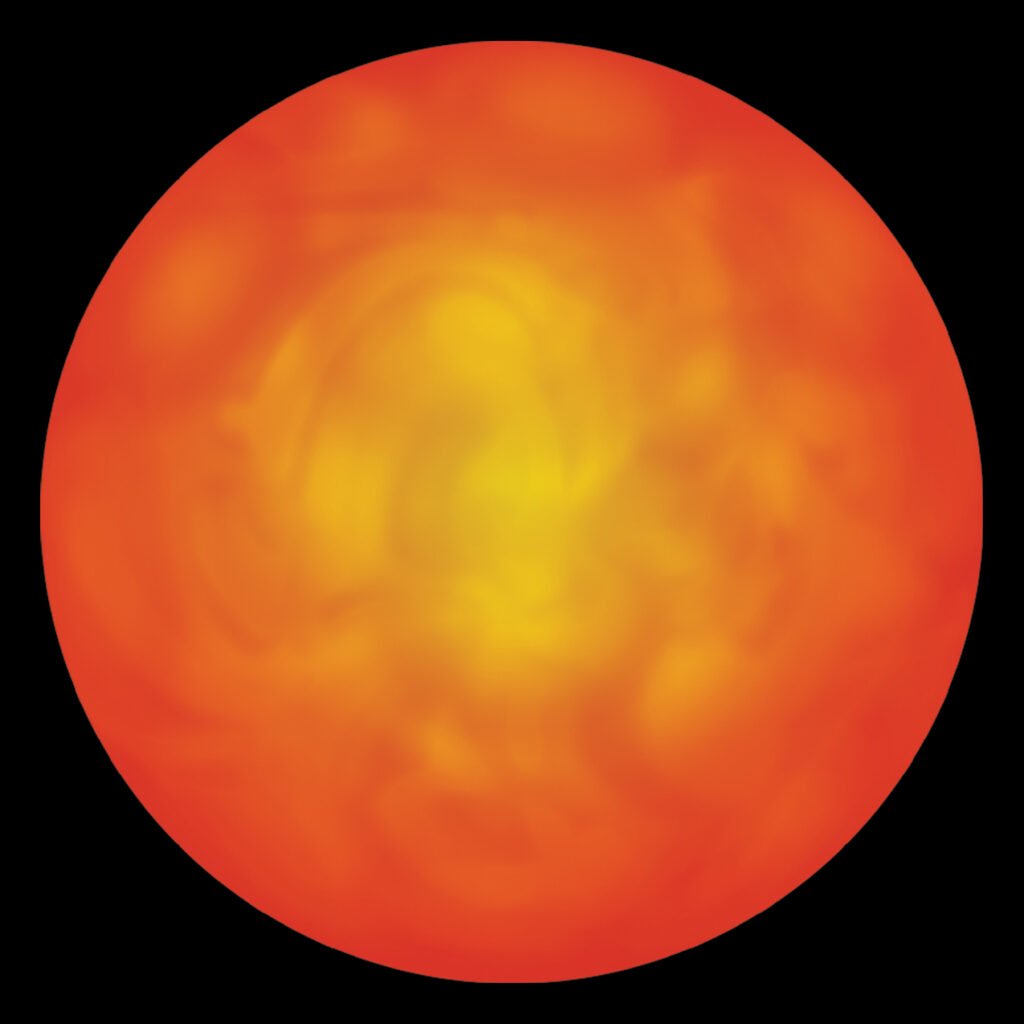
But on the inside, the physics works completely differently, unusual nuclear reactions occurring near the buried neutron star’s surface would produce a distinct chemical signature, unusually high levels of elements like lithium, rubidium, and molybdenum that shouldn’t normally show up in a standard supergiant. In 2014, astronomer Emily Levesque and her team identified a star called HV 2112 in the Small Magellanic Cloud that displayed exactly this kind of chemical fingerprint, sparking real excitement that the first confirmed Thorne-Żytkow object had finally been found. Unfortunately, follow up research couldn’t fully confirm the claim, and HV 2112’s true nature remains genuinely debated to this day. Decades after the idea was first proposed, astronomers are still actively searching for solid proof.
Quark Stars: Denser Than a Neutron Star, Not Quite a Black Hole
Neutron stars are already almost incomprehensibly dense, cramming more mass than our Sun into a sphere roughly the size of a city. But theory suggests theres a possible in between step between a neutron star and a full black hole, an object called a quark star.
Neutron stars are made of, unsurprisingly, neutrons, tightly packed subatomic particles that normally exist inside atomic nuclei. But under extreme enough pressure, some physicists believe those neutrons could actually break down further into their fundamental building blocks, quarks, forming an entirely new, even denser state of matter known as quark matter. A quark star would sit in a strange gap, too dense and compact to be a normal neutron star, but not quite massive enough to collapse the rest of the way into a black hole.
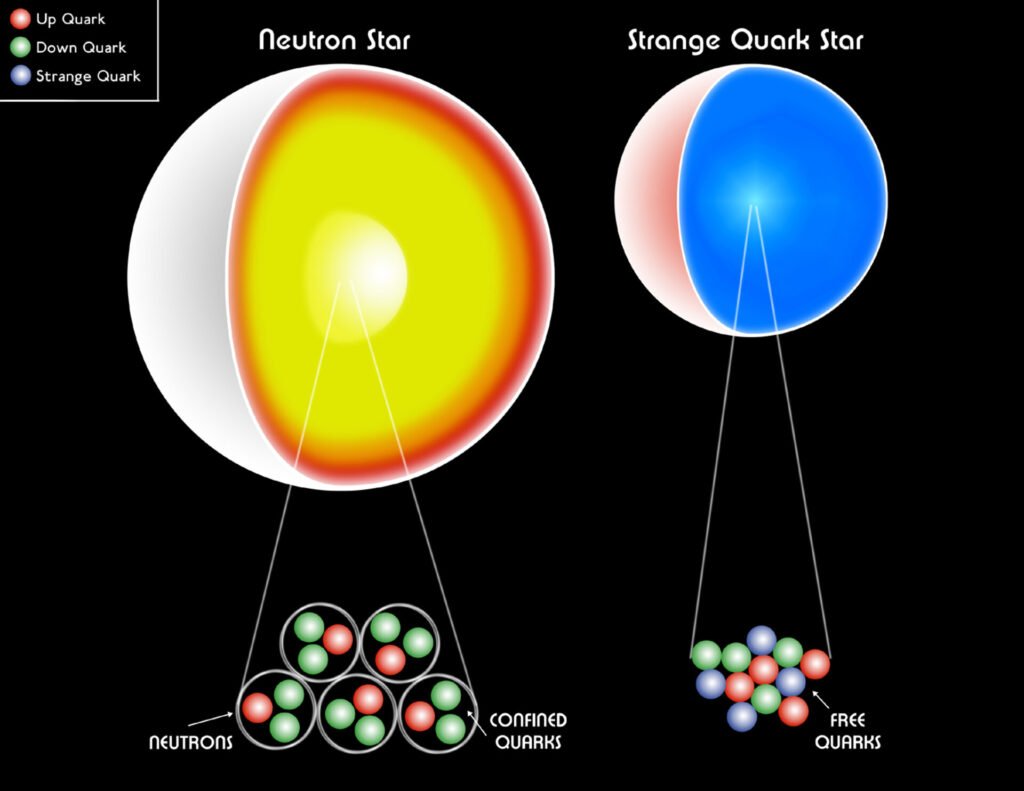
A handful of candidates have caught astronomers’ attention over the years, including a mysterious object cataloged as 3C58, a stellar remnant whose unusual temperature behavior doesn’t cleanly match what scientists expect from an ordinary neutron star. Its neither been confirmed nor ruled out as a genuine quark star, and more research is needed before anyone can say for certain whether these objects are real.
If you’re curious how quark stars fit into the broader picture of what happens after a massive star explodes, our detailed breakdown of what a supernova actually is covers the collapse process that leads to neutron stars, and potentially, objects even stranger than that.
Dark Stars: Powered by Dark Matter Instead of Fusion
Every star we’ve ever directly observed generates its energy the same basic way, nuclear fusion, smashing lighter elements together to release energy as light and heat. But a genuinely wild theory, first proposed by physicist Katherine Freese and colleagues in the mid 2000s, suggests the very first generation of stars in the early universe might have worked completely differently, powered not by fusion at all, but by dark matter annihilation.
The idea goes like this, in the dense, dark matter rich environment of the early universe, some of the first protostars may have collected huge amounts of dark matter particles, specifically a theoretical type called WIMPs, or weakly interacting massive particles. As these particles collided and annihilated each other inside the protostar, the resulting energy could have heated and powered the star long before traditional fusion ever kicked in. These theoretical dark stars could have grown dramatically larger and more luminous than any fusion powered star, potentially reaching millions of times the mass of our Sun.
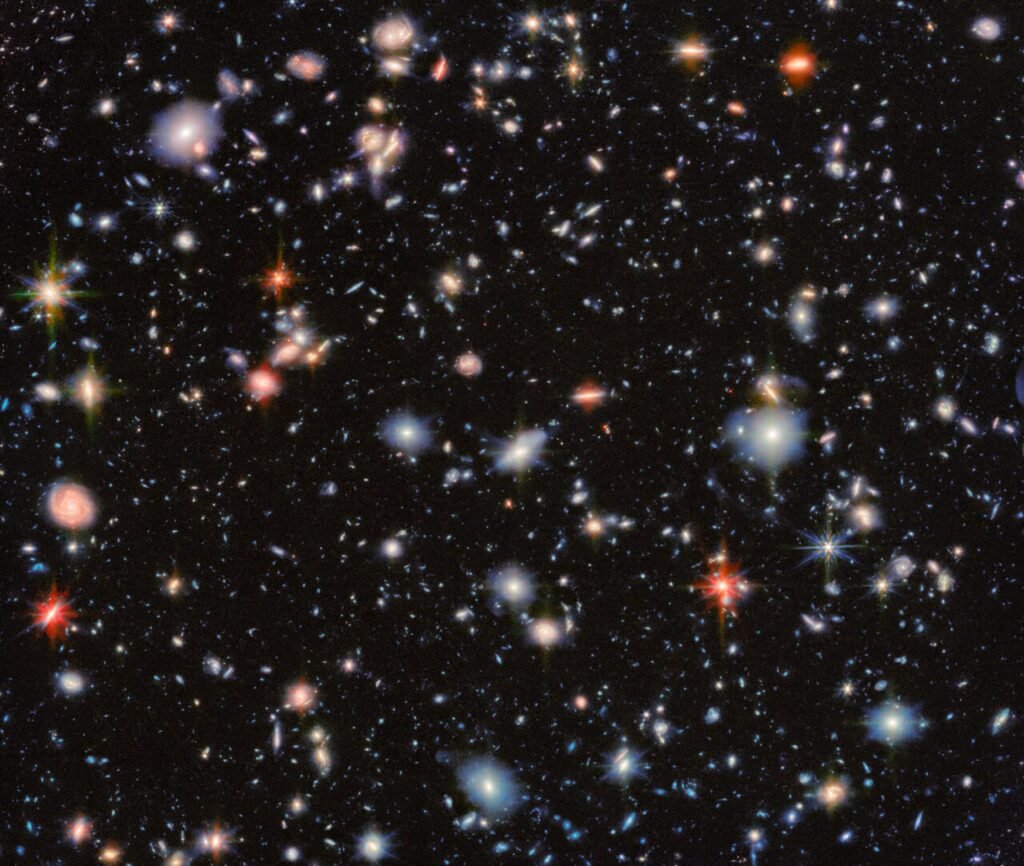
Interestingly, this isn’t purely an abstract, untestable idea anymore. Some researchers have suggested that a handful of unusually bright, compact objects spotted by the James Webb Space Telescope at extremely high redshifts, meaning extremely far back in cosmic time, could potentially be candidates for these dark matter powered stars, rather than the early galaxies they were originally assumed to be. Its still a hotly debated interpretation, but it’s exactly the kind of possibility that makes this particular theoretical star worth keeping an eye on. If digging deeper into dark matter itself interests you, our full explainer on what dark matter actually is covers the evidence behind this mysterious substance in much more detail.
Boson Stars: Invisible, Almost Ghost-Like Objects
The last entry on this list might be the strangest of all. Every star we know of, along with basically everything else in the visible universe, is built out of fermions, the category of particles that includes protons, neutrons, and electrons. A boson star, by contrast, would be built entirely out of bosons, an entirely different category of particle that behaves in a fundamentally different way.
Because bosons can occupy the same quantum state simultaneously, unlike fermions, a boson star theoretically wouldn’t need the same kind of internal pressure that keeps normal stars from collapsing. Some theoretical models suggest boson stars would be almost entirely transparent and invisible, giving off no light of their own at all, held together purely by gravity and quantum effects rather than nuclear fusion. Because of that immense gravity, a boson star could still bend light around it dramatically, creating a dark, shadowy region eerily similar in appearance to a black hole’s event horizon, without actually being one.
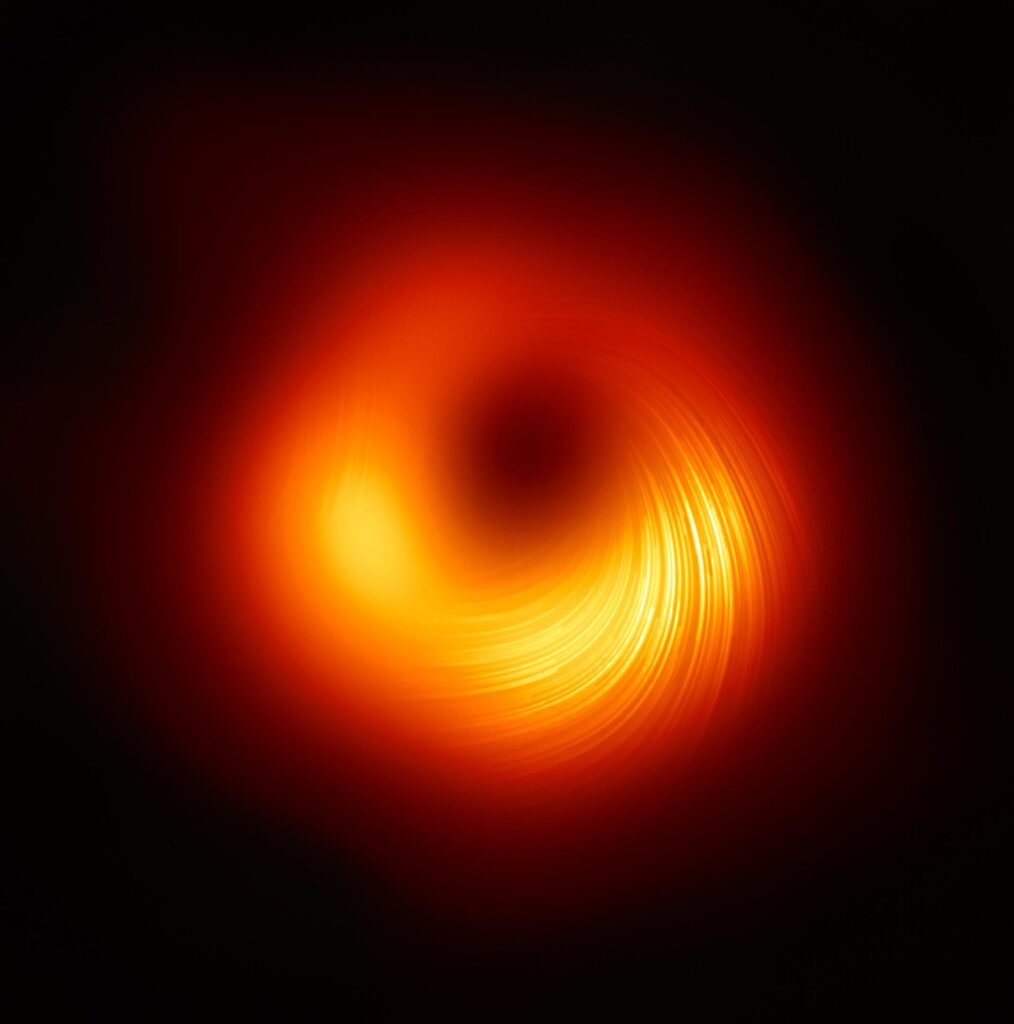
No boson star has ever been confirmed to exist, and some physicists question whether the specific type of particle needed to form one, a stable, self repelling boson, even exists in nature at all. Still, it remains a genuinely serious area of theoretical research, partly because boson stars have been proposed as one possible candidate for explaining dark matter itself.
Why Scientists Keep Chasing Objects That Might Not Even Exist
It might seem strange to spend serious research time chasing objects that could very well turn out to be purely theoretical. But astronomy has a long track record of turning “impossible” ideas into confirmed reality. Black holes themselves were considered a mathematical curiosity for decades before scientists found overwhelming observational evidence they actually exist. Neutron stars were purely theoretical until pulsars were discovered in 1967 and turned out to be exactly that. Every one of these hypothetical stars started out exactly the same way black holes and neutron stars once did, as a solution on a chalkboard that nobody was sure nature had actually bothered to build.
With increasingly powerful telescopes like the James Webb Space Telescope now peering deeper into the universe than ever before, and gravitational wave detectors picking up signals from collisions that traditional telescopes could never catch, astronomers have more tools than ever to actually go looking for objects this strange. Whether any of these four candidates eventually gets confirmed, or gets ruled out entirely, remains one of the more exciting open questions in modern astrophysics.
For more detailed research and candidate objects for each of these hypothetical stars, check out the original breakdown from Astronomy.com and the additional overview from BBC Sky at Night Magazine.
If you enjoyed this article, don’t forget to drop us a comment, it really helps support the site, and be sure to check out our other articles because we think you’re going to love them too.