
Theres something genuinely strange sitting at the heart of modern astronomy, scientists are confident that most of the universe’s mass is made of something we’ve never actually seen, can’t directly detect, and honestly still don’t fully understand. That something is dark matter, and despite decades of research, it remains one of the biggest open questions in all of physics. So what is dark matter, exactly, and why are astronomers so convinced its out there if nobody’s ever actually laid eyes on it?
We Can’t See It, But We Can See What It Does
Dark matter doesn’t emit light, doesn’t reflect light, and doesn’t interact with light in any way scientists have been able to detect, which is exactly why it’s called “dark” in the first place, its completely invisible to every kind of telescope we’ve ever built, whether optical, radio, or otherwise. Despite that, astronomers estimate dark matter makes up roughly 27 percent of the universe’s total mass and energy, dwarfing the roughly 5 percent made up of ordinary matter, the stuff that makes up stars, planets, and everything else we can actually see and touch.
If dark matter is invisible, the obvious question becomes, how do we even know its there? The answer comes down to gravity. Even though dark matter doesn’t interact with light, it still has mass, and mass still exerts a gravitational pull on everything around it. Astronomers have found several independent lines of evidence, all pointing toward the same conclusion, that theres a huge amount of unseen mass scattered throughout the universe.
The Galaxy Rotation Problem
The single most famous piece of evidence for dark matter comes from something called galaxy rotation curves, largely thanks to the pioneering work of astronomer Vera Rubin back in the 1970s. Here’s the basic idea, in a spiral galaxy, most of the visible matter, stars, gas, dust, is concentrated toward the center, with much less out toward the edges. Based on standard physics, stars orbiting near the outer edge of a galaxy should move noticeably slower than stars closer to the crowded, mass dense center, the same way outer planets in our own solar system orbit the Sun more slowly than inner ones.
Except that’s not what astronomers actually observe. When Rubin and others measured the rotation speeds of stars across various galaxies, they found something surprising, stars way out at the edges were moving almost as fast as stars much closer to the center, producing what’s known as a “flat” rotation curve instead of the expected decline. The only way to explain that extra speed is if theres a lot more mass out there than what we can actually see, an invisible halo of dark matter surrounding the galaxy, extending well beyond its visible edge and providing the additional gravitational pull needed to keep those outer stars moving as fast as they do.
Gravitational Lensing: Catching Dark Matter’s Shadow
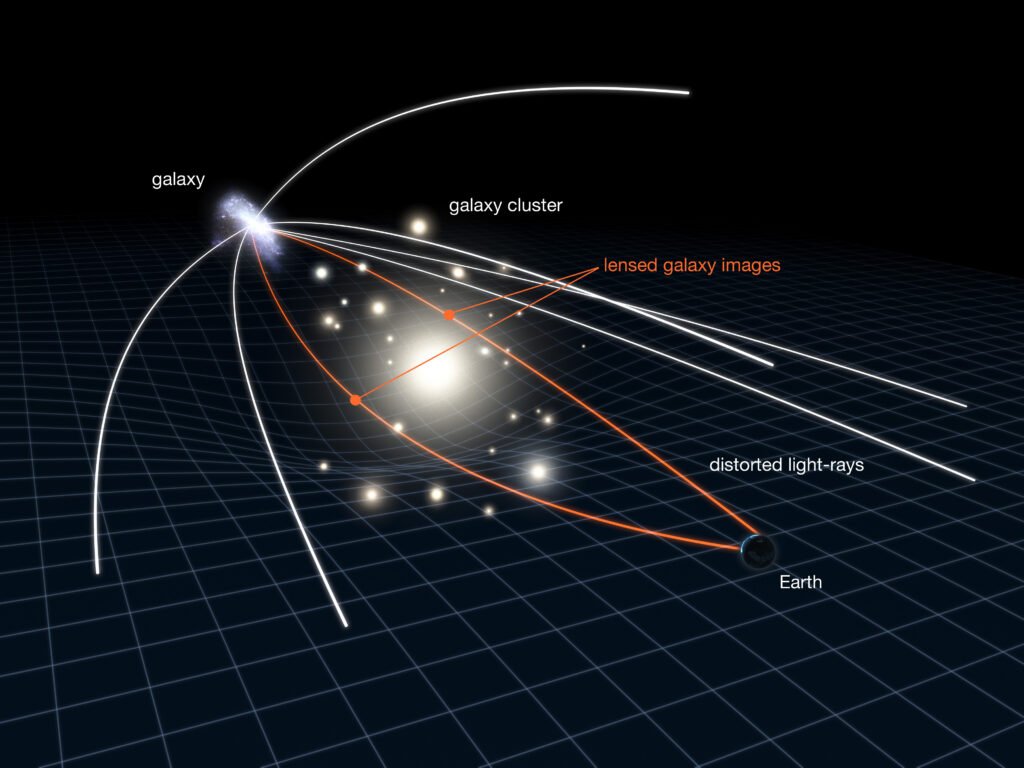
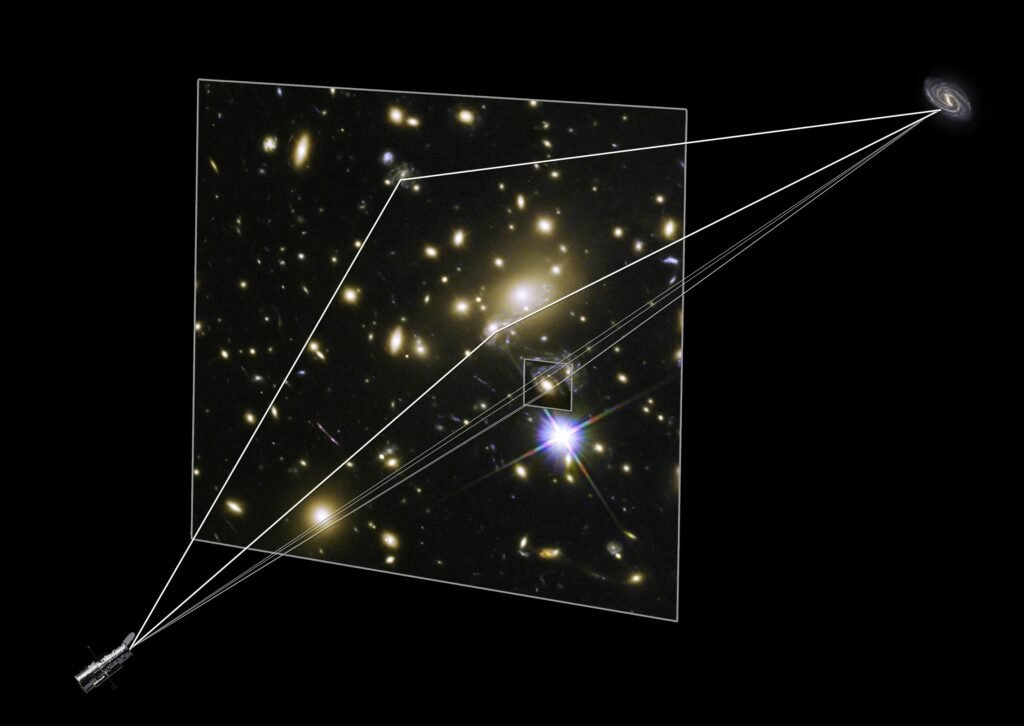
Another powerful piece of evidence comes from an effect called gravitational lensing, a consequence of Einstein’s theory of general relativity. Massive objects actually bend the fabric of space around them, and light passing near that mass gets bent along with it, similar to how a glass lens bends light passing through it. When astronomers study massive galaxy clusters, they often see distant background galaxies appearing warped, stretched, or even duplicated, distorted by the gravitational pull of everything sitting in front of them.
Here’s the key part, the amount of bending observed is often far greater than what the visible matter in that cluster could possibly account for on its own. That extra bending points directly to a huge amount of additional, invisible mass, dark matter, contributing to the overall gravitational pull. One of the most famous examples is the Bullet Cluster, a system where two galaxy clusters collided, and observations showed the bulk of the mass, mapped through gravitational lensing, had actually separated from the visible hot gas that makes up most of the clusters’ ordinary matter, essentially catching dark matter’s gravitational shadow moving independently from the matter we can actually see.
So What Actually Is Dark Matter?
Heres the honest, slightly unsatisfying answer, nobody knows for certain yet. Scientists are confident dark matter exists based on its gravitational effects, but its exact nature remains one of the biggest unsolved mysteries in physics. The leading theory suggests dark matter is made up of some kind of exotic, still undiscovered particle, one that interacts with gravity but doesn’t interact with light or ordinary matter in any other meaningful way. Researchers have proposed various theoretical candidates over the years, with acronyms like WIMPs, short for Weakly Interacting Massive Particles, among the most widely studied possibilities, though direct detection experiments searching for these particles deep underground have so far come up empty.
Its worth noting that dark matter research is still very much an active, evolving field. Recent analysis using precise star tracking data from the European Space Agency’s Gaia mission has actually complicated part of the traditional picture, suggesting the outer rotation curve of our own Milky Way might decline more than the classic “flat” model predicted, reopening some of the finer details scientists are still working through. Its a good reminder that even well established evidence can get refined and debated further as measurement techniques keep improving.
If you’re curious how dark matter connects to some of the most extreme objects in the universe, our piece on the nearest black holes to Earth touches on how astronomers hunt for invisible objects using similar gravitational detective work, watching how visible matter behaves to infer the presence of something we can’t directly see.
Dark Matter vs Dark Energy
Its easy to mix these two up, but dark matter and dark energy are actually completely different things, despite sharing similar sounding names. Dark matter is the invisible mass responsible for extra gravitational pull holding galaxies together. Dark energy, by contrast, is an entirely separate and even more mysterious phenomenon believed to be responsible for the accelerating expansion of the universe itself, making up roughly 68 percent of the universe’s total mass and energy, an even larger slice than dark matter. Between dark matter and dark energy combined, ordinary matter, everything we can actually see and study directly, makes up less than 5 percent of everything that exists.
Why This Mystery Actually Matters
Understanding dark matter isn’t just an academic curiosity, its central to understanding how the universe actually formed and evolved. Without dark matter’s extra gravitational pull, scientists believe galaxies likely wouldn’t have been able to form and hold together the way they have, the universe’s early matter simply wouldn’t have clumped together efficiently enough on its own. In a very real sense, dark matter appears to be the invisible scaffolding that galaxies, including our own Milky Way, are built around.
Solving the mystery of exactly what dark matter is made of remains one of the primary goals driving modern particle physics and astrophysics forward, with new telescopes, underground detectors, and particle accelerators all continuing the search from different angles, each hoping to be the one that finally catches a direct glimpse of the invisible material making up most of the universe’s mass.
If diving deeper into the scale of the cosmos dark matter helps shape interests you, our piece on how vast the universe actually is puts some of these enormous, invisible influences into a broader cosmic perspective.
An Invisible Backbone
Dark matter remains one of the strangest, most humbling reminders in all of science, that the vast majority of everything in the universe is made of something we still can’t directly see or fully explain. Its there, holding galaxies together, bending light around massive clusters, shaping the large scale structure of the cosmos itself, all while remaining stubbornly invisible to every instrument we’ve built so far. Sometimes the biggest mysteries in astronomy aren’t about what we can see in the night sky, they’re about everything we know is there, but simply can’t.
For more detailed research and detection methods, check out the breakdown from NASA Science and the evidence summary from TechTimes.
If you enjoyed this article, don’t forget to drop us a comment, it really helps support the site, and be sure to check out our other articles because we think you’re going to love them too.