
Some deep sky objects take a serious telescope, a dark sky reservation, and a whole lot of patience to even glimpse. The Dumbbell Nebula isn’t one of them. Its bright, its relatively easy to find, and it holds a genuinely cool piece of astronomy history, it was the very first planetary nebula ever discovered. If you’re building out a list of must see cosmic objects to hunt down this year, this one belongs near the top.
A Quick History Lesson
The Dumbbell Nebula, officially catalogued as Messier 27 or M27, was first spotted by the French astronomer Charles Messier back on July 12, 1764. Messier was primarily a comet hunter, and he kept a running catalog of fuzzy, comet-like objects specifically so he wouldn’t mistake them for actual comets during his searches. He described this particular one simply as an “oval nebula without stars,” having no idea at the time that he’d just stumbled onto an entirely new category of celestial object.
It wasn’t until decades later that astronomer William Herschel took a closer look and gave the nebula the name that stuck, comparing its shape to a dumbbell or an hourglass. Herschel is also credited as the first person to correctly identify it as what astronomers now call a planetary nebula, a term that’s honestly a bit of a historical misnomer, these objects have nothing to do with planets, early astronomers just thought their round, glowing shapes looked similar to planets through the primitive telescopes of the time.
What Exactly Is a Planetary Nebula?
A planetary nebula forms during the final act of a dying star’s life. As a star like our own Sun runs low on fuel, it swells into a red giant and eventually sheds its outer layers into space in a series of dramatic bursts. What’s left behind is a hot, compact white dwarf at the center, surrounded by an expanding, glowing shell of gas and dust, illuminated by ultraviolet radiation pouring off that exposed stellar core.
The Dumbbell Nebula is a textbook example of exactly this process. At its center sits an extremely hot white dwarf, one of the largest known white dwarfs by physical size, still radiating intense energy that lights up the surrounding gas cloud in vivid, layered colors.
The Numbers Behind the Nebula
The Dumbbell Nebula sits in the small constellation Vulpecula, the Fox, at a distance thats still debated a bit among astronomers but generally accepted to be somewhere around 1,200 to 1,360 light-years from Earth. Its one of the closest and brightest planetary nebulae visible from our part of the galaxy, which is a big part of why its remained such a popular target since Messier first logged it.
Physically, the nebula spans roughly 2.5 light-years across, made up of glowing knots and filaments of gas that have been expanding outward for an estimated 9,800 to 48,000 years, depending on which study you reference. Hubble Space Telescope images have revealed intricate detail in these gas clouds, including strange, finger-like knots pointing back toward the central star, some trailing long tails as they get sculpted by radiation and stellar winds streaming outward from the dying star at the nebula’s core.
If exploring what our own Sun has in store at the end of its life interests you, our detailed piece on how the Sun will eventually die walks through the same red giant to white dwarf transformation responsible for objects exactly like the Dumbbell Nebula.
Why It’s Called the Dumbbell (and a Few Other Names Too)
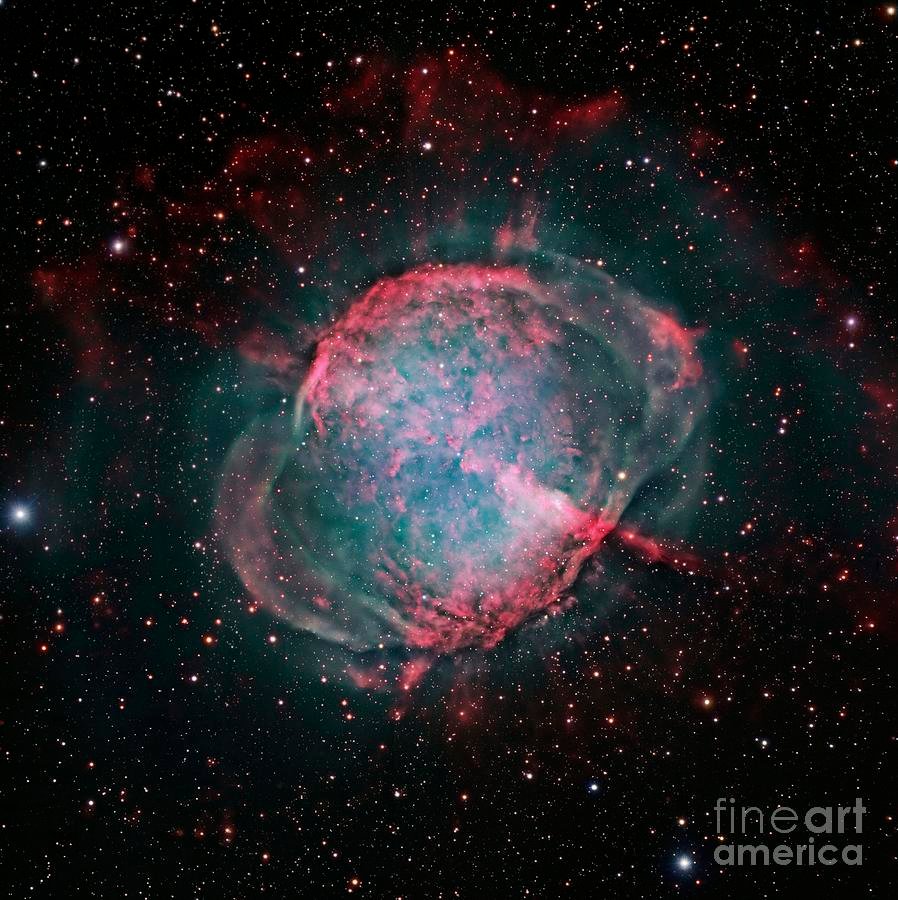
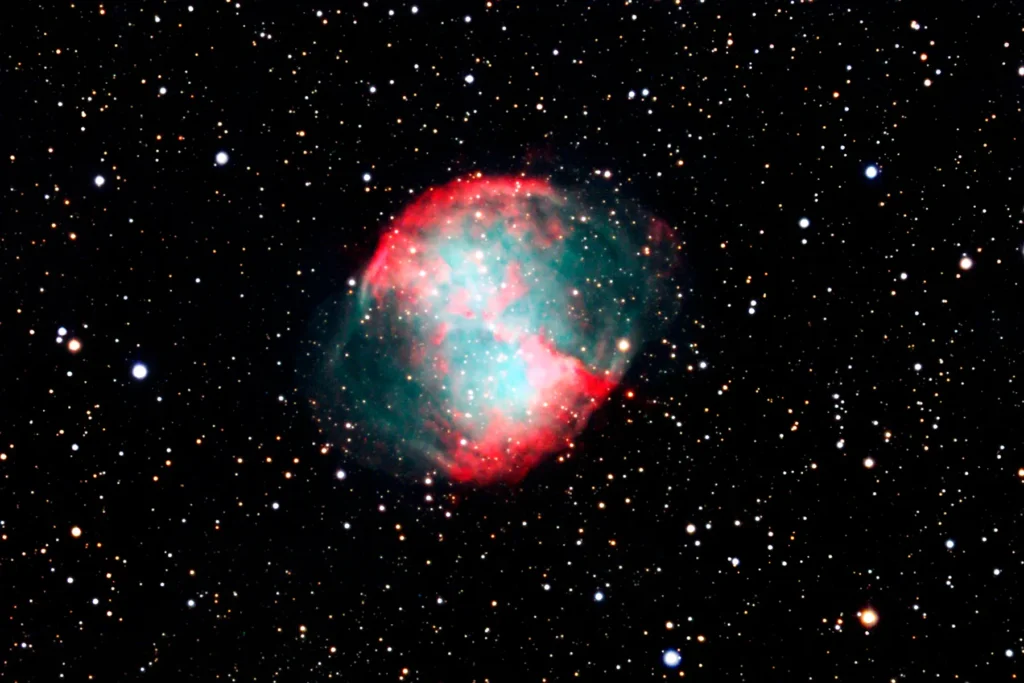
The nebula’s most recognizable feature, and the reason for its name, is its distinctive double lobed shape, two brighter regions bulging outward on either side of a narrower central band, similar in outline to an old fashioned dumbbell weight. That shape comes from the way we happen to be viewing the nebula, roughly along its equatorial plane, which emphasizes the hourglass like structure of the expanding gas.
The Dumbbell Nebula also goes by a couple of other nicknames depending on who you ask. Some call it the Apple Core Nebula, thanks to a greenish glow near its center caused by doubly ionized oxygen, while others refer to it as the Diabolo Nebula, after the two cone shaped juggling toy connected at a narrow waist. Whichever name you use, all three point to the same distinctive double lobed silhouette.
How to Find It Yourself
One of the best things about the Dumbbell Nebula is just how accessible it is for backyard astronomers. Its bright enough, with an apparent magnitude of around 7.5, to spot with a decent pair of binoculars under dark skies, and it becomes a genuinely striking sight through even a modest amateur telescope.
The nebula sits in Vulpecula, tucked between the larger, more recognizable constellations Cygnus and Aquila, making it best viewed during summer evenings in the Northern Hemisphere. Since Vulpecula itself is small and faint, the easiest way to track down M27 is by first locating two bright stars, Altair in Aquila and Deneb in Cygnus, and then searching roughly halfway between them. Through binoculars, expect a small, fuzzy, oval patch of light. Bump up to a telescope, and that iconic double lobed dumbbell shape starts to reveal itself clearly.
If you’re new to locating deep sky objects like this and want to build up some confidence first, our guide on what you can see in the night sky without a telescope tonight is a solid starting point before working your way up to trickier targets like M27.
A Hidden Bonus Inside the Nebula
Here’s a fun bit of trivia even seasoned stargazers sometimes miss, back in 1988, an amateur astronomer named Leos Ondra spotted a variable star appearing in some images of the Dumbbell Nebula but not others. He nicknamed it the “Goldilocks Variable,” and it turned out to be a pulsating star located far beyond the nebula itself, visible only because M27’s gas cloud is partially transparent. Its a neat reminder that even a well studied, centuries old object can still have small surprises hiding within it.
Why the Dumbbell Nebula Belongs on Every Skywatcher’s List
Between its historical significance as the first planetary nebula ever discovered, its relative ease of spotting from a backyard telescope, and the genuinely striking double lobed shape that gave it its name, the Dumbbell Nebula checks pretty much every box for a must see cosmic object. Its bright, its accessible, and it offers a direct, visible glimpse into exactly what awaits stars like our own Sun billions of years down the road. Few objects in the night sky manage to combine that much scientific significance with that much sheer visual reward for such a modest amount of equipment.
For more detailed imagery and research on the Dumbbell Nebula, check out the full breakdown from NASA Science and the observing guide from Constellation Guide.
If you enjoyed this article, don’t forget to drop us a comment, it really helps support the site, and be sure to check out our other articles because we think you’re going to love them too.
hi