
Ask most people which planet has rings, and Saturn is the only answer you’ll get. Fair enough, its rings are the only ones bright enough to spot through a backyard telescope. But Saturn isn’t alone at all, every single giant planet in our solar system, Jupiter, Saturn, Uranus, and Neptune, wears rings of its own. And the planet you’d expect to have the biggest, showiest rings of all turns out to have almost the opposite problem.
All Four Giant Planets Wear Rings
Saturn’s rings are the ones everyone knows, discovered by Galileo in 1610 and still the only ring system easily visible with binoculars from Earth. But scientists confirmed Jupiter has rings too, back in 1979, when NASA’s Voyager 1 spacecraft caught them during its flyby. Uranus’s rings turned up in 1977, spotted indirectly when the planet passed in front of a distant star and dimmed its light in an unexpected pattern. Neptune’s took until Voyager 2’s 1989 flyby to confirm outright, after a similar stellar occultation hinted at their presence five years earlier.
“Saturn’s are mostly ice, Jupiter’s are mostly dust, and Uranus’ and Neptune’s are made of both,” explains William Saunders, a planetary scientist at NASA’s Langley Research Center. That difference in material is exactly why three of these four ring systems are so hard to see, dust and dark rock simply don’t reflect nearly as much sunlight as bright, icy particles do.
Why the Biggest Planet Has Some of the Faintest Rings
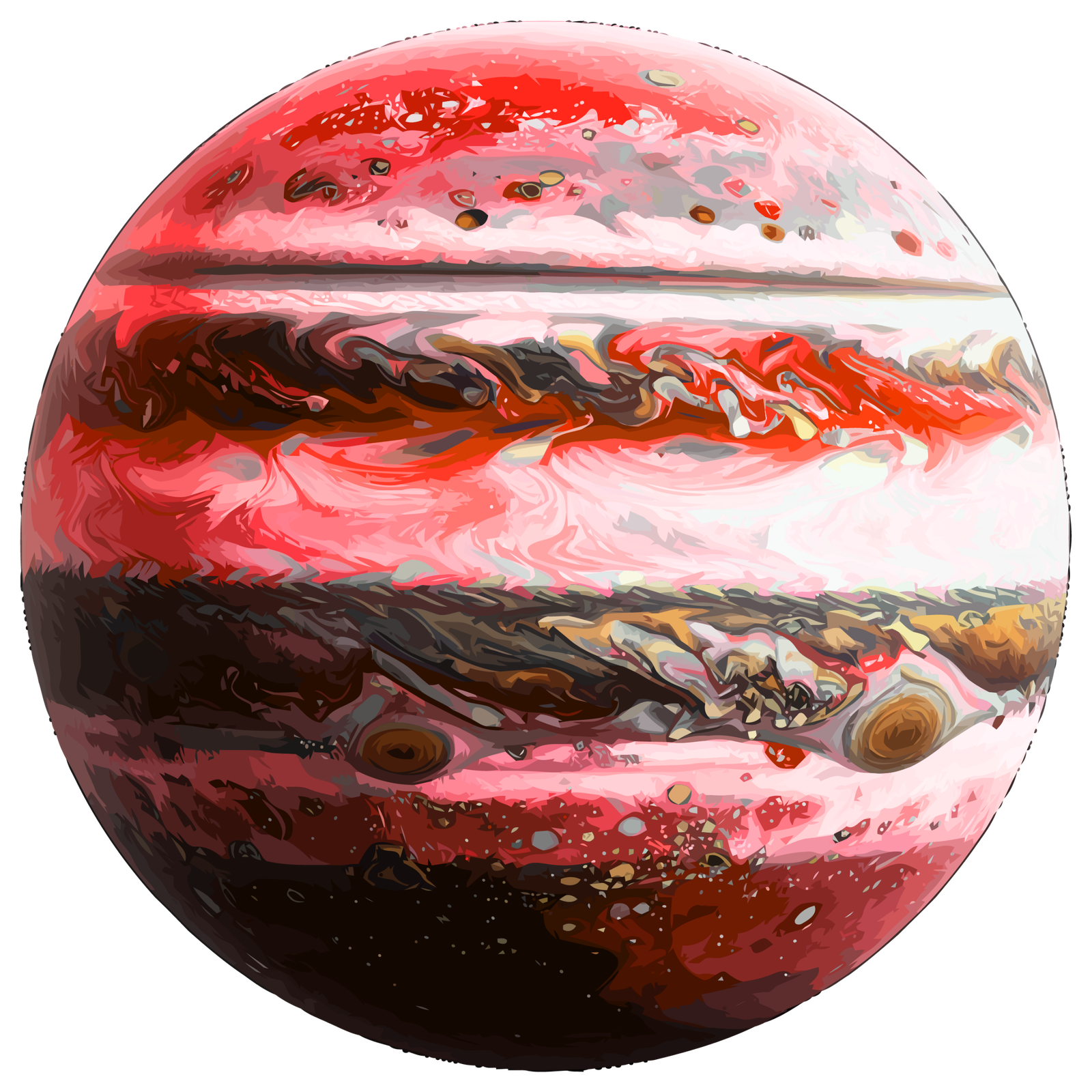
Here’s the genuinely surprising part. Jupiter is by far the largest, most massive planet in the solar system, so logic suggests it should have correspondingly massive rings. Instead, its rings are so faint and dusty they’re barely detectable without a space telescope. Research published in 2022 by planetary scientist Stephen Kane at UC Riverside finally explained why, Jupiter’s own enormous moons are the culprit.
“We found that the Galilean moons of Jupiter, one of which is the largest moon in our solar system, would very quickly destroy any large rings that might form,” Kane said. “Massive planets form massive moons, which prevents them from having substantial rings.” In other words, Jupiter built itself a family of moons so large that their gravity keeps sweeping up or scattering any material that tries to accumulate into a real ring system, before it ever gets the chance. If you’re curious about those very moons responsible for keeping Jupiter’s rings so thin, our full count of Jupiter’s 115 confirmed moons covers the Galilean giants in detail.
Uranus and Neptune: Dark, Narrow, and Genuinely Strange
Uranus currently holds the record for the most known rings among the outer planets, 13 in total, made of chunks ranging from gravel to boulder-sized, coated in material nearly as dark as coal. Some scientists suspect these rings share an origin story with the planet’s most famous quirk, its bizarre 98-degree axial tilt, possibly debris left behind by the same ancient collision that knocked Uranus onto its side in the first place. Our full guide to Uranus’s distance from the Sun covers more of what makes this sideways-spinning planet so unusual.
Neptune’s five rings are fainter and even more tenuous still, so dim that astronomers only confirmed them conclusively during Voyager 2’s single flyby in 1989. They remain some of the least understood structures in the entire solar system, simply because no spacecraft has been back since to take a closer look.
Rings Aren’t Just for Planets, Either
Ring systems turn out to be less exclusive than anyone assumed even a couple decades ago. Astronomers have since discovered rings around the asteroid Chariklo and the dwarf planets Haumea and Quaoar, tiny worlds nobody expected to host rings of their own. It’s a genuine reminder that “ringed planet” was never really shorthand for Saturn alone, just the one bright enough that we happened to notice first.
For more on planetary ring systems, check out the detailed guide from The Planetary Society and the research summary on Jupiter’s rings from UC Riverside.
If you enjoyed this article, don’t forget to drop us a comment, it really helps support the site, and be sure to check out our other articles because we think you’re going to love them too.