
These two terms get mixed up constantly, and honestly, it’s an easy mistake to make. Both involve stars, both involve gravity holding things together, but the scale difference between them is so enormous it’s almost hard to put into words. Here’s the actual distinction, in plain terms.
One Star vs. Billions
A solar system is built around a single star, in our case, the Sun, along with everything gravitationally bound to it, planets, moons, asteroids, comets, and assorted debris. Technically, “solar system” only applies to our own system, since our star is named Sol; other stars with orbiting planets are properly called planetary systems or star systems. Either way, the defining feature is the same, one central star anchoring everything else.
A galaxy is a completely different scale of object entirely, a massive, gravitationally bound collection of anywhere from a few hundred million to over a trillion stars, along with interstellar gas, dust, and dark matter, all held together as one system. Our own solar system is just one tiny piece embedded within a much larger galaxy, the Milky Way, which itself contains hundreds of billions of other stars, most with planetary systems of their own.
The Scale Gap Is Almost Incomprehensible
Numbers make the difference clearer than almost anything else. Our solar system, out to Pluto’s orbit, spans roughly one light-day across. The Milky Way, by comparison, stretches about 100,000 light-years from edge to edge. That’s not a small jump, it’s the difference between a single grain of sand and an entire beach.
Think of it this way, if you shrank the Milky Way down to the size of a dinner plate, our entire solar system, Sun, planets, and all, would be smaller than a single atom on that plate. Many solar systems exist within any galaxy, but the reverse is never true, a solar system can never contain a galaxy.
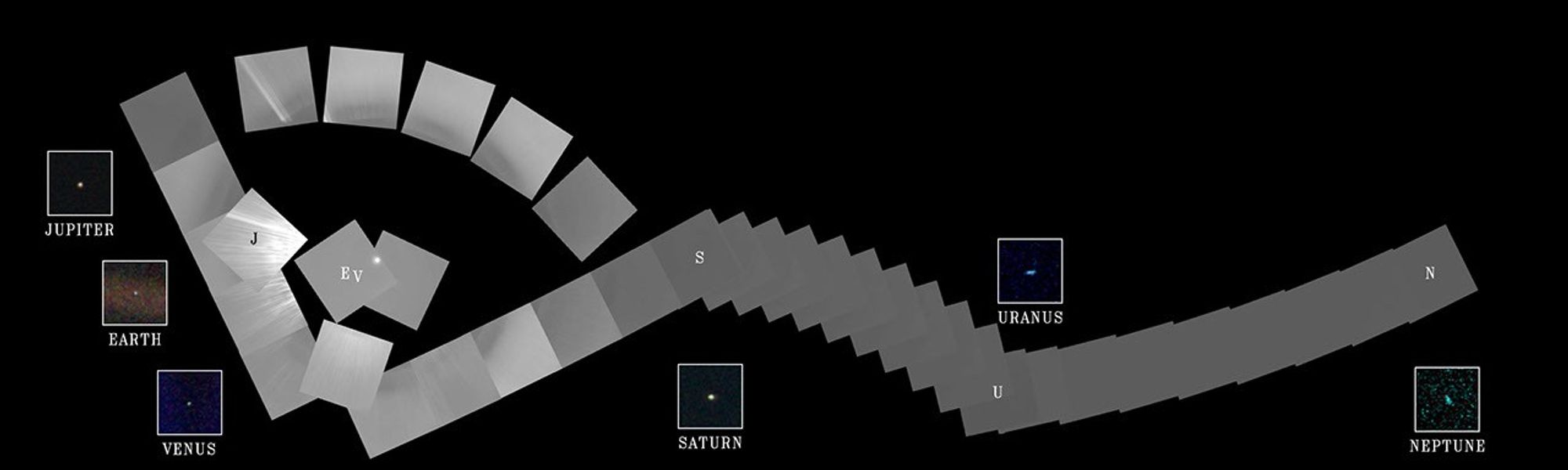 Voyager 1’s 1990 “family portrait,” the only time a spacecraft has photographed our entire solar system from the outside. Even at this scale, showing six planets scattered across billions of miles, the whole scene would still be far too small to register as more than a single point against the size of our galaxy. (Image: NASA/JPL-Caltech)
Different Origins, Different Timescales
The two also form through very different processes and on very different timelines. Our solar system formed about 4.6 billion years ago, when part of a giant molecular cloud gravitationally collapsed, with most of that original material ending up concentrated in the Sun itself. Galaxies, by contrast, formed far earlier and through a much larger process, clouds of gas and dust colliding and merging on a cosmic scale, with some of the oldest galaxies dating back over 13 billion years, not far behind the age of the universe itself.
If you’re curious just how many solar systems, or more precisely, planetary systems, exist within our own galaxy, our full breakdown of how many solar systems are in the Milky Way covers that exact question in detail.
One More Layer: The Universe
It’s worth mentioning where this scale ultimately tops out. Galaxies themselves aren’t the largest structures out there, they group together into galaxy clusters, and those clusters group into even larger superclusters. The observable universe as a whole contains an estimated two trillion galaxies, each one home to its own staggering count of individual solar systems.
For more on how these cosmic scales compare, check out the overview from Difference Between and the detailed breakdown from Love the Night Sky.
If you enjoyed this article, don’t forget to drop us a comment, it really helps support the site, and be sure to check out our other articles because we think you’re going to love them too.