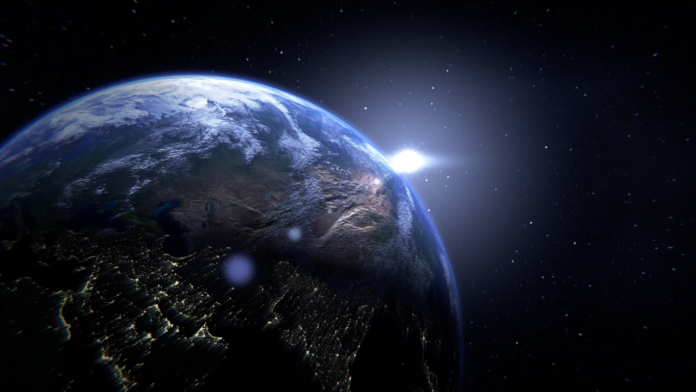

Right now, as you sit comfortably on your couch reading this on your phone or computer, you are actually moving at an incredible speed. At the equator, the Earth is spinning around at roughly 1,000 miles per hour. Yet we dont feel a single thing because everything around us—the air, the buildings, the oceans, and even our bodies—is moving right along with it at the exact same velocity.
Its kind of like riding in an airplane at 500 mph. As long as the plane flies smooth, your coffee cup sits still on the tray table.
But what if someone suddenly hit the emergency brakes on our planet? Have you ever wondered what would happen if earth stops spinning all of a sudden?
Its a classic sci-fi trope, but geophysicists and planetary scientists have actually run the numbers. And honestly, the realistic breakdown of this scenario is far wilder than any disaster movie Hollywood has ever produced.
The Immediate Cataclysm: 1,000 MPH Winds and Instant Inertia
If the planet came to a sudden halt, physics wouldn’t be very forgiving. Newton’s first law of motion states that an object in motion stays in motion unless acted upon by an outside force.
So if the solid ground beneath your feet stopped dead in its tracks, everything not firmly anchored to bedrock—people, cars, trees, topsoil, and every single building—would keep flying eastward at 1,000 miles per hour at the equator.
- Supersonic Airflow: The atmosphere would keep moving at 1,000 mph, unleashing winds stronger than any hurricane ever recorded in human history.
- Massive Destruction: Rocks, water, and debris would scour the surface of the planet clean in a matter of minutes.
- Ocean Megatsunamis: Wall-of-water tsunamis would sweep hundreds of miles inland, washing away entire coastal cities.
Even if the Earth slowed down gradually over a few decades instead of stopping instantly, we would still face a totally transformed world that barely resembles the planet we know today.
Oceans Migration and One Giant Mega-Continent
Because Earth has been spinning for billions of years, centrifugal force has caused the planet to bulge slightly at the equator. This means Earth is actually an oblate spheroid rather than a perfect sphere, with equatorial regions sitting about 13 miles higher than the poles.
This outward centrifugal push also holds a huge portion of our oceans around the middle of the planet.
If the rotation stopped, gravity would instantly pull all that water toward the poles where gravity is strongest.
The oceans would split into two massive polar seas:
- A northern ocean covering most of Canada, Europe, and Russia.
- A southern ocean covering Antarctica and parts of South America.
Meanwhile, the equator would dry up completely. A massive, dry land ring would emerge around the belly of the globe, creating one huge mega-continent wrapping all the way around Earth.
Six Months of Day, Six Months of Night
We take our 24-hour day-night cycle for granted. Wake up, go to work, watch the sunset, go to sleep, and repeat. But that daily rhythm only exists because Earth turns on its axis once every 24 hours.
Without axial rotation, a single “day” on Earth would match its 365-day journey around the Sun.
That means one single day would last an entire year!
You would get six months of continuous, scorching daylight followed immediately by six months of freezing, pitch-black darkness. During the six-month day, temperatures in the center of continents would skyrocket well past 130 degrees Fahrenheit, drying up rivers and killing off crops. During the long winter night, temperatures would plunge far below freezing, coating landmasses in heavy frost and ice.
The Collapse of Earth Magnetic Shield
Deep inside our planet, a liquid iron and nickel outer core flows around a solid inner core. This churn creates what geologists call a dynamo effect, generating the massive magnetic field that wraps around Earth like an invisible forcefield.
That magnetic field is our ultimate shield against harsh solar radiation and cosmic rays.
If the Earth stops spinning, that internal core dynamo slows down and eventually shuts off. Without a active magnetic shield:
- Solar flares and charged particles from the Sun would bombard the surface directly.
- Cosmic radiation would make standing outdoors highly dangerous for living organisms.
- The atmosphere would slowly get stripped away into space by solar winds over millions of years, much like what happened to Mars billions of years ago.
Frequently Asked Questions
Could the Earth actually stop spinning in real life?
No, not anytime soon. The inertia keeping Earth spinning is massive, and there is no force in space large enough to stop it. While the Moon gravity slows down Earth rotation by a fraction of a millisecond every century, the planet will keep spinning for billions of years to come.
What would happen if earth stops spinning slowly over millions of years?
If it slowed down gradually over millions of years, we wouldn’t experience catastrophic 1,000 mph winds or sudden tsunamis. However, we would still deal with extreme temperatures, six-month long days, shifting oceans, and the loss of our magnetic field over time.
Would humans survive if the Earth stopped spinning?
Surviving on the surface would be nearly impossible due to extreme temperature swings, lethal cosmic radiation, and lost atmosphere. Humanity would likely have to move underground or live in mobile cities that constantly move along the twilight zone between day and night.
Our planet spinning motion is one of those hidden background mechanics of nature that makes our lifes possible every single second. It keeps our weather balanced, protects us from solar rays, and gives us comfortable 24-hour days.
If you enjoyed this article, don’t forget to leave us a comment to encourage us, and check out our other articles because you’re going to love them!