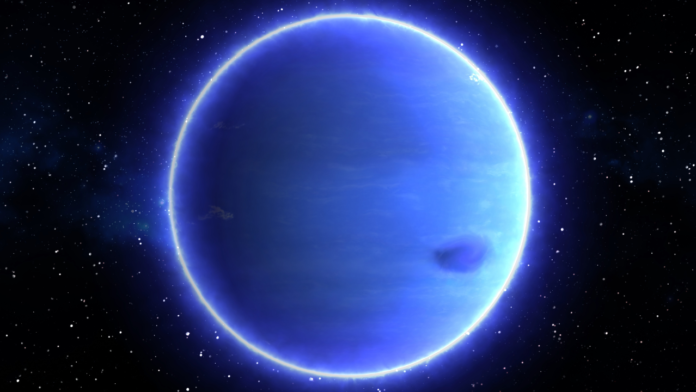

Out on the chilly edges of our solar system sits a deep blue world that scientists love calling the ultimate ice giant. Neptune is gorgeous, mysterious, and so far away that it takes a telescope just to spot it in the night sky. Most people know it as the eighth planet from the Sun, but when you start looking at the numbers, its scale is genuinely hard to wrap your head around.
If you have ever tried looking up the actual distance from the sun from neptune, you know it isn’t a simple fixed number either.
Here is a quick, straightforward breakdown of Neptune size, its weirdly long orbit, and just how far out this frozen world really sits.
Exactly How Far Is Neptune From the Sun?
Space distances get real big real fast once you pass Jupiter and Saturn. On average, the distance from the sun from neptune is about 2.8 billion miles (or roughly 4.5 billion kilometers).
Since astronomers hate typing out long strings of zeros all day, they use a measurement called Astronomical Units (AU). One AU is the average distance between Earth and the Sun. Neptune sits about 30 AU away from our central star. That means Neptune is thirty times further from the Sun than we are here on Earth!
Because planets dont orbit in perfect circles, Neptune distance actually changes as it travels around the Sun:
- Perihelion (Closest Approach): About 2.77 billion miles (29.8 AU)
- Aphelion (Farthest Point): About 2.82 billion miles (30.4 AU)
At that massive distance, sunlight takes roughly 4 hours and 15 minutes just to travel from the Sun to Neptune. So if the Sun suddenly went dark right now, someone standing on Neptune wouldn’t notice until over four hours later!
How Big Is Neptune Compared to Earth?
Even though Neptune looks like a tiny blue marble in space photos, its a absolute giant compared to our home planet.
Neptune is the fourth-largest planet by diameter and the third-most massive planet in our solar system. Its equatorial diameter is about 30,599 miles (49,244 km), which makes it roughly four times wider than Earth.
If Earth was the size of an apple, Neptune would be about the size of a basketball. You could fit nearly 57 Earths inside Neptune if it were hollow!
Despite its huge volume, Neptune is actually less dense than Earth because its made mostly of gas and ice—specifically water, ammonia, and methane over a heavy rocky core. That methane in its upper atmosphere is actually what absorbs red light and reflects back that deep cyan-blue color we all recognize.
A Mind-Boggling Orbit That Takes Generations
Because Neptune sits so far out in the solar system, gravity from the Sun doesn’t pull on it nearly as hard as it does on inner planets. Plus, its orbital path is insanely huge.
That combination means Neptune travels around the Sun at a super slow pace—around 12,256 mph (19,720 km/h), compared to Earth moving at about 67,000 mph.
Because of this, a single year on Neptune lasts about 165 Earth years!
Think about that for a second. Neptune has only completed one full orbit around the Sun since human beings discovered it back in 1846! Its second official orbit since discovery won’t finish until the year 2011 rolled around back in July.
Interestingly, Pluto has an elliptical orbit that actually crosses inside Neptune’s orbit for 20 years out of its 248-year journey. So for brief periods, Neptune actually takes the crown as the furthest planet from the Sun, even counting dwarf planet dwarf classifications.
Crazy Weather on an Frozen World
You might think a planet sitting at such a extreme distance from the sun would be quiet and dead, but Neptune has some of the most violent weather ever recorded in space.
- Freezing Temperatures: Average surface temperatures hover around -353 degrees Fahrenheit (-214 Celsius).
- Supercharged Winds: Neptune boasts the fastest winds in the solar system, reaching up to 1,200 miles per hour (nearly supersonic speed).
- Massive Storms: Hubble and Voyager 2 have both photographed giant dark spots on Neptune that are basically huge planetary storms similar to Jupiter Great Red Spot.
Scientists are still trying to figure out where Neptune gets the internal heat required to drive such powerful wind speeds when it receives less than 1 percent of the sunlight Earth gets.
Frequently Asked Questions
What is the average distance from the sun from neptune in miles?
The average distance from the sun from neptune is roughly 2.79 billion miles (4.5 billion kilometers), which equals approximately 30 Astronomical Units (AU).
How long would it take to fly to Neptune from Earth?
With current space probe technology, a spacecraft takes between 9 to 12 years to reach Neptune. NASA Voyager 2 probe took about 12 years to get there after launching in 1977.
Is Neptune colder than Uranus?
Oddly enough, no. Even though Neptune is much farther from the Sun than Uranus, both ice giants have very similar average temperatures. Uranus actually holds the record for the coldest temperature measured on a planet in our solar system.
Neptune remains one of the coolest and most mysterious corners of our planetary neighborhood—a freezing world of supersonic winds sitting millions of miles out in the dark expanse of space.
If you enjoyed this article, don’t forget to leave us a comment to encourage us, and check out our other articles because you’re going to love them!
Where Did the Term “Right Ascension” Originate, and Why Not Just Call It “Ascension”?