
Of all the planets in our solar system, Uranus tends to get the least amount of love. It doesn’t have Saturn’s rings stealing the spotlight or Jupiter’s dramatic storms making headlines, it just quietly spins, tilted almost completely on its side, way out in the cold, distant reaches of the solar system. So what is Uranus’s distance from the sun exactly, and why does this strange, sideways planet sit so far from the light and heat that keeps the rest of us going? Lets get into the numbers.
The Basic Distance
Uranus orbits the Sun at an average distance of about 1.8 billion miles, or roughly 2.9 billion kilometers. In astronomical units, the standard measurement astronomers use based on the Earth to Sun distance, Uranus sits at about 19.2 AU. That means Uranus is nearly 20 times farther from the Sun than Earth is, a genuinely massive gap once you actually try to picture it.
Sunlight, which reaches Earth in about 8 minutes, takes roughly 2 hours and 40 minutes just to reach Uranus. If you’re trying to imagine the scale here, thats the same beam of light traveling twenty times longer just to reach one more planet farther out in our own solar system.
Why the Distance Isn’t a Fixed Number
Like every other planet, Uranus doesn’t travel in a perfect circle around the Sun, its orbit is elliptical, meaning the distance shifts depending on where the planet sits at any given moment. At its closest point, called perihelion, Uranus comes within about 1.7 billion miles of the Sun. At its farthest point, aphelion, that distance stretches out to roughly 1.87 billion miles.
Interestingly, Uranus actually has one of the largest swings between its closest and farthest points of any planet in the solar system, a difference of about 1.8 AU between the two extremes. Its another one of those small details that makes Uranus stand out as a bit of an oddball, even in terms of something as basic as its orbit shape.
How Long Is a Year on Uranus?
Because Uranus sits so far out, it has an enormous amount of ground to cover to complete a single trip around the Sun. One full Uranian year takes about 84 Earth years. If you were watching Uranus from the day you were born, it wouldn’t return to that same spot in its orbit until you were closing in on your 84th birthday, a length of time that stretches well past most human lifespans.
Despite that painfully slow orbit, Uranus actually spins fairly quickly on its axis, completing a full rotation, meaning a single Uranian day, in about 17 hours. Combine that quick spin with an 84 year orbit, and you get a planet where a single “year” contains tens of thousands of individual days.
The Sideways Planet
No conversation about Uranus is complete without mentioning its strangest feature, it rotates almost completely on its side. While most planets spin somewhat upright relative to their orbit, Uranus is tilted at nearly 98 degrees, essentially rolling around the Sun like a ball instead of spinning the way Earth does. Scientists believe a massive collision with an Earth sized object sometime in the solar system’s early history likely knocked Uranus into this extreme tilt, and it’s been rolling along that way ever since.
That sideways spin creates genuinely bizarre seasons. Combined with its 84 year orbit, each pole of Uranus experiences roughly 21 years of continuous darkness followed by 21 years of continuous daylight, a seasonal extreme unlike anything else in the solar system.
Why Uranus Sits So Far From the Sun
Uranus’s distance from the Sun isn’t random, it directly connects to how the solar system formed billions of years ago. Close to the young Sun, temperatures were far too high for lightweight gases and ices to stick around, which is why the inner planets, Mercury, Venus, Earth, and Mars, all ended up small and rocky. Past a boundary scientists call the frost line, conditions cooled enough for ice and gas to accumulate in large quantities. Uranus formed well beyond that line, which is exactly why it grew into an ice giant made up largely of water, ammonia, and methane ices surrounding a small rocky core, rather than staying small and solid like the planets closer to home.
If you’re curious how Uranus’s distance compares to other planets across the solar system, our light travel time calculator is a fun way to see exactly how much longer sunlight takes to reach each planet, Uranus included.
What That Distance Means for the Planet Itself
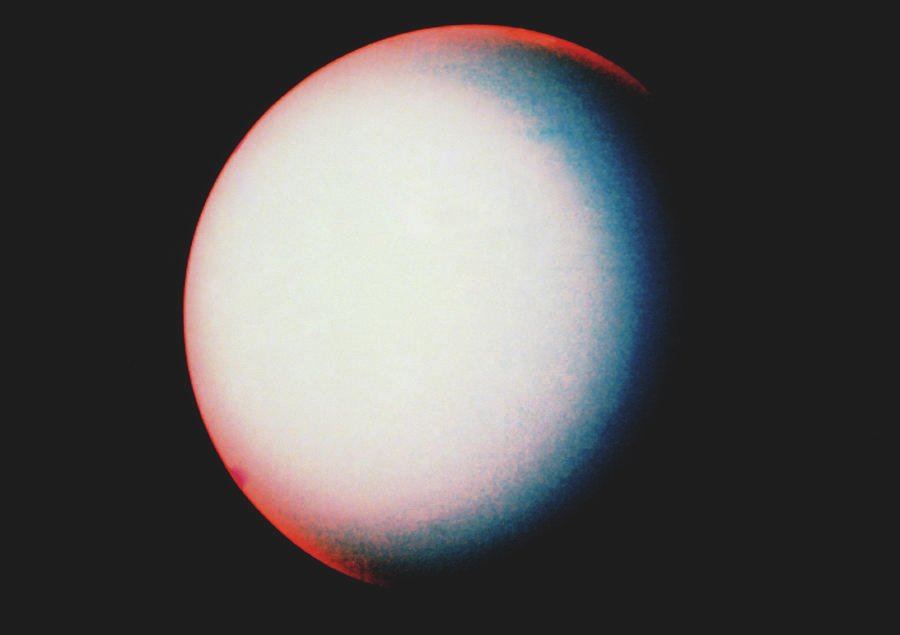
Sitting so far from the Sun has a couple of obvious effects on Uranus. Sunlight reaching its cloud tops is only a small fraction of what Earth receives, and combined with very little internal heat generation compared to other gas giants, Uranus ends up as one of the coldest planets in the entire solar system, with average temperatures dropping to around negative 350 degrees Fahrenheit. Its pale blue-green color comes from methane in its atmosphere, which absorbs red light while reflecting blue light back out toward any telescope pointed its way.
That extreme distance also explains why Uranus wasn’t discovered until relatively recently in astronomical history. Unlike Mercury, Venus, Mars, Jupiter, and Saturn, all of which are visible to the naked eye and have been known since ancient times, Uranus moves so slowly and dimly across the sky that it went unrecognized as a planet for centuries. William Herschel finally identified it correctly in 1781 using a telescope, initially mistaking it for a comet before follow up observations confirmed it was actually a new planet.
If you want to try spotting Uranus for yourself, our guide on what you can see in the night sky without a telescope tonight is a good starting point, though under truly dark skies, Uranus can occasionally be spotted with the naked eye alone.
The Bottom Line
Uranus’s distance from the sun averages out to about 1.8 billion miles, or 19.2 astronomical units, ranging anywhere from roughly 1.7 billion miles at its closest to 1.87 billion at its farthest point in its elliptical orbit. That distance shapes nearly everything about the planet, its brutal cold, its painfully slow 84 year orbit, and its status as one of the last planets in our solar system to actually be discovered. Its a genuinely strange, sideways world, sitting quietly out in the cold, and honestly, it deserves a little more attention than it usually gets.
For more detailed data straight from the source, check out NASA’s Uranus Facts page and the additional breakdown from Astronomy.com.
If you enjoyed this article, don’t forget to drop us a comment, it really helps support the site, and be sure to check out our other articles because we think you’re going to love them too.