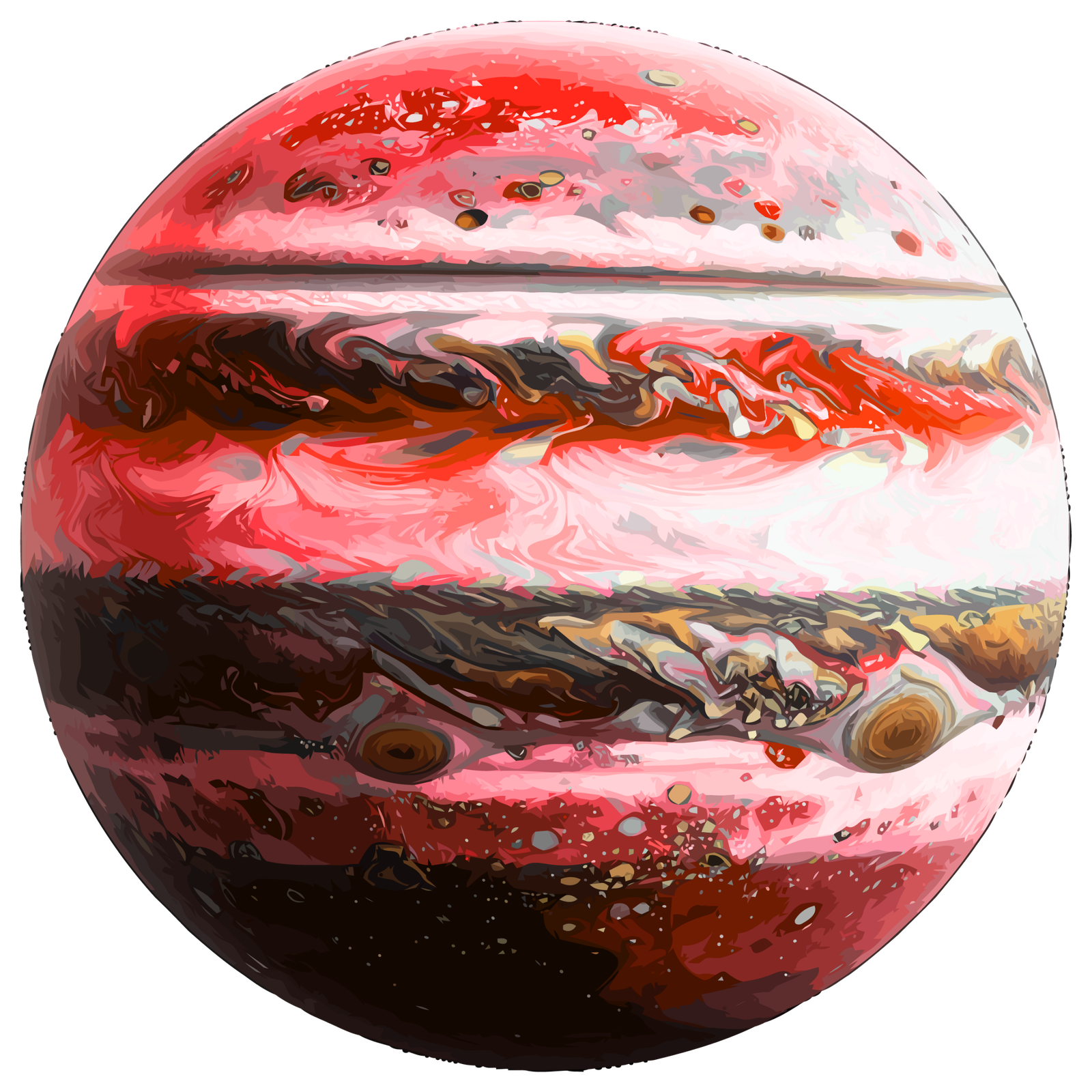

Point a telescope at a quasar and you’d see what looks like an ordinary, faint star. In reality, you’d be looking at one of the most violently energetic objects in the universe, a supermassive black hole so aggressively feeding that it outshines its entire host galaxy, sometimes by a factor of thousands.
A Black Hole Caught Feeding
A quasar forms when a supermassive black hole at a galaxy’s center actively pulls in huge amounts of surrounding gas and dust. That material can’t all fall in at once, so it piles up into a spiraling accretion disk, and friction within that disk heats it to millions of degrees, causing it to blaze across the entire electromagnetic spectrum, visible light, ultraviolet, X-rays, and radio waves all at once. Astronomers call this general phenomenon an active galactic nucleus, or AGN, and a quasar is simply the most extreme, most luminous version of it.
The power output is genuinely hard to picture. Quasars can shine anywhere from ten to ten thousand times brighter than an entire galaxy’s worth of stars combined, making them some of the most luminous single objects ever observed.
Our Own Galaxy Was Probably One, Once
Nearly every large galaxy, including our own Milky Way, is thought to host a supermassive black hole at its center. What determines whether that black hole becomes a blazing quasar isn’t really its size, its how much gas happens to be falling into it at any given time. Our own galactic center, Sagittarius A*, is currently dormant and quiet simply because it has very little material nearby to feed on.
That wasn’t always the case, though. Evidence suggests the Milky Way itself went through an active quasar-like phase roughly a few million years ago, and astronomers expect it to become active again, and possibly form a genuine quasar, once it merges with the Andromeda Galaxy several billion years from now.
Ancient Light From the Early Universe
Because quasars are so extraordinarily bright, astronomers can detect them across billions of light-years, making them some of the most distant individual objects ever observed. The first quasar ever identified, 3C 273, was discovered in 1963 and sits about 2.5 billion light-years away, making it one of the closest known quasars despite that staggering distance. More distant examples let astronomers peer back to when the universe was under a billion years old, offering a rare direct look at galaxies in their earliest, most chaotic stages of growth.
Not Every Active Black Hole Looks the Same
Quasars are just one member of a broader family of active galactic nuclei that includes blazars and radio galaxies. What actually distinguishes them from each other often comes down to viewing angle, a black hole’s accretion disk and jets can look completely different depending on whether we’re viewing it face-on, edge-on, or somewhere in between. A thick donut-shaped ring of gas and dust surrounding the black hole can also block or reveal different parts of the system, depending on our line of sight from Earth.
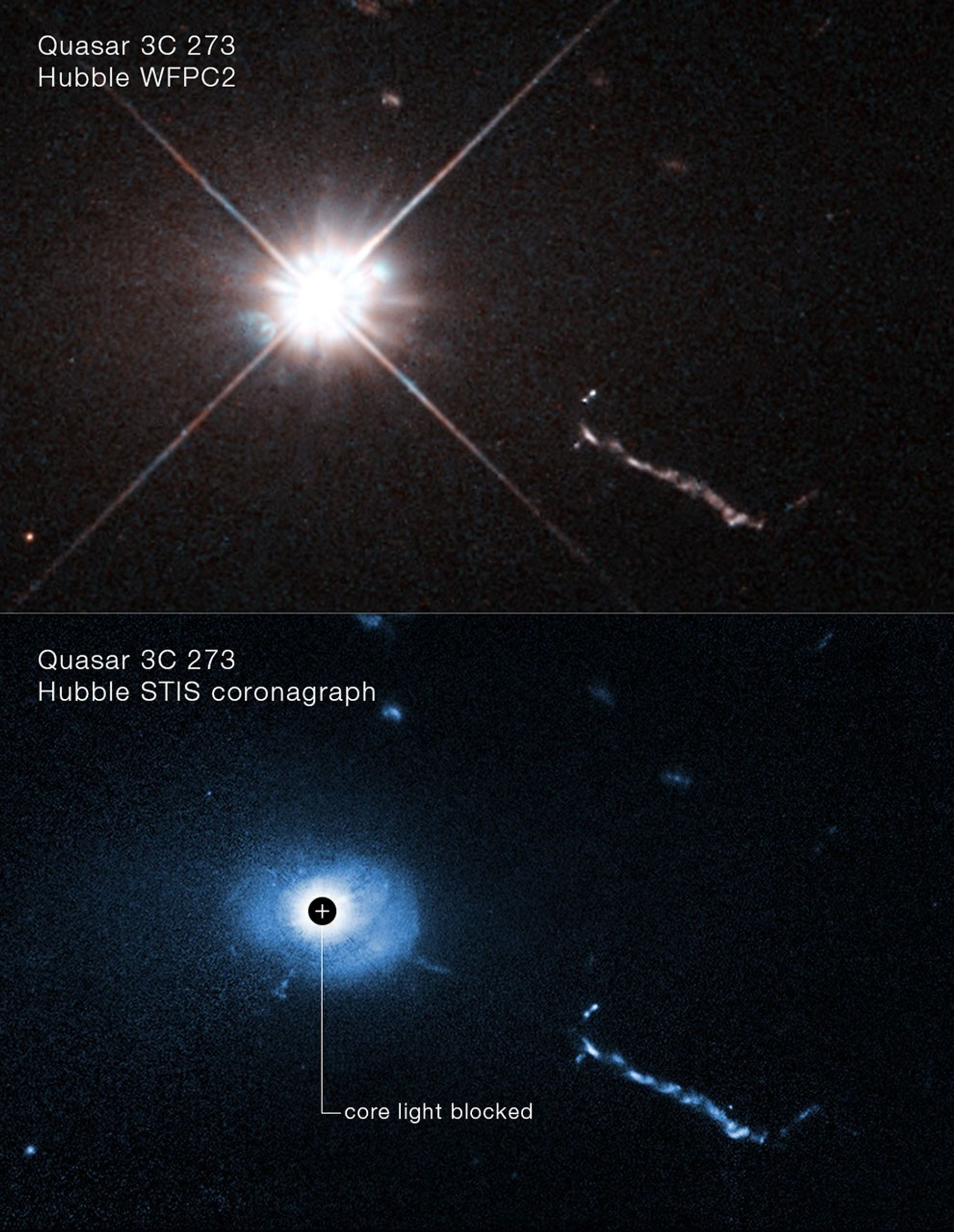 Quasar 3C 273, the first quasar ever discovered, in 1963, sits 2.5 billion light-years away yet remains bright enough to study in detail. This Hubble image reveals a jet of material streaming outward from its supermassive black hole. (Image: NASA, ESA, Bin Ren/Université Côte d’Azur/CNRS)
For more on quasars and the black holes that power them, check out the overview from Space.com and the research summary from the Center for Astrophysics at Harvard & Smithsonian.
If you enjoyed this article, don’t forget to drop us a comment, it really helps support the site, and be sure to check out our other articles because we think you’re going to love them too.