
Ask a kid to draw a picture of a planet and theres a solid chance they’ll draw Saturn, rings and all, before any other world in the solar system. Its the single most recognizable feature belonging to any planet out there, but ask most people what those rings are actually made of, and you’ll get a lot of guesses involving rock, or maybe gas, or just a general shrug. So what are Saturn’s rings made of, exactly, and how did they even get there in the first place?
Mostly Ice, With a Little Bit of Everything Else
Here’s the short answer, Saturn’s rings are made up almost entirely of water ice, with just a small amount of rocky debris and dust mixed in. Data collected by NASA’s Cassini spacecraft, which studied Saturn up close for over a decade before its mission ended in 2017, confirmed the rings are somewhere around 95 percent water ice, give or take depending on which specific ring you’re looking at.
That ice doesn’t come in one uniform size either. The particles making up Saturn’s rings range from tiny, dust sized grains barely visible on their own, all the way up to chunks the size of a house, with a scattered few pieces reaching mountain sized proportions. Despite that huge range in particle size, the rings themselves are surprisingly thin, only about 30 feet thick in most places, even though the entire ring system stretches out roughly 175,000 miles from the planet. Its a genuinely strange combination, a structure wide enough to span most of the distance between Earth and the Moon, yet thin enough that it would practically disappear if viewed edge on from just the right angle.
Why Ice and Not Rock?
For a long time, scientists weren’t entirely sure why Saturn’s rings ended up almost entirely ice, with barely any rock mixed in, especially since rings are thought to form from shattered moons or comets, objects that typically contain a healthy mix of both. A more recent study using detailed impact simulations offered a compelling explanation, if two icy moons collided with each other in Saturn’s past, the specific physics of that kind of impact would scatter mostly ice into the region close to the planet where rings can form, while denser rocky material would behave differently and end up somewhere else entirely. Its exactly the kind of ice-rich outcome that matches what Cassini actually observed.
If you’re curious how Saturn’s ring composition compares to the makeup of other icy bodies in the solar system, our piece on how the diameter of our Moon connects to its violent formation history covers a similarly dramatic collision story, just on a very different scale.
Where Did the Rings Actually Come From?
Scientists have floated a few competing theories over the years to explain exactly how Saturn ended up with such an elaborate ring system in the first place. One leading idea suggests a moon wandered too close to Saturn and got torn apart by the planet’s powerful tidal forces. Another theory points to a comet or asteroid slamming into one of Saturn’s icy moons, shattering it into the countless fragments that eventually spread out into the rings we see today. A third possibility involves Saturn’s gravity simply capturing a passing icy object and gradually shredding it apart over time.
Whichever explanation turns out to be correct, all of them point to some kind of violent, icy origin story, rather than the rings having formed gradually alongside Saturn itself. And that leads to one of the most surprising discoveries Cassini made during its mission.
The Rings Are Younger Than You’d Think
Saturn itself formed about 4.5 billion years ago, right alongside the rest of the solar system. Its rings, on the other hand, are shockingly young by comparison, astronomers now estimate they’re only somewhere between 100 and 400 million years old. Scientists figured this out by measuring how “pure” the ice in the rings actually is, older rings would have accumulated far more dust and debris from space over billions of years, while younger rings stay relatively clean and bright, which is exactly what Cassini’s instruments detected.
To put that timeline into perspective, dinosaurs were already walking around on Earth by the time Saturn’s rings likely started forming. For a solar system that’s existed for 4.5 billion years, a ring system less than half a billion years old is a genuinely recent addition.
The Rings Are Slowly Disappearing
Heres a detail that tends to surprise people the most, Saturn’s rings aren’t a permanent fixture, they’re actively disappearing, and have been the whole time we’ve been watching. Cassini discovered a phenomenon known as “ring rain,” where charged ice particles get pulled out of the rings by Saturn’s magnetic field and rain down into the planet’s upper atmosphere, where they simply burn up and vanish. Scientists estimate this process dumps somewhere around 10,000 kilograms of ice into Saturn’s atmosphere every single second.
At that rate, researchers calculate the rings could fully disappear somewhere between 100 million and 300 million years from now. Its a genuinely wild thought, the rings that make Saturn instantly recognizable in basically every piece of space themed art and every science textbook photo are, on a cosmic timescale, a fairly temporary decoration.
How the Rings Are Actually Organized
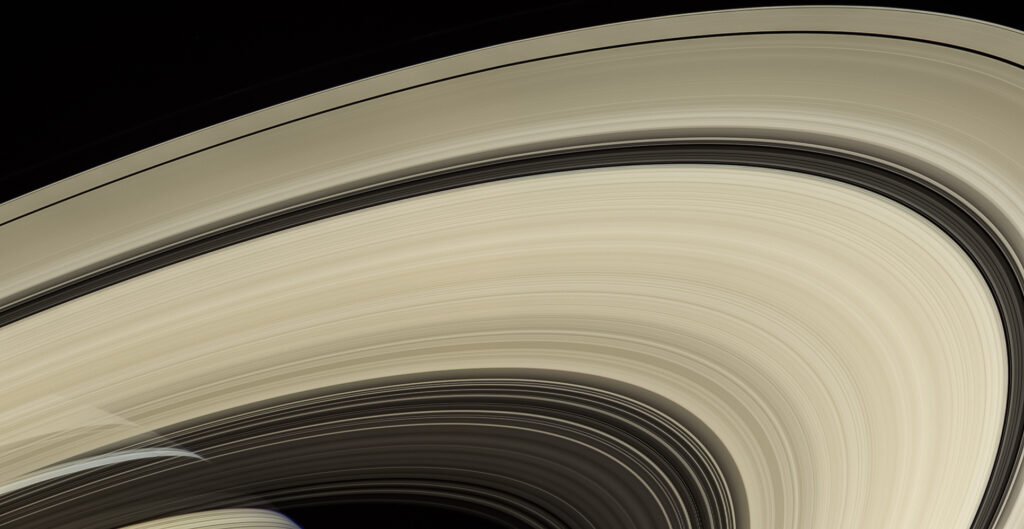
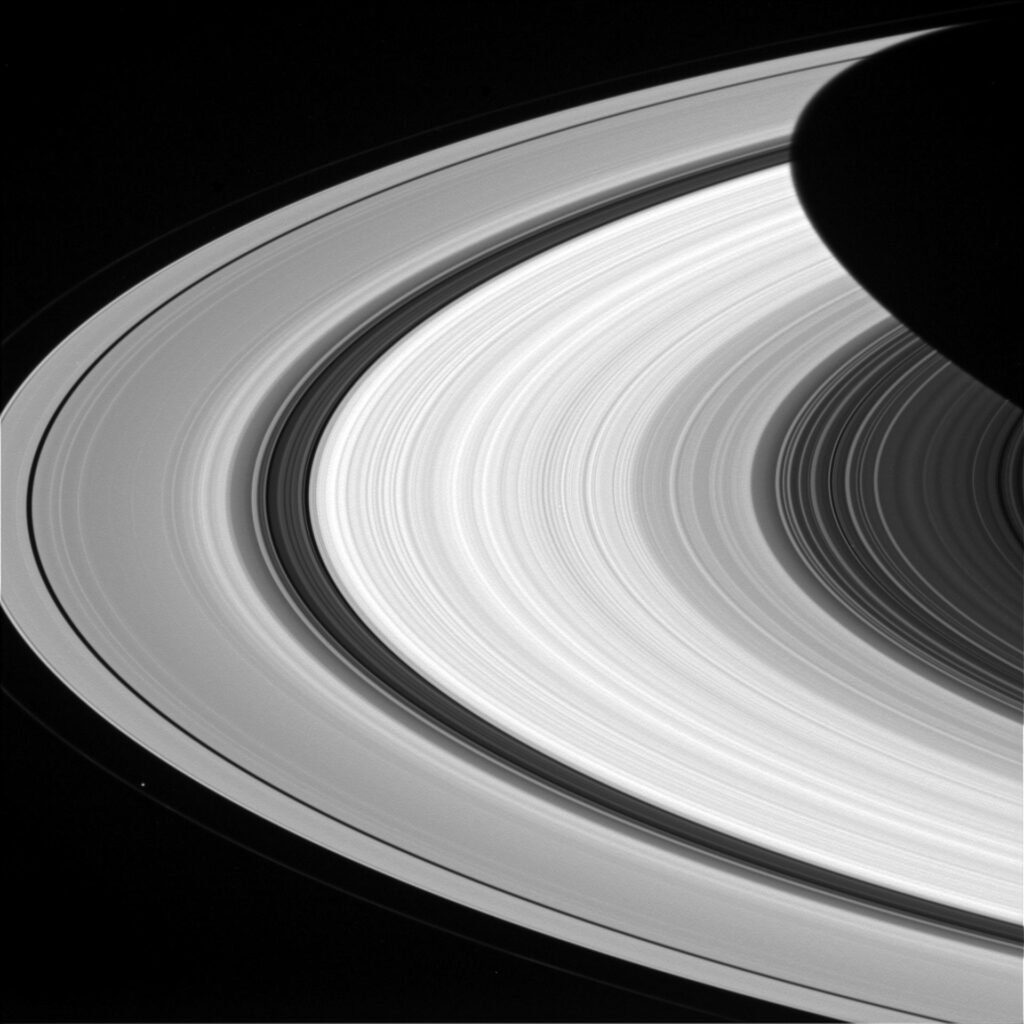
Saturn’s rings aren’t one single continuous disk, they’re divided into several distinct sections, each one named alphabetically in the order it was discovered rather than in the order they actually sit around the planet, which admittedly makes the naming system a little confusing at first glance. The main rings visible through a decent backyard telescope are labeled A, B, and C, with the wide, dark gap between the A and B rings known as the Cassini Division, named after the astronomer Giovanni Cassini, who first spotted it back in 1675, over three centuries before NASA’s spacecraft borrowed his name.
Beyond the main rings, Saturn also has several fainter, more distant rings that are much harder to observe, some made almost entirely of extremely fine dust rather than the larger icy chunks found closer to the planet.
If you want to try spotting Saturn’s rings for yourself, a modest beginner telescope is genuinely enough to pick them out on a clear night. Our guide on what you can see in the night sky without a telescope tonight is a good place to start building up your stargazing skills before working your way up to a target like Saturn.
A Beautiful, Temporary Icy Halo
So the next time someone asks what Saturn’s rings are made of, you’ve got the real answer, billions upon billions of icy particles, ranging from dust to house sized chunks, held together in a razor thin disk by Saturn’s gravity, likely formed from some kind of violent collision or tidal destruction a few hundred million years ago. They’re relatively young by solar system standards, and thanks to the slow but steady process of ring rain, they won’t be around forever either. Its a good reminder that even the most iconic, seemingly permanent features in our solar system are still very much a work in progress.
For more detailed research and stunning imagery from the Cassini mission, check out the full breakdown from NASA Science and the additional overview from Space.com.
If you enjoyed this article, don’t forget to drop us a comment, it really helps support the site, and be sure to check out our other articles because we think you’re going to love them too.