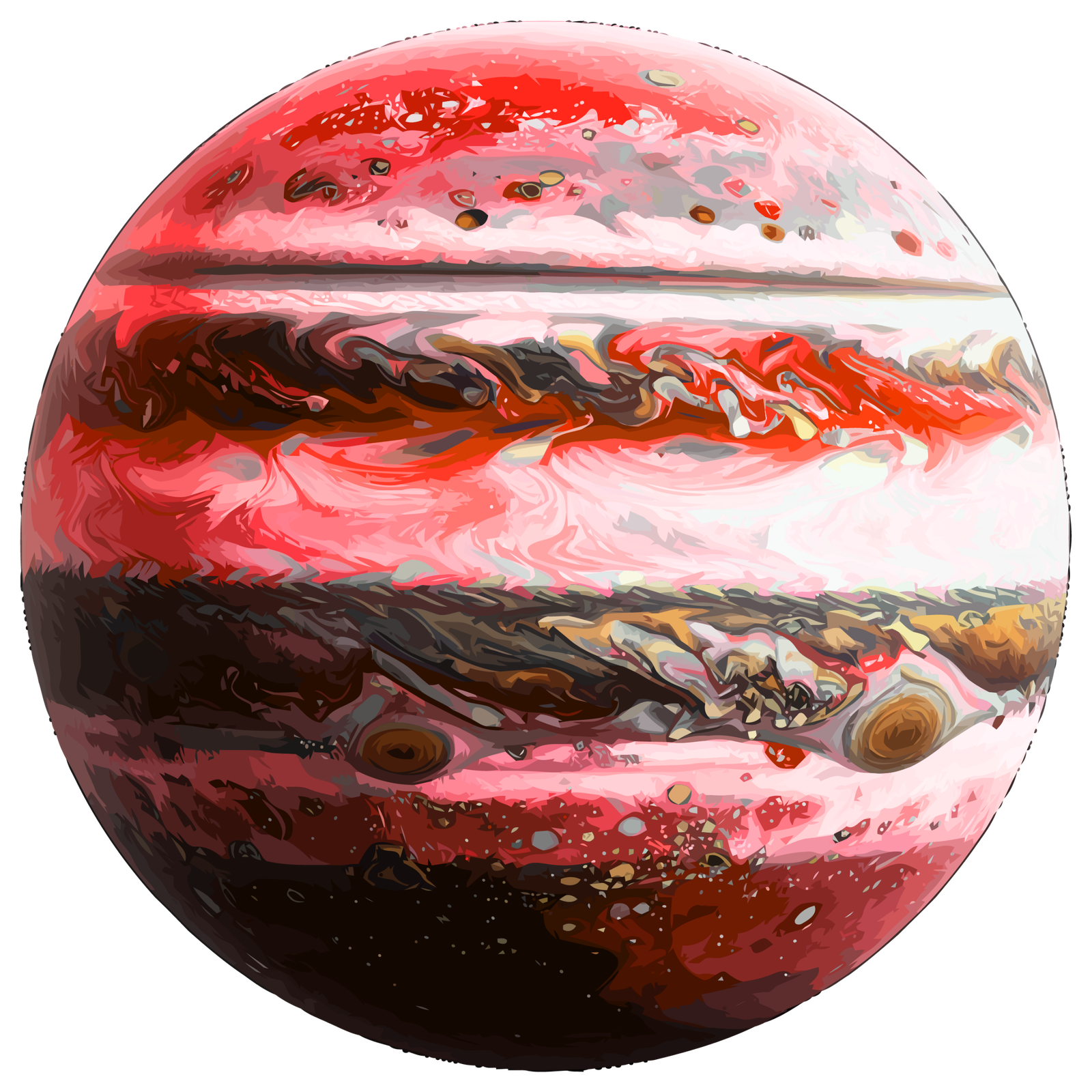

When you look up at the evening sky right after sunset, you can often spot a brilliant point of light shining brighter than almost any star. That bright gem is Venus, our closest planetary neighbor. For centuries, people called it both the Evening Star and the Morning Star, not realizing it was actually a whole other world orbiting our central star.
Because Venus is similar to Earth in a lot of ways, scientists often call it Earths evil twin. But when you look closely at its physical dimensions, its orbit, and ask yourself how far venus from the sun really is, you quickly realize how hostile and bizarre this world actually turned out to be.
Here is a straightforward guide to understanding Venus size, its distance from the Sun, and one of the weirdest orbits in the entire solar system.
How Far Is Venus From the Sun?
If you were to trace the inner solar system starting from the center, Venus sits right in the second spot between Mercury and Earth. But space distances aren’t entirely fixed numbers because planetary orbits are slightly stretched out.
So, how far venus from the sun on average?
Venus orbits the Sun at an average distance of about 67 million miles (or roughly 108 million kilometers). In astronomical terminology, that translates to about 0.72 Astronomical Units (AU), where 1 AU is the distance between Earth and the Sun.
Because Venus has the most circular orbit of any planet in our entire solar system, its distance doesn’t fluctuate nearly as much as other planets do:
- Perihelion (Closest Distance to the Sun): Around 66.7 million miles (107.5 million km)
- Aphelion (Farthest Distance from the Sun): Around 67.7 million miles (108.9 million km)
At this distance, sunlight takes a little under 6 minutes to travel from the Sun to Venus surface. Compare that to Earth, where light takes about 8 minutes, and you can see why Venus receives almost double the solar energy that we do here on Earth.
Venus Size Compared to Earth
When astronomers call Venus our “twin,” they are mostly talking about its physical size and mass. If you put the two planets side by side, they would look almost identical in diameter.
Venus has an equatorial diameter of about 7,521 miles (12,104 kilometers). That makes it about 95 percent the size of Earth. It also holds roughly 81 percent of Earths total mass.
If Earth were the size of a standard nickel, Venus would be about the size of a penny.
Because their sizes and densities are so close, gravity on Venus is very similar to what we feel on Earth. If you weigh 150 pounds on Earth, you would weigh around 135 pounds standing on the surface of Venus. Of course, you couldn’t actually stand there without a specialized spacesuit because the atmospheric pressure on the ground is nearly 90 times heavier than Earths—equivalent to being nearly a mile underwater!
A Weird Orbit That Spins Backwards
While Venus size and solar distance seem fairly normal, its orbital mechanics and rotation are downright weird.
First off, a single year on Venus—the time it takes to make one complete revolution around the Sun—lasts about 225 Earth days.
However, Venus spins on its axis so slowly that a single day on Venus (one full rotation) takes 243 Earth days! That means a day on Venus is actually longer than its year.
Even stranger is the direction it rotates. Almost every planet in our solar system, including Earth, spins counterclockwise on its axis. But Venus spins clockwise. Scientists call this “retrograde rotation.”
If you were standing on the surface of Venus (and somehow survived the toxic atmosphere), the Sun would rise in the west every morning and set in the east every evening!
Most planetary scientists believe that billions of years ago, a massive collision with a giant protoplanet or strong atmospheric tidal forces flipped the planet rotation upside down or slowed it to a crawl.
Why Distance Isn’t the Only Reason Venus Is So Hot
You might assume Mercury is the hottest planet in the solar system because its closer to the Sun than Venus. But Venus actually takes the crown for the hottest planetary surface.
Even though Venus sits 67 million miles out, its thick atmosphere is made up of 96 percent carbon dioxide, creating a runaway greenhouse effect.
Heat from the Sun enters through the upper cloud decks but gets completely trapped by the dense atmosphere. Surface temperatures on Venus reach a scorching 900 degrees Fahrenheit (475 degrees Celsius) day and night. That is hot enough to melt solid lead in seconds!
Frequently Asked Questions
How far venus from the sun in miles and kilometers?
Venus is an average of 67 million miles (108 million kilometers) away from the Sun, which is equal to roughly 0.72 Astronomical Units (AU).
Is Venus closer to the Sun than Earth?
Yes, Venus is the second planet from the Sun, placing it between Mercury and Earth. It orbits about 26 million miles closer to the Sun than Earth does.
Why does Venus take longer to rotate than to orbit the Sun?
Venus has a super slow rotational speed due to gravitational tidal friction or ancient collision impacts. It takes 243 Earth days to rotate once on its axis, but only 225 Earth days to complete an orbit around the Sun.
Venus is a fascinating world of extremes—a planet nearly identical to Earth in size, yet completely transformed into a fiery wasteland by its close distance to the Sun and thick atmosphere.