
Six more meteor showers cross Earth’s path before the year is out, and two of them rank among the best of the entire year. Here’s exactly when to look up, what to expect, and how the Moon will affect each one.
The Full Schedule
| Shower | Peak Night | Rate (per hour) | Moon Conditions | Source |
|---|---|---|---|---|
| Southern Taurids | Nov 4–5 | ~5 | Waning crescent, dark skies | Comet 2P/Encke |
| Northern Taurids | Nov 11–12 | ~5 | Waxing crescent, sets early | Asteroid 2004 TG10 |
| Orionids | Oct 21–22 | ~20 | New Moon, excellent | Halley’s Comet |
| Leonids | Nov 17–18 | ~15 | Thin waxing crescent, dark | Comet 55P/Tempel-Tuttle |
| Geminids | Dec 13–14 | 40–120 | Waxing crescent, sets early | Asteroid 3200 Phaethon |
| Ursids | Dec 21–22 | <10 | Full Moon, poor | Comet 8P/Tuttle |
October: Orionids
The Orionids kick things off, and 2026 is shaping up to be an excellent year for them. Earth passes through debris shed by Halley’s Comet, the same object that won’t swing back through the inner solar system until 2061, and this year’s peak lands right on a new Moon, meaning nothing washes out the fainter meteors. Look toward the constellation Orion after midnight for the best rates, roughly 20 meteors an hour under a truly dark sky.
November: A Three-Shower Month
November is genuinely busy. It opens with the Southern Taurids peaking November 4–5, then the Northern Taurids follow just a week later on November 11–12. Neither Taurid stream produces high rates, only about five meteors an hour each, but they’re famous for something the bigger showers rarely deliver, slow, unusually bright fireballs. When both streams overlap in early-to-mid November, fireball activity tends to tick up noticeably.
The Leonids close out the month on November 17–18. This shower has a wild reputation, past Leonid returns in 1833, 1966, and 2001 produced genuine meteor storms with thousands of meteors per hour, though nothing like that is expected until the parent comet’s next close pass in 2031. A thin waxing crescent Moon sets early this year, leaving the entire post-midnight window dark, one of the better viewing setups for the Leonids in recent memory.
December: Geminids, Then Ursids
December delivers the year’s strongest show. The Geminids peak the night of December 13–14, and NASA rates them among the most reliable annual showers, producing anywhere from 40 to 120 meteors an hour depending on sky darkness. Unlike almost every other major shower, the Geminids come from an asteroid rather than a comet, 3200 Phaethon, a rocky body that may be a burned-out “dead comet.” A waxing crescent Moon sets early in the evening this year, leaving the night largely moon-free for the peak.
The Ursids close out the year on December 21–22, right around the winter solstice. It’s a modest shower, typically under 10 meteors an hour, and 2026 isn’t a great year for it, a full Moon will wash out all but the brightest meteors.
How to Actually See Any of These
The same basic rules apply to every shower on this list. Get as far from city lights as you reasonably can, give your eyes a full 20 to 30 minutes to adjust to the dark without checking your phone, and look up at a wide stretch of sky rather than staring only at the named constellation, meteors can streak across any part of the sky. No telescope or binoculars needed, meteors move too fast for either to be useful. Bundle up, bring something comfortable to lie back on, and be patient, meteors tend to arrive in clusters with quiet stretches in between.
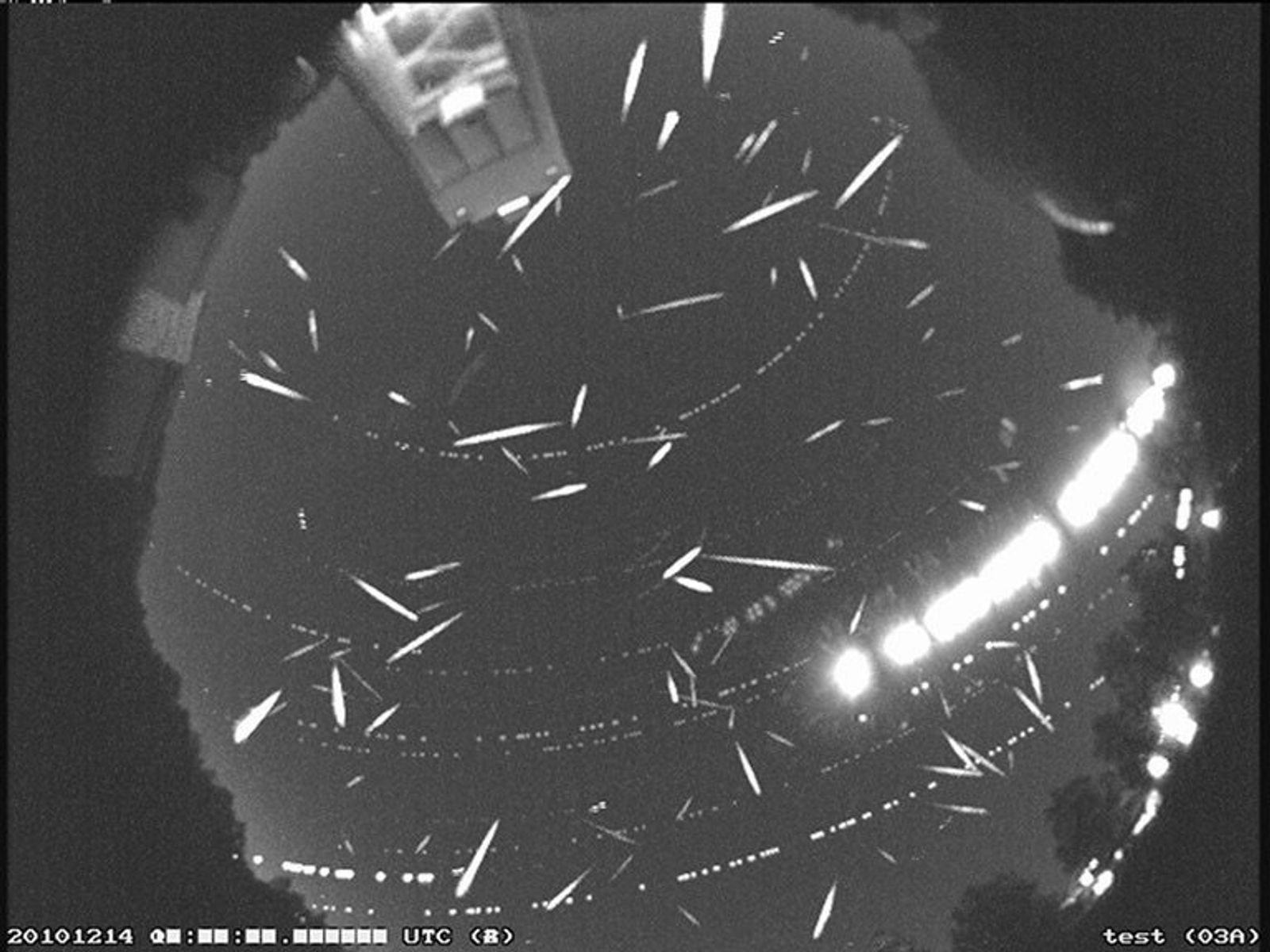 Over 100 meteors recorded in a composite image taken during a Geminid meteor shower peak, one of the most reliable annual showers. (Image: NASA/MSFC, Danielle Moser/NASA’s Meteoroid Environment Office)
For real-time predictions tailored to your location and the current Moon phase, our meteor shower tracker updates automatically as each of these dates approaches. And if you want the full deep dive on this past August’s Perseids specifically, our complete Perseid guide covers the shower that already came and went this year.
If you enjoyed this article, don’t forget to drop us a comment, it really helps support the site, and be sure to check out our other articles because we think you’re going to love them too.