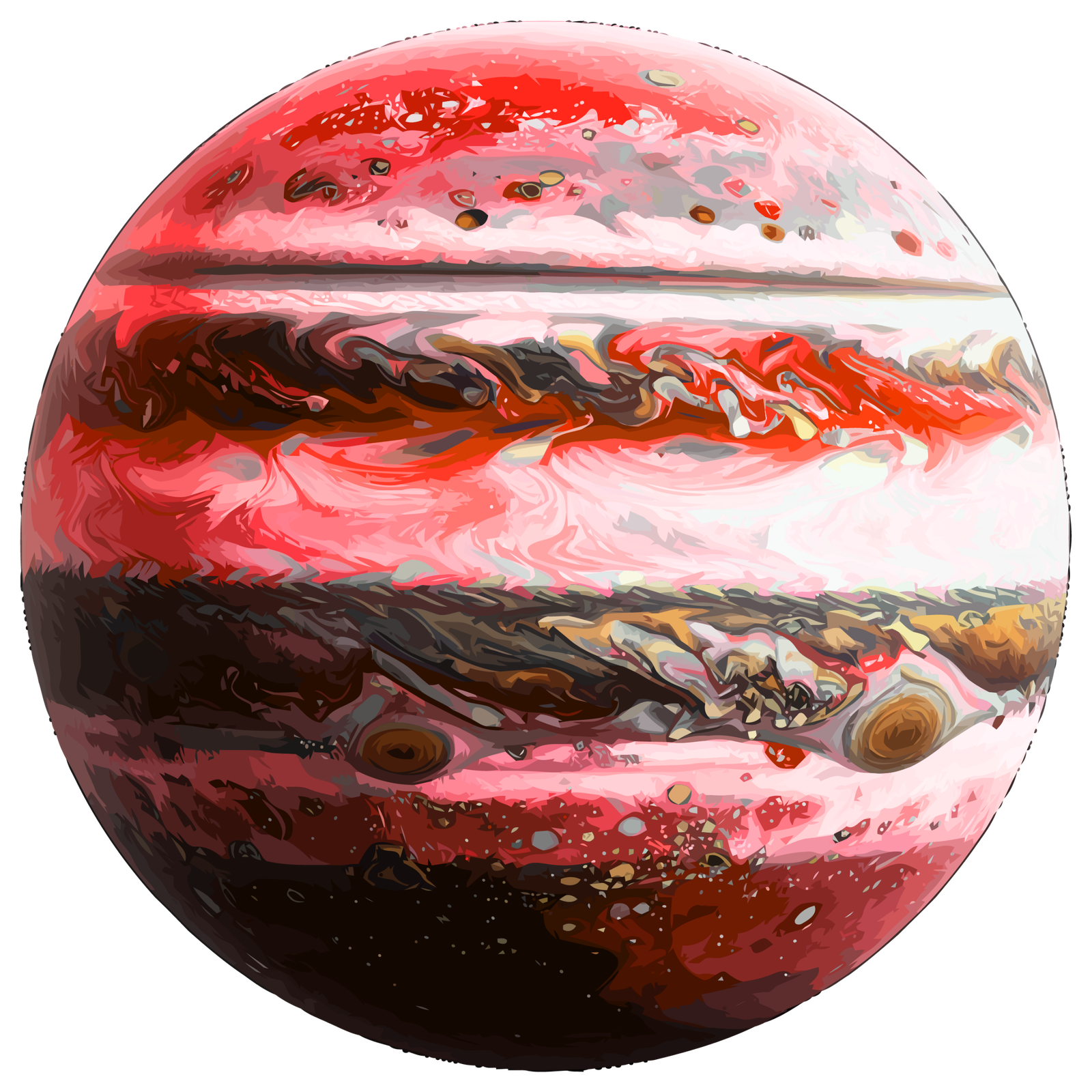

Look up on almost any clear night and theres a decent chance you’ll spot a bright, steady point of light thats actually not a star at all. Theres a good chance its Jupiter, the biggest planet in our solar system and one of the easiest to pick out with just your own two eyes. But how big is Jupiter really, how far away is it, and how long does it actually take to circle the Sun? Lets get into it.
Just How Far Is the Distance from the Sun to Jupiter?
On average, the distance from the Sun to Jupiter comes out to about 484 million miles, or roughly 778 million kilometers. Astronomers usually describe this using a unit called an astronomical unit, or AU for short, which is just the average distance between Earth and the Sun. Using that measuring stick, Jupiter sits at about 5.2 AU from the Sun, meaning its more than five times farther from the Sun than we are.
To put that distance into something a little more relatable, sunlight takes about 8 minutes to reach Earth. By the time that same sunlight reaches Jupiter, its been traveling for around 43 minutes. Thats a genuinely massive gap, and it plays a big role in why Jupiter is such a cold, dim world despite being so enormous.
Its worth mentioning that Jupiter’s orbit isn’t a perfect circle, its slightly elliptical, so the exact distance from the Sun to Jupiter shifts a bit depending on where the planet is in its orbit at any given time. Still, that 484 million mile figure is the number astronomers use as the standard average.
If comparing distances across the solar system is something that interests you, our light travel time calculator is a fun way to see how long light takes to reach each planet, Jupiter included.
How Big Is Jupiter, Actually?
Jupiter earns its nickname as the king of the planets for good reason. Its equatorial diameter comes in at around 88,846 miles, or about 142,984 kilometers, which makes it roughly 11 times wider than Earth. A popular way scientists like to describe the size difference is this, if Earth were shrunk down to the size of a grape, Jupiter would be about the size of a basketball sitting right next to it.
The scale gets even wilder when you look at mass instead of just width. Jupiter is so massive that it outweighs every other planet in the solar system combined, with room to spare. Despite all that bulk, Jupiter doesn’t have a solid surface you could stand on. Its almost entirely made of hydrogen and helium gas, the same basic ingredients that make up the Sun, just not quite enough of it to ever ignite into a star of its own.
For anyone who wants to see just how dramatically your own weight would change standing on a planet with gravity that intense, check out our weight on planets calculator and plug in Jupiter to see the numbers for yourself.
How Long Is a Year, and a Day, on Jupiter?
Heres where things get a little backwards compared to what you might expect. Even though Jupiter is gigantic, it spins incredibly fast. One full rotation, meaning one day on Jupiter, takes under 10 hours, making it the shortest day of any planet in the solar system. That fast spin is actually why Jupiter looks slightly squashed at the poles and bulges out around its equator.
A year on Jupiter is a whole different story. Because Jupiter is so far from the Sun, it has a lot more ground to cover during each orbit, and it takes nearly 12 Earth years to complete just one trip around the Sun. So if you were born the same year Jupiter passed a certain point in its orbit, it wouldn’t return to that exact spot again until close to your twelfth birthday.
The Famous Storm You Can Actually See
No conversation about Jupiter feels complete without mentioning the Great Red Spot, a massive storm that’s been raging on the planet for at least 400 years. Its so large that it could swallow Earth whole, with room left over. Even a modest backyard telescope can pick it out on a clear night when its facing our direction, which makes Jupiter one of the most rewarding planets for beginner stargazers to track down.
If you’re just getting into planet spotting, our guide on what you can see in the night sky without a telescope tonight is a great starting point before working your way up to telescope targets like the Great Red Spot.
A Mini Solar System of Its Own
Jupiter doesn’t travel alone. It’s got dozens upon dozens of moons, with the four largest, Io, Europa, Ganymede, and Callisto, discovered all the way back in 1610 by Galileo himself. Ganymede alone is larger than the planet Mercury, and Europa is considered one of the most promising places in the solar system to search for signs of life thanks to the ocean scientists believe is hiding beneath its icy shell.
Between its moons, its storms, and its sheer scale, Jupiter behaves almost like its own miniature solar system tucked inside our larger one, all sitting out there roughly 484 million miles from the Sun, quietly shaping the orbits of everything around it.
For more detailed figures and NASA’s official data on Jupiter, you can check out the numbers straight from NASA’s Jupiter Facts page and the additional breakdown over at Astronomy.com.
If you enjoyed this article, don’t forget to drop us a comment, it really helps support the site, and be sure to check out our other articles because we think you’re going to love them too.