
On a crisp autumn or winter night, away from the worst of the city glow, look up and you’ll eventually notice a tiny, tight little knot of stars that almost looks like a smudge or a miniature dipper. People spot it, squint, and often assume their eyes are playing tricks. They’re not. That delicate cluster is the Pleiades, one of the most beloved sights in the entire night sky, and humans have been gazing at it and telling stories about it for thousands of years. You may even carry it around without realizing, since it’s the very cluster on the Subaru car badge.
The Little Cluster You’ve Seen a Thousand Times
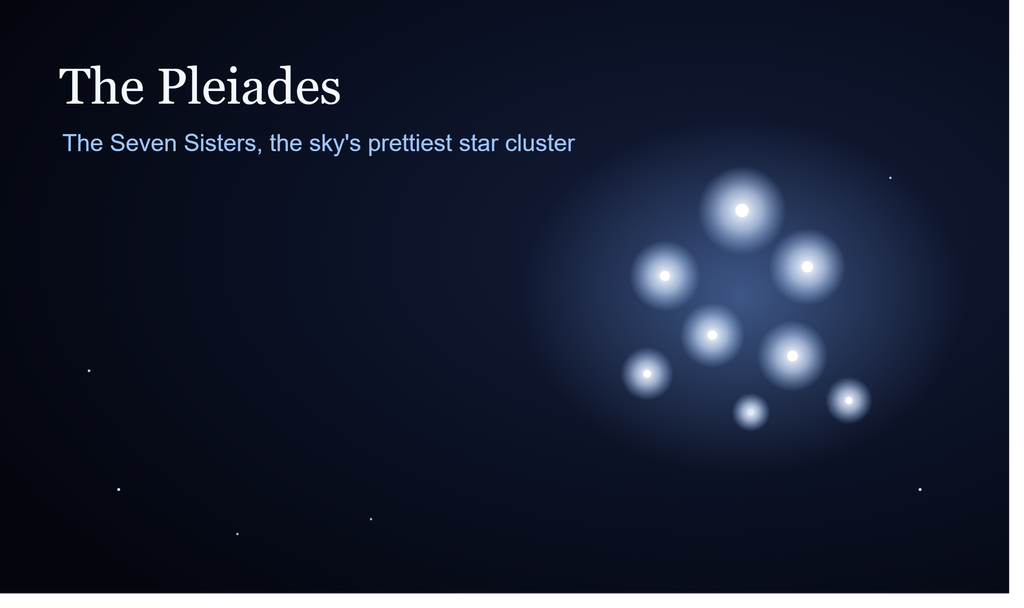
The Pleiades go by many names. Astronomers catalog them as Messier 45, or M45 for short. Most cultures across history simply called them the Seven Sisters. Whatever you call them, they form a compact, sparkling group that stands out even to a casual glance, and that’s a big part of their charm. You don’t need a telescope, a dark-sky reserve, or any special skill. If the night is clear, they’re right there waiting.
They sit within the constellation Taurus, the Bull, and once you learn where to look, you’ll find yourself picking them out automatically for the rest of your life.
What Exactly Are the Pleiades?
The Pleiades are what astronomers call an open star cluster, which means a loose family of stars that all formed together from the same cloud of gas and dust and are still drifting through space in roughly the same direction. They lie about 440 light-years from Earth, which makes them one of the nearest and most easily visible clusters to us.
The cluster contains more than a thousand stars, though only a handful shine brightly enough to catch the eye. What really defines the Pleiades is their color and their youth. These are hot, brilliant, blue-white stars, and they’re astronomically young, having formed only around 100 million years ago. For comparison, that’s a small fraction of our Sun’s age. If you’ve ever wondered why some stars burn blue while others glow red or gold, our piece on why there are no green stars unpacks the surprising physics of stellar color.
Why “Seven Sisters,” and Why Can I Only Count Six?
Here’s a puzzle that has intrigued people for ages. The cluster is famously called the Seven Sisters, named in Greek mythology for the seven daughters of the titan Atlas and the sea-nymph Pleione. Yet when most people look up, they can only count six stars.
There’s no single tidy answer, but the everyday explanation is simply eyesight and sky conditions. Under a genuinely dark sky, sharp-eyed observers can pick out seven, and some even claim nine or more. City lights, haze, and tired eyes tend to wash out the fainter members, leaving the famous six. Grab a pair of binoculars, though, and the “handful” of stars suddenly blossoms into dozens, which is one of the great little thrills of stargazing. For more easy targets you can enjoy without any equipment, our guide to what you can see in the night sky without a telescope is a lovely companion.
Those Ghostly Blue Wisps Around the Stars
If you look at a long-exposure photograph of the Pleiades, like the one above, you’ll notice the stars appear tangled in soft, glowing blue veils. For a long time astronomers assumed this was leftover gas from the cluster’s birth. We now know the truth is more of a happy accident.
The cluster is simply passing through an unrelated cloud of interstellar dust, and the brilliant blue starlight is scattering off that dust like a car’s headlights catching fog. The wisps aren’t the stars’ cradle at all, just a beautiful coincidence of a young cluster drifting through a dusty patch of the galaxy at exactly the right moment for us to admire it.
How to Find the Pleiades Yourself
The easiest way to track them down is to use the constellation Orion as a pointer, since almost everyone can find Orion’s Belt. Take the line of the three belt stars and follow it up and to the right. You’ll first arrive at a bright orange-red star, Aldebaran, the fiery eye of Taurus the Bull. Keep going a little farther in the same direction and you’ll run right into the small, glittering knot of the Pleiades.
The best months to catch them are roughly October through April in the Northern Hemisphere, with December being prime time when they ride high in the evening sky. They’re visible from the Southern Hemisphere too, where in New Zealand the cluster is known as Matariki and marks the start of the Māori new year. Once you’ve found them a few times, try lingering with binoculars to soak in the full sparkle. If star colors and clusters delight you, our beginner’s stargazing guide to the sky’s colorful stars is a great next stop.
A Cluster That Just Got Much Bigger
For all their ancient fame, the Pleiades still have surprises left in them. In late 2025, astronomers using NASA’s TESS spacecraft announced that the cluster is far larger than anyone realized. By carefully studying the ages, chemistry, and galactic orbits of nearby stars, they identified a sprawling “Greater Pleiades Complex” of more than 3,000 stars, siblings born from the same original cloud that have since scattered across a huge swath of the sky.
It’s a wonderful reminder that even the most familiar objects can still teach us something new. The little cluster our ancestors named after seven sisters turns out to be the bright, dense heart of a much bigger stellar family, spread out like a slow-motion firework across the heavens. You can dive deeper into the cluster on NASA’s Messier 45 page.
Next clear night, step outside and hunt for that tiny sparkling smudge near Orion. When you find it, you’ll be looking at the same stars that have guided calendars, inspired myths, and quietly delighted skywatchers for as long as there have been eyes to look up.
If you enjoyed this article, don’t forget to drop us a comment, it really helps support the site, and be sure to check out our other articles because we think you’re going to love them too.