
Look up at the Moon on two different nights and it can seem like a completely different object. One evening it’s a fat, glowing circle. A week later it’s a thin silver curve, barely there. We’ve all watched it happen our whole lives, and yet most people never quite learn why. The good news is that the Moon isn’t doing anything mysterious. Once you understand the simple bit of cosmic geometry behind it, the whole cycle clicks into place and you’ll be able to read the sky like a clock.
The Moon Isn’t Actually Changing Shape at All
Here’s the single most important thing to understand, and everything else follows from it. The Moon doesn’t make its own light. What we call moonlight is just sunlight bouncing off the Moon’s surface. And at every single moment, the Sun lights up exactly one half of the Moon, the same way it lights up half of the Earth to give us day and night.
So the Moon is always half in light and half in darkness. What changes is our viewing angle. As the Moon circles the Earth over the course of a month, we see that sunlit half from different directions. Sometimes we’re looking straight at the lit side, sometimes at the dark side, and usually somewhere in between. The “shape” we see is simply how much of the Moon’s bright half is turned toward us on any given night.
The One Big Myth to Clear Up First
Before we go further, let’s kill the most common misconception. The phases of the Moon are not caused by the shadow of the Earth falling on it. Plenty of people believe this, but it’s simply not true.
The Earth’s shadow does fall on the Moon occasionally, and when it does, we get a completely different and much rarer event called a lunar eclipse. That’s when the Moon slides into Earth’s shadow and often turns a deep coppery red. If that particular spectacle interests you, we cover it in our guide to what a blood moon actually is. But the ordinary monthly phases have nothing to do with shadows. They’re all about angles and orbits.
The 8 Phases of the Moon, in Order
The full cycle takes about 29.5 days to go from one new moon to the next, and along the way the Moon passes through eight named phases:
- New Moon — The Moon sits between us and the Sun, so its lit side faces away and it’s essentially invisible. It’s also up during the day, lost in the Sun’s glare.
- Waxing Crescent — A thin sliver of light appears and slowly grows. In the Northern Hemisphere, that sliver is on the right.
- First Quarter — We now see half of the lit side, which looks like a neat half-circle. It rises around midday and shines high in the evening sky.
- Waxing Gibbous — More than half is lit now, swelling toward full each night.
- Full Moon — The Moon sits opposite the Sun, so we see its entire sunlit face. It rises right as the Sun sets and glows all night.
- Waning Gibbous — The bright area begins to shrink from the other side as the Moon heads back toward the Sun.
- Last Quarter — Down to a half-circle again, but the opposite half from before. It rises in the middle of the night.
- Waning Crescent — A thin curve of light, fading a little more each morning until we’re back to new moon and the cycle starts over.
Waxing vs Waning: A Trick to Never Mix Them Up
Those two words trip people up constantly, so here’s an easy way to remember them. Waxing means growing, as in a candle building up wax. Waning means shrinking, as in enthusiasm that’s waning away. A waxing Moon is on its way to full, and a waning Moon is on its way back to new.
There’s a handy visual cue too, at least if you live in the Northern Hemisphere. When the lit part of the Moon is on the right, it’s waxing and getting bigger. When the light is on the left, it’s waning and getting smaller. Down in the Southern Hemisphere the whole thing flips, since observers there are effectively looking at the Moon upside down.
What Exactly Is a “Blue Moon”?
You’ve almost certainly heard the phrase “once in a blue moon,” meaning something rare. It comes straight from the sky, though it has nothing to do with color. The Moon doesn’t actually turn blue.
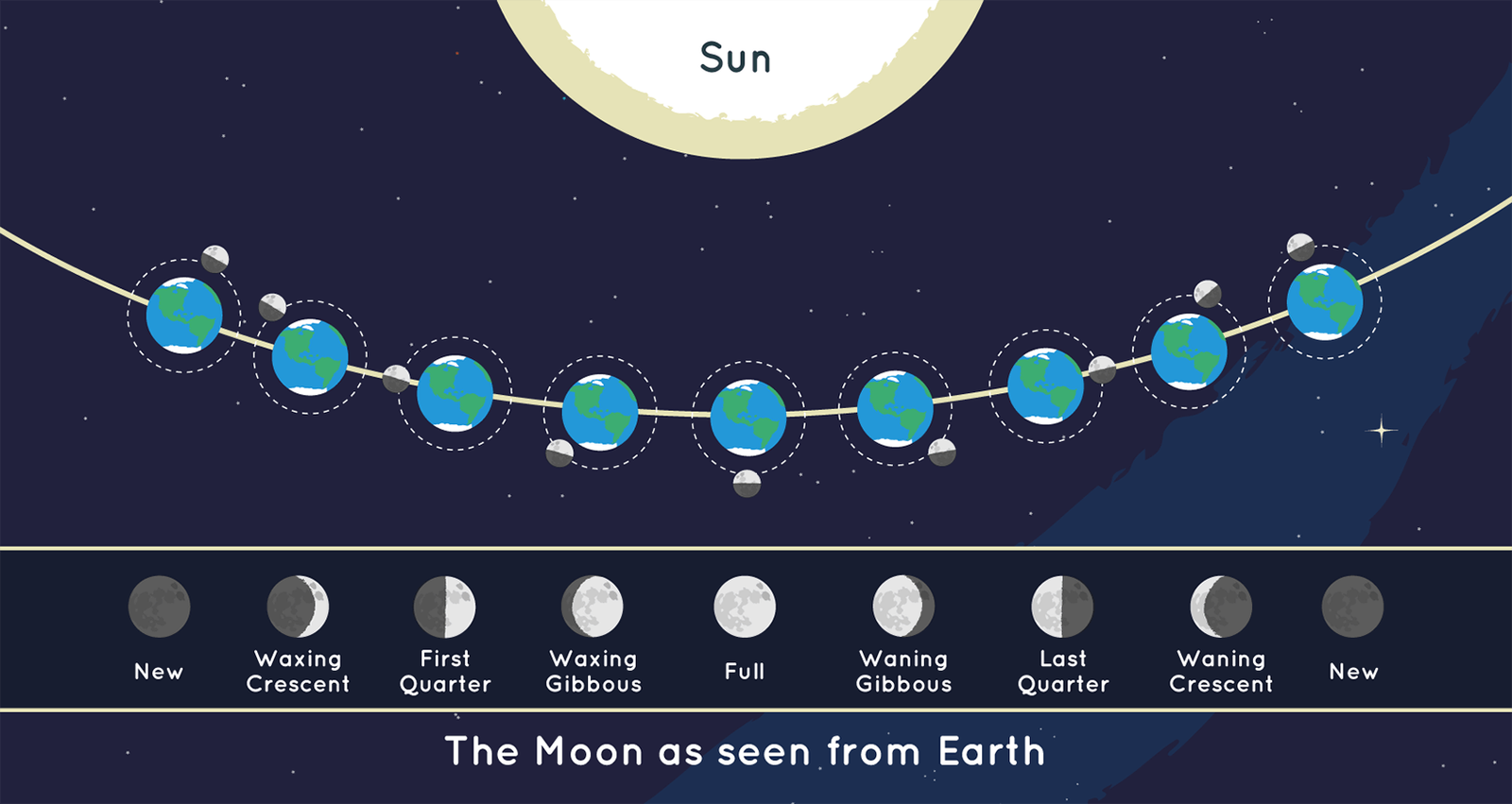 How the Moon’s position relative to the Sun and Earth produces each phase we see. Not to scale. (Image: NASA/JPL-Caltech)
Because the lunar cycle runs about 29.5 days and most of our calendar months are a day or two longer, every so often a single month manages to squeeze in two full moons. That second full moon is what we call a blue moon, and it only happens roughly every two to three years. So the phrase is well earned. It really is a fairly uncommon event, just not a colorful one.
Same Face, Every Single Night
One last lovely detail. As the Moon runs through all these phases, you might expect to see different parts of its surface, but you never do. The same familiar pattern of dark patches and craters faces us at every phase, month after month.
That’s because the Moon is tidally locked to the Earth. It spins on its own axis at exactly the same rate that it orbits us, so one side is permanently turned our way and the far side never shows. It’s the reason the “man in the Moon” always looks the same. If you’re curious about how our Moon came to behave this way, our piece on what makes our Moon so special digs into its origins and oddities.
The best way to make all of this stick is simply to watch. Pick a spot, glance up each clear night for a few weeks, and you’ll start to feel the rhythm of the cycle in your bones. To plan ahead and see exactly what tonight’s Moon looks like, try our Moon phase and supermoon calculator, and for the full scientific rundown you can always visit NASA’s Moon Phases page.
If you enjoyed this article, don’t forget to drop us a comment, it really helps support the site, and be sure to check out our other articles because we think you’re going to love them too.