
Mark your calendar, because the night of August 27th into the early morning of August 28th is bringing one of the most striking sky events of the year, a deep, near total blood moon, and unlike a solar eclipse, this one is completely safe to watch with nothing but your own eyes.
So What Actually Is a Blood Moon?
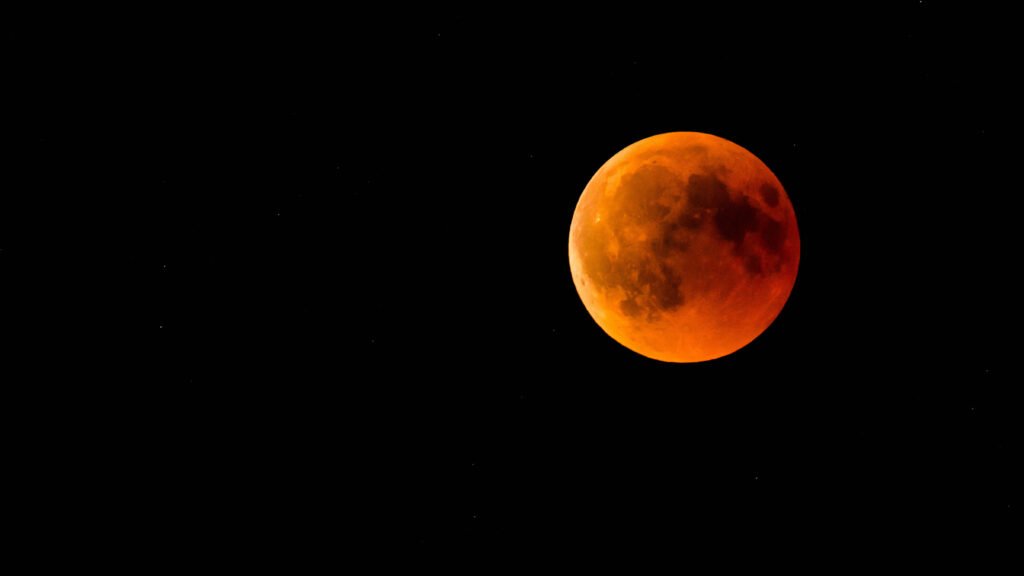
A blood moon isn’t an official astronomy term, its a nickname for a total lunar eclipse, which happens when Earth lines up directly between the Sun and the Moon, casting its shadow across the lunar surface. Once the Moon slides into the darkest part of that shadow, called the umbra, direct sunlight cant reach it anymore. But instead of just going dark, the Moon takes on a deep red, orange, or copper glow, and that reddish color is exactly where the nickname comes from.
The reason for the color actually comes down to Earth’s atmosphere. As sunlight grazes past the edge of our planet on its way toward the Moon, the atmosphere scatters out the blue wavelengths, the same process, called Rayleigh scattering, thats responsible for making our sky blue and our sunsets orange. What’s left over after that scattering is mostly red and orange light, and that filtered light is what ends up painting the eclipsed Moon. Its essentially every sunrise and sunset happening on Earth at that moment, projected all at once onto the lunar surface.
This Month’s Eclipse Is a Big One
The upcoming eclipse on August 27th and 28th, 2026 is whats called a partial lunar eclipse, but don’t let “partial” undersell it. At maximum eclipse, roughly 96 percent of the Moon’s diameter will be swallowed by Earth’s shadow, just barely missing the cutoff for a true total eclipse. That makes this one of the deepest, most dramatic partial eclipses in years, visually almost indistinguishable from a full blood moon, with only a thin, bright sliver of the Moon left glowing along one edge.
For skywatchers across the United States, the show unfolds during the evening and overnight hours of August 27th, with maximum eclipse landing around 9:12 p.m. PDT, 10:12 p.m. MDT, 11:12 p.m. CDT, and 12:12 a.m. EDT heading into the 28th. Most of North America will have a good view, so its worth stepping outside once the Moon starts sliding into shadow.
How to Watch
The best part about a blood moon is how little effort it takes to enjoy one. Unlike a solar eclipse, which requires certified eclipse glasses to view safely, a lunar eclipse is completely safe to look at directly with the naked eye for as long as you want. No special equipment is required at all, though a pair of binoculars or a small telescope will make the color and detail noticeably more vivid.
Find a spot with a clear view of the sky, away from bright streetlights if you can manage it, and give yourself a little time to actually watch the process unfold, the Moon gradually darkening and shifting color is honestly more dramatic to witness in real time than it looks in a single photo. If you want a refresher on tracking moon phases before eclipse night arrives, our moon phase and supermoon calculator is a handy tool for planning ahead.
Why the Color Changes Every Time
No two blood moons look exactly alike, and that’s part of what makes them fun to photograph and compare. The exact shade, anywhere from a bright copper orange to a dark brick red, depends heavily on conditions in Earth’s atmosphere at the time, dust, clouds, humidity, even smoke or volcanic ash drifting through the upper atmosphere can shift the color one way or another. A particularly clear, dust free atmosphere tends to produce a brighter, more orange eclipse, while extra particulates in the air can deepen the red toward something closer to dark rust.
If eclipses in general have you curious about the bigger picture, our breakdown of how often a solar eclipse actually occurs covers the sibling event to this one, and explains why total solar eclipses feel so much rarer for any one specific location on Earth.
Don’t Miss This One
Deep partial eclipses at this magnitude don’t come around often, this is being called the most visually striking lunar eclipse in over two years for viewers across a wide stretch of the globe. So if the sky’s clear where you are on the night of August 27th, its worth setting a reminder and stepping outside. No glasses, no telescope required, just a clear view of the sky and a few minutes of patience while the Moon quietly turns red right in front of you.
For exact eclipse times in your specific location, check the detailed timing tables from The Old Farmer’s Almanac and the visibility maps from BBC Sky at Night Magazine.
If you enjoyed this article, don’t forget to drop us a comment, it really helps support the site, and be sure to check out our other articles because we think you’re going to love them too.