
The Short Answer
About 1,300 Earths could fit inside Jupiter. The king of the planets is so vast that you could pour more than a thousand Earths into it and still have room to spare. It’s a number that really drives home just how much of a giant Jupiter truly is compared to our own modest little world.
If you’ve ever seen those diagrams lining the planets up side by side, Jupiter always looks like the big kid standing next to a row of toddlers. But side-by-side pictures only tell part of the story. The real shock comes when you stop thinking about width and start thinking about volume, about actually filling Jupiter up with Earths. So let’s do exactly that, and see how the biggest planet stacks up.
The Big Number: Around 1,300 Earths
Jupiter’s volume is roughly 1,300 times that of Earth. So if you imagined Jupiter as a giant hollow ball and started dropping Earths into it, about 1,300 of them would fit before it was full.
As with any of these thought experiments, there’s a small footnote. That 1,300 figure assumes the Earths fill the space perfectly, but round objects always leave little gaps between them when you pack them together. Account for those gaps and the realistic number is closer to 1,000 Earths. Either way, we’re talking about a planet that could comfortably hold a four-digit pile of Earths, which is genuinely hard to picture. To see where Jupiter sits among its neighbours, our beginner’s guide to the planets lays out the whole lineup by size and distance.
How Many Earths Fit Across Jupiter?
Volume gives you the dramatic headline, but lining Earths up in a row gives you a different and maybe more intuitive feel for the size. So how many Earths would it take to stretch across Jupiter’s face?
Jupiter’s diameter is about 143,000 kilometres, while Earth’s is only around 12,700 kilometres. Divide one by the other and you get roughly 11. So you could line up about 11 Earths side by side across Jupiter and just span it. That’s a far smaller number than 1,300, and it’s the same lesson we see every time, volume grows astonishingly fast once you move from a single line to a full three-dimensional sphere.
A Storm You Could Lose the Earth In
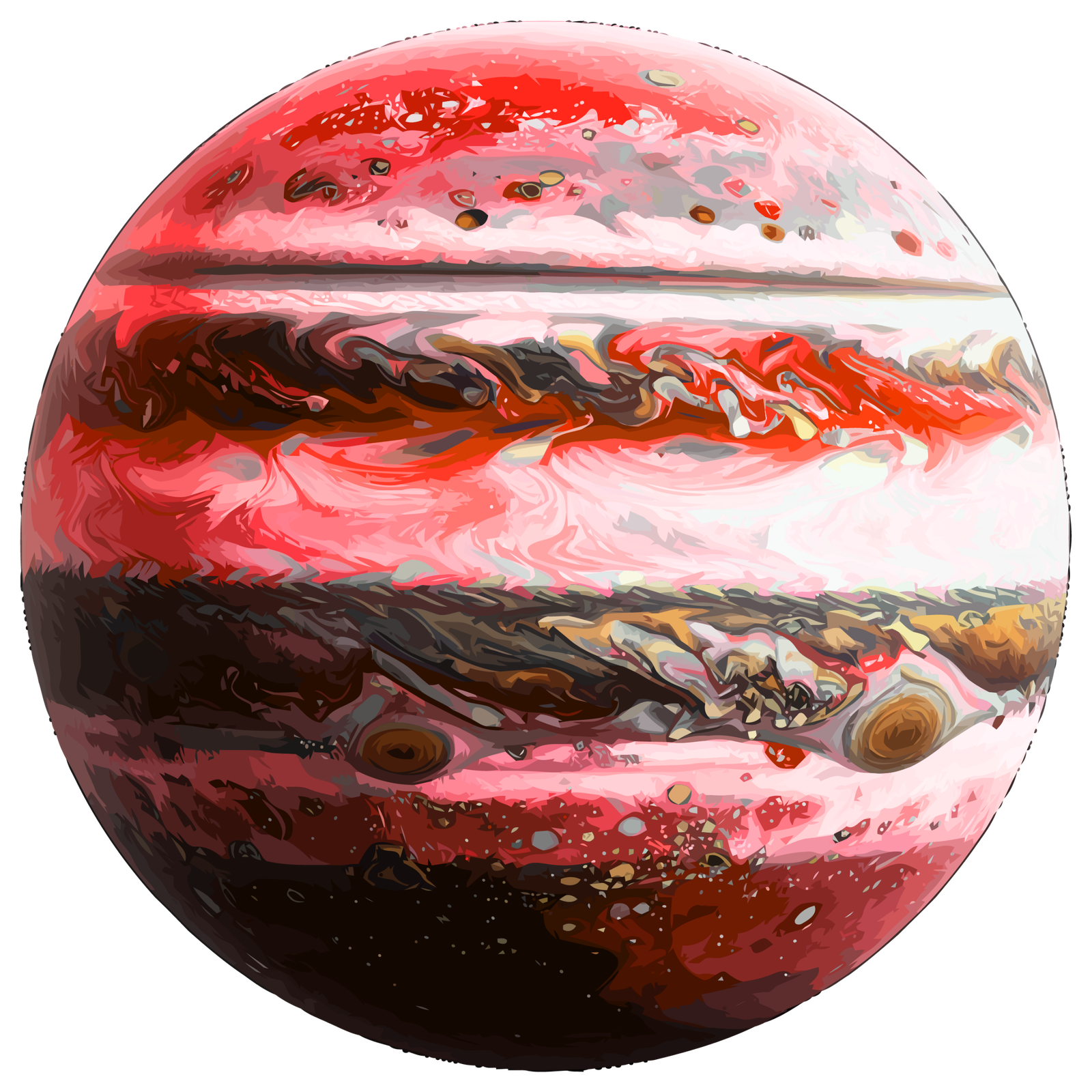
Here’s a detail that makes Jupiter’s scale feel real. That giant swirling oval on its surface, the Great Red Spot, isn’t just a pretty marking. It’s a colossal storm that has been raging for centuries, and it’s so enormous that the entire Earth would fit inside it.
For a long time the Great Red Spot was wide enough to swallow two or three Earths at once, though in recent decades it has been slowly shrinking. Even now, a whole planet’s worth of storm is churning away up there, with winds far fiercer than anything our own weather can muster. When a single storm on a planet is bigger than your entire world, you know you’re dealing with something on a different scale entirely.
It’s Not Just Big, It’s Heavier Than Everything Else Combined
Fitting Earths inside Jupiter is a question of volume, but mass tells an even more staggering story. Jupiter weighs about 318 times as much as Earth. More striking still, Jupiter is more than two and a half times as massive as every other planet in the solar system put together.
Think about that. Take Saturn, Neptune, Uranus, Earth, Venus, Mars, and Mercury, add up all their mass, and Jupiter still outweighs the whole lot with plenty to spare. It’s the undisputed heavyweight of the planets, and its gravity is so dominant that it shapes the paths of asteroids and comets across the solar system. Its enormous family of moons is part of that story too, which we count up in how many moons Jupiter has.
Big Planet, But Still No Star
For all its bulk, Jupiter has a humbling place in the wider scheme. It may dwarf Earth 1,300 times over, but the Sun dwarfs Jupiter in turn. You could fit around 1,000 Jupiters inside the Sun, and well over a million Earths. Jupiter is sometimes called a “failed star,” because if it had gathered up far more mass during its formation, it might have ignited into a small star of its own. It never quite got there, so it remains a planet, just the grandest one we have.
So the next time someone asks how many Earths fit in Jupiter, you can hit them with the full picture. About 1,300 by volume, roughly 11 across its face, and a single storm on its surface large enough to lose our entire planet inside. For more on the giant’s orbit and vital statistics, our guide to Jupiter’s size, distance, and orbit has you covered, and NASA’s Jupiter overview is a great place to keep exploring.
If you enjoyed this article, don’t forget to drop us a comment, it really helps support the site, and be sure to check out our other articles because we think you’re going to love them too.