
Most constellations take a generous imagination to see. Someone tells you a random scattering of stars is a water bearer or a sea goat, and you nod politely while seeing nothing of the sort. Leo is different. Leo actually looks like a lion. With its proud, sphinx-like pose and a bright star marking its heart, it’s one of the few star patterns that genuinely resembles its namesake, which is exactly why it’s such a joy for beginners to find. When Leo climbs into the spring sky, the lion is unmistakable. leo constellation
A Star Pattern That Actually Looks Like Its Name
Leo is one of the twelve constellations of the zodiac, the band of star patterns that the Sun, Moon, and planets appear to travel through. It represents a lion, and the resemblance is surprisingly good once someone points it out. Picture a great cat sitting upright and facing you, chest out, head held high, a bit like the Great Sphinx of Egypt. That’s the shape hiding in the stars.
It has been seen as a lion for thousands of years, across Mesopotamia, Persia, Greece, and beyond. In Greek mythology it represents the fearsome Nemean Lion, a beast with a hide so tough that no weapon could pierce it, slain by the hero Heracles as the first of his twelve labors. Placed among the stars, the lion has prowled the spring sky ever since.
How to Find Leo in the Night Sky
The key to spotting Leo is a little pattern of stars shaped like a backwards question mark. Astronomers call it the Sickle, and it forms the lion’s head and flowing mane. Once you learn to recognize that reverse question mark, you’ll never lose Leo again.
At the bottom of that question mark, standing in for the dot, sits a brilliant blue-white star. That’s Regulus, and it marks the lion’s heart. To the lower left of the Sickle, a neat triangle of stars forms the lion’s hindquarters and tail. Connect the two shapes and the whole crouching lion appears. The best time to hunt for Leo is on spring evenings, roughly from March through May in the Northern Hemisphere, when it rides high in the south. If you need a hand getting oriented under the stars, our guide to what you can see in the night sky without a telescope is a friendly place to begin.
Regulus: The Little King at the Lion’s Heart
Regulus is the undisputed star of the show. Its name means “the little king,” a fitting title for the brightest star in Leo and one of the brightest in the entire night sky. It shines a cool blue-white and sits about 79 light-years away.
There’s more to Regulus than meets the eye. What looks like a single star is really a system of four stars bound together, and the main one is a hot, furiously fast spinner, whirling so quickly that it’s squashed into an egg shape rather than a sphere. Regulus also happens to lie almost exactly on the ecliptic, the path the Sun, Moon, and planets trace across our sky. That means the Moon and the occasional planet can drift right up to Regulus and even pass in front of it, a lovely event to catch if you’re watching at the right moment. If bright, colorful stars fascinate you, our beginner’s stargazing guide to the sky’s colorful stars has plenty more to admire.
The Lion’s Hidden Treasures
Leo rewards anyone willing to look a little closer. Tucked into the curve of the Sickle is Algieba, the lion’s mane, which appears as a single star to the naked eye but splits into a gorgeous pair of golden suns through a small telescope. It’s one of the prettier double stars in the sky, and comparing the warm glow of its two components is a classic backyard-astronomy treat.
Venture deeper with a telescope and you’ll find Leo hides a trio of galaxies known as the Leo Triplet. These three spiral galaxies, sitting around 30 million light-years away, appear close together in the same field of view, each one tilted at a different angle to our line of sight. One of them, NGC 3628, is nicknamed the Hamburger Galaxy for the dark lane of dust slicing across its middle. Spotting three whole galaxies at once is the kind of thing that turns a casual stargazer into a lifelong one.
The Leonids: When the Lion Sends Shooting Stars
Leo has one more trick up its sleeve, and it comes every November. Each year around the 17th and 18th of the month, the sky lights up with the Leonid meteor shower, so named because the meteors appear to stream outward from within the constellation Leo.
These shooting stars are tiny bits of debris left behind by a comet called Tempel-Tuttle, burning up as Earth plows through the trail. In most years the Leonids are a modest but pretty shower, yet every few decades they erupt into a spectacular storm with thousands of meteors an hour, as they famously did in 1833 and again in 1966. To keep track of when the Leonids and other showers peak, our meteor shower tracker will help you plan your nights out.
So next spring, step outside and look for that backwards question mark hanging in the south. Find the bright heart-star Regulus, trace the crouching lion around it, and you’ll have made friends with one of the most rewarding and recognizable constellations in the sky. For more to seek out within the lion, NASA’s guide to the celestial wonders in Leo is a wonderful next step.
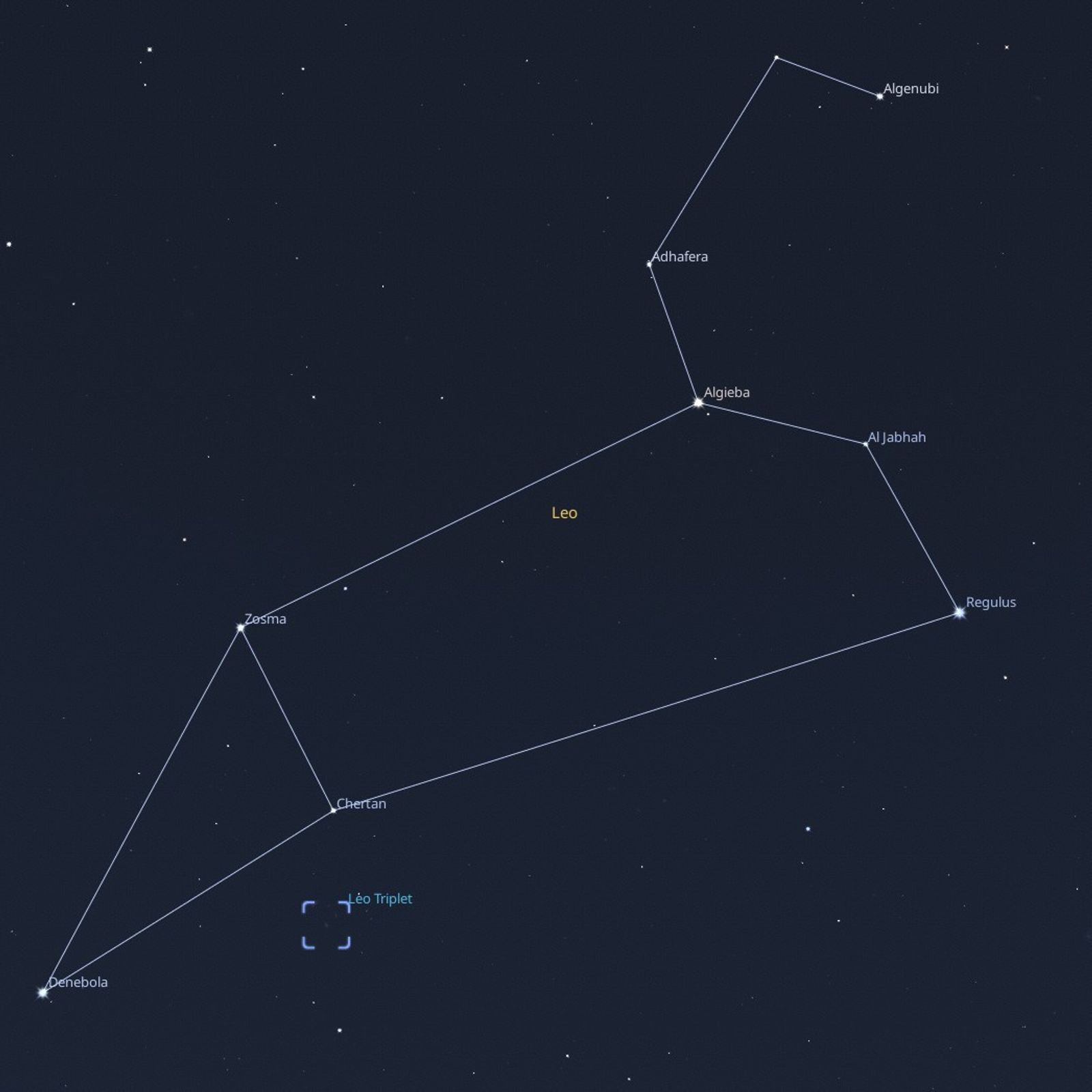 The constellation Leo, best seen on spring evenings. The backwards question mark on the right is the lion’s head and mane, anchored by the bright star Regulus. (Image: Stellarium, via NASA)
If you enjoyed this article, don’t forget to drop us a comment, it really helps support the site, and be sure to check out our other articles because we think you’re going to love them too.