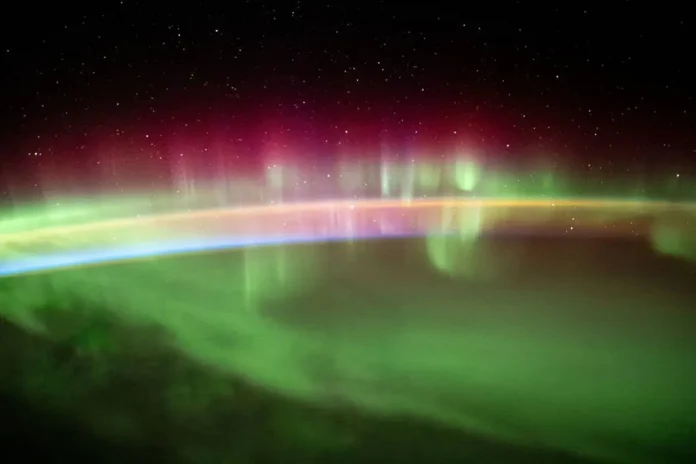

Almost everyone has seen photos of the Northern Lights, those rippling green curtains that draw travelers to Iceland, Norway, and Alaska every winter. Far fewer people know that the Earth puts on the exact same show at the opposite end of the planet. Down at the bottom of the world, curtains of colored light dance across the sky just as beautifully, yet hardly anyone is around to watch them. This is the Aurora Australis, the Southern Lights, and it’s one of the most spectacular and underrated sights our planet has to offer.
The Northern Lights Have a Twin
The Aurora Australis is simply the southern counterpart of the famous Aurora Borealis. The names come from Latin: “aurora” after the Roman goddess of dawn, “borealis” meaning northern, and “australis” meaning southern. So one is the dawn of the north, the other the dawn of the south.
They are, in every meaningful way, the same phenomenon. Both are glowing displays of light that ripple around the polar regions, and both are created by identical forces. In fact the two auroras often switch on at the very same moment, appearing as near mirror images of each other at opposite ends of the globe. If you could hover far out in space, you’d see two glowing crowns of light circling both poles at once.
What Actually Causes the Southern Lights?
The whole spectacle begins 93 million miles away, at the Sun. Our star constantly blows out a stream of electrically charged particles known as the solar wind, and when a gust of that wind reaches Earth, our planet’s magnetic field steps in to protect us. That magnetic field funnels the incoming particles toward the north and south poles, which is why auroras cluster around the polar regions rather than appearing everywhere.
As those particles plunge into the upper atmosphere, they slam into atoms of oxygen and nitrogen. The collisions give those atoms a jolt of energy, and when the atoms settle back down, they release that energy as light. Multiply that by countless collisions happening high above, and you get the shimmering glow we call the aurora. It’s a direct, visible connection between our planet and our star. To learn more about the source of it all, take a look at our guide to what sort of star the Sun really is.
Why the Colors? Green, Red, and Purple Explained
One of the loveliest things about the aurora is its palette, and every color tells you exactly which gas is glowing and how high up.
Green is by far the most common shade, and it comes from oxygen at altitudes around 60 miles up. That vivid green is the signature color most people picture when they think of an aurora. Higher still, oxygen glows a deep, rarer red, which is why intense displays sometimes show crimson tops fading up into the dark. Nitrogen, meanwhile, adds the blues and purples that fringe the lower edges of the curtains during especially strong storms. So the aurora isn’t just pretty. It’s essentially the upper atmosphere revealing its own chemistry in light.
Why Hardly Anyone Sees It
Here’s the great irony of the Southern Lights. They’re every bit as brilliant as their northern twin, yet they’re far harder to catch, and the reason is pure geography.
Up north, plenty of populated land sits at high latitudes, so millions of people live within reach of the Northern Lights. The far south is a different story. At the equivalent southern latitudes there’s almost nothing but open ocean and the frozen, empty expanse of Antarctica. There simply aren’t many places, or people, positioned to look up and see the show. So while the aurora australis blazes away just as often, most of its performances play out over cold, dark, uninhabited seas with no audience at all. The best seats in the house belong to astronauts on the International Space Station and the occasional research team in Antarctica.
Where and When to Catch the Southern Lights
Don’t let all that put you off, because it absolutely can be seen from land if you know where to go. The prime viewing spots are the southernmost inhabited places on Earth: Tasmania, the South Island of New Zealand, and the southern tips of Chile and Argentina in Patagonia. During powerful solar storms, the glow can even reach mainland southern Australia.
Timing matters just as much as location. Aim for the dark, colder months of the Southern Hemisphere, roughly from autumn through winter, and pick a night with little or no moonlight. You’ll want to escape city lights and find a clear, open view toward the south, since that’s the direction the display will appear. Your odds climb dramatically during periods of high solar activity, when the Sun is peppering Earth with more of those charged particles. A little patience and a dark horizon are really all you need. For more tips on making the most of a dark sky, our guide to what you can see in the night sky without a telescope is full of ideas. And to dig deeper into the science, NASA’s Earth Observatory has a wonderful writeup on the aurora australis seen from orbit.
The Southern Lights are a quiet reminder that the sky is putting on shows all the time, even when no one is watching. Somewhere south of you right now, the atmosphere may well be glowing green and red over an empty ocean. And if you ever find yourself far enough south on the right dark night, you’ll understand instantly why people travel to the ends of the Earth to witness it.
If you enjoyed this article, don’t forget to drop us a comment, it really helps support the site, and be sure to check out our other articles because we think you’re going to love them too.