

It was a Saturday in November 2025 when an algorithm flagged something strange in the outskirts of a galaxy 750 million light-years away, a flicker of light exactly 30,000 light-years from where any supermassive black hole should be. “I remember the moment we discovered it very clearly,” said Robert Stein, the researcher whose code caught it. “Everyone was very excited to be messaging. We dropped everything.” What they’d found was a black hole that had been hiding, completely invisible, possibly for billions of years, until the moment it happened to catch a star.
An Address Nobody Expected
Nearly every large galaxy in the universe has exactly one supermassive black hole, anchored dead center, like a keel holding the whole structure steady. That’s simply where astronomers have always known to look. So when a star wandered too close to a black hole roughly a million times the Sun’s mass and got torn apart in what’s called a tidal disruption event, nobody expected it to happen 30,000 light-years out on the galactic rim, farther out than our own solar system sits from the center of the Milky Way. “Almost every tidal disruption event we’ve ever observed has occurred at the center of a galaxy, right where we expect the biggest black holes to be,” said Jonathan Carney, a co-author on the study from the University of North Carolina at Chapel Hill.
For a few months, the flare outshone its entire host galaxy in ultraviolet light, briefly burning with the brightness of 10 billion Suns, before fading back into invisibility.
Caught Only By Accident, at Exactly the Right Moment
Here’s what makes this discovery genuinely remarkable, this black hole gives off no light of its own. It’s not sitting at the center of a galaxy where astronomers routinely search, and without a star wandering close enough to feed it, it simply doesn’t glow at all. It was pure chance, one unlucky star crossing paths with one drifting black hole, at precisely the moment an AI system built by Stein and his colleagues happened to be sifting through half a million nightly flashes from the Zwicky Transient Facility’s sky survey, looking for exactly this kind of anomaly.
“These events are essentially cosmic billboards,” said Igor Andreoli, a co-author at UNC-Chapel Hill. “They allow us to find black holes that would otherwise remain completely invisible.” Without that one star, this particular black hole might have drifted through the rest of the galaxy’s history completely unnoticed, the same way it apparently had for however long it had already been out there.
How Does a Black Hole End Up Homeless?
The leading explanation is almost as dramatic as the discovery itself. Stein’s team believes this black hole didn’t form where it was found, it likely began at the center of a completely different, smaller galaxy, one that later collided and merged with the larger galaxy we see today. Galaxy mergers can fling a lighter black hole clear out to the galactic outskirts through gravitational tug-of-war with other black holes, or a still-merging dwarf galaxy’s stars can simply fall past its neighbor’s core, occasionally passing close enough to feed it. Either way, the black hole ended up drifting, effectively orphaned from the galactic center that built it.
If you’re curious about the settled, well-behaved version of a supermassive black hole sitting exactly where astronomers expect one, our profile of Sagittarius A* covers the Milky Way’s own, considerably less mysterious, resident.
Just the Second of Its Kind, With Many More Expected
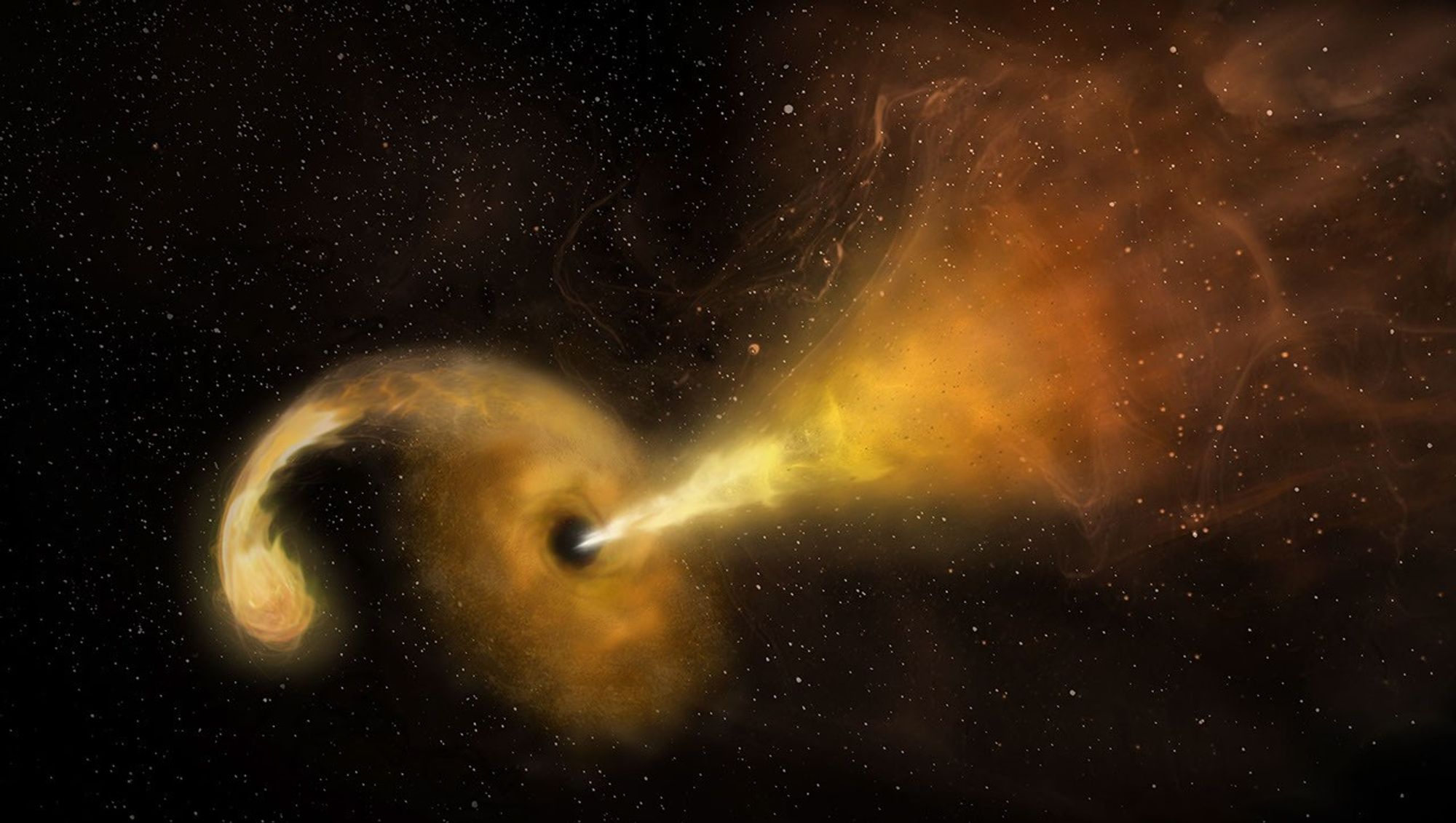 An artist’s concept of a tidal disruption event, the moment a star strays too close to a massive black hole and gets shredded by its gravity. (Image: NRAO/AUI/NSF/NASA)
This is only the second wandering black hole ever confirmed this way, following a similar find in 2024 that was closer in, about 2,600 light-years from its galaxy’s center. Researchers expect that number to grow fast. The newly operational Vera C. Rubin Observatory in Chile is expected to catch far more of these fleeting flares, and NASA’s upcoming Roman Space Telescope will extend the search out through 9 billion years of cosmic history. “The key science question we want to answer is: How common are wandering black holes?” Stein said. For now, this one stands as proof that some of the universe’s biggest objects can hide in plain sight for eons, waiting for exactly the wrong star to wander by.
For more on the discovery, check out the full release from NASA and the published study in The Astrophysical Journal Letters.